สวัสดิรักษาและแฟชั่นในราชสำนักสยาม วันเสาร์: นุ่งม่วงเม็ดมะปราง ห่มโศก
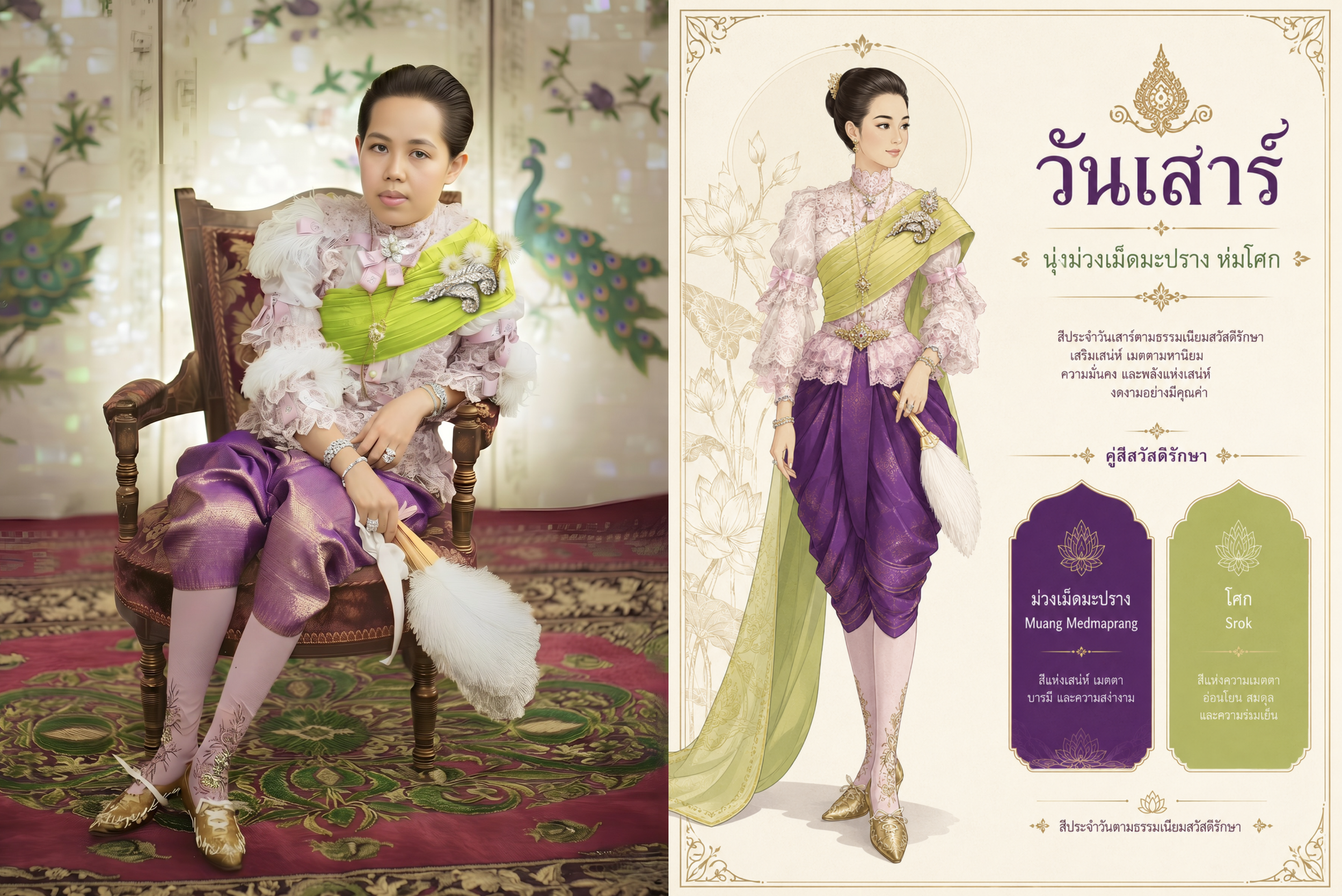
สวัสดิรักษาและแฟชั่นในราชสำนักสยาม วันเสาร์: นุ่งม่วงเม็ดมะปราง ห่มโศก
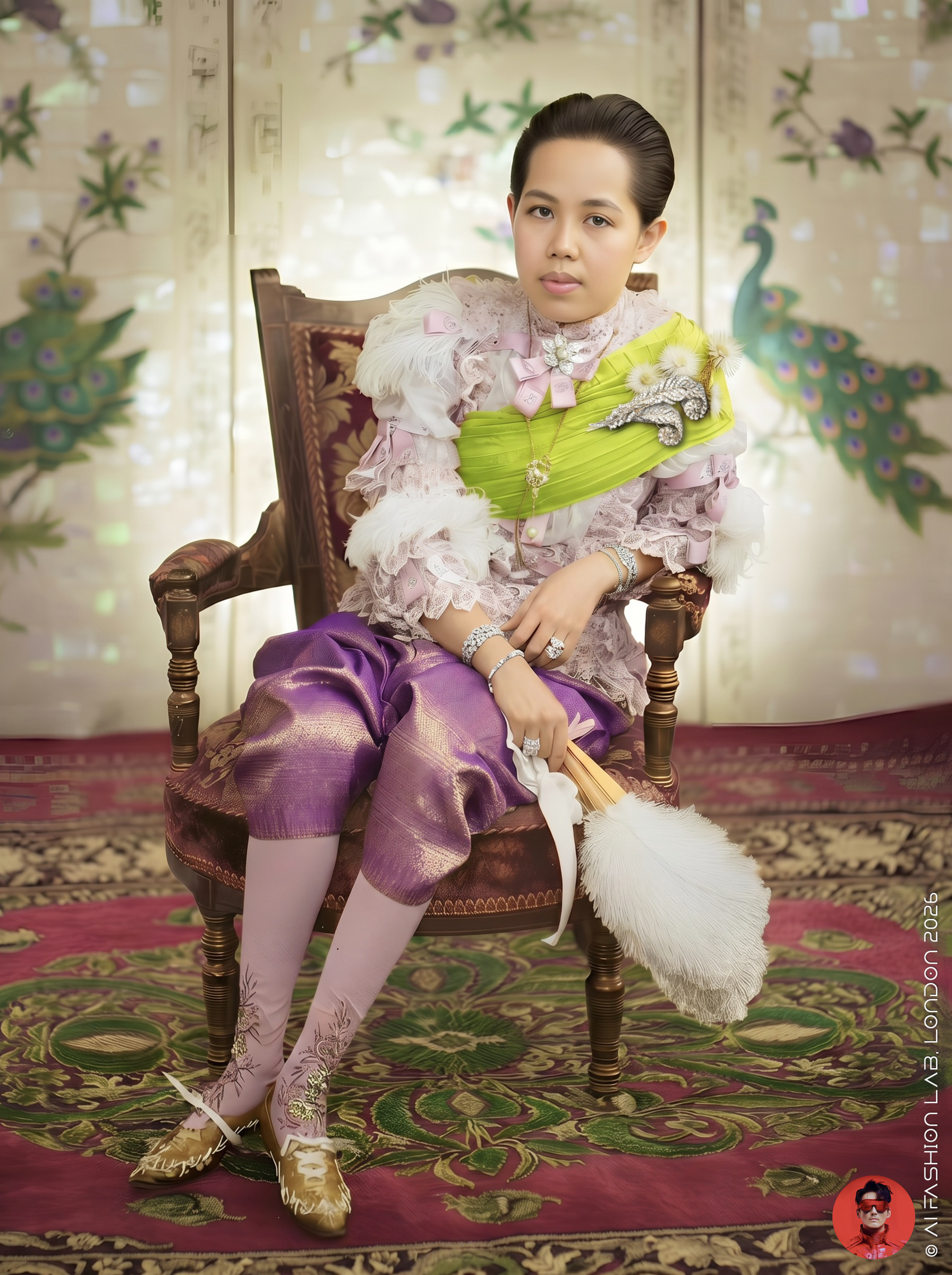
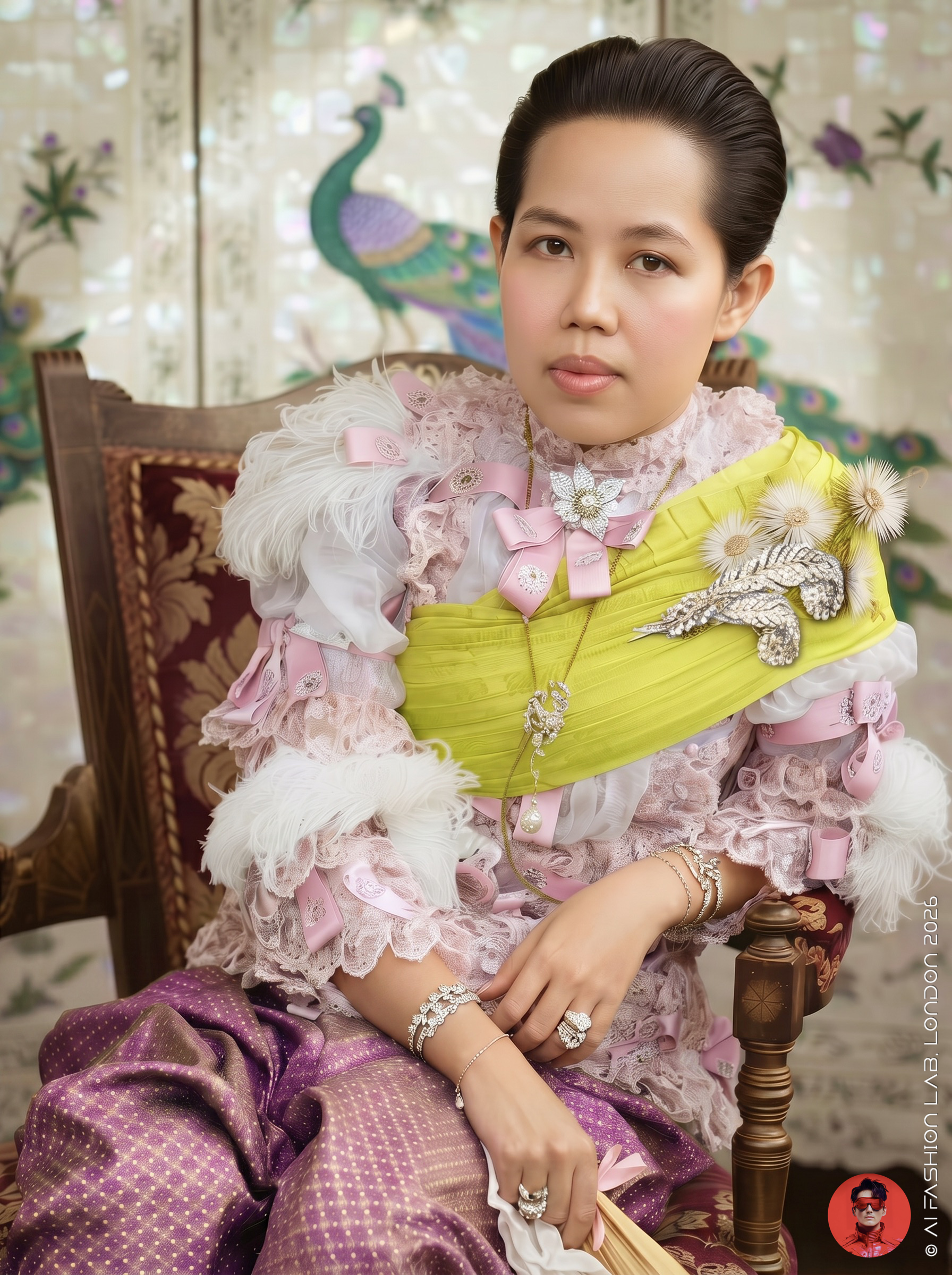
คอลเลกชันภาพที่ได้รับการบูรณะและสร้างสรรค์ด้วยเทคโนโลยี AI นี้ คือพระฉายาลักษณ์ของ สมเด็จพระศรีพัชรินทราบรมราชินีนาถ พระบรมราชชนนีพันปีหลวง ซึ่งสันนิษฐานว่าฉายขึ้นใน รัชกาลที่ ๕ ตอนกลาง ประมาณ พุทธศักราช ๒๔๒๐ (ค.ศ. 1880)
คอลเล็คชั่นภาพในซีรีย์นี้ เป็นการสร้างสรรค์คู่สีประจำวัน หรือสวัสดิรักษา ที่เป็นธรรมเนียมปฏิบัติในสมัยรัชกาลที่ ๕
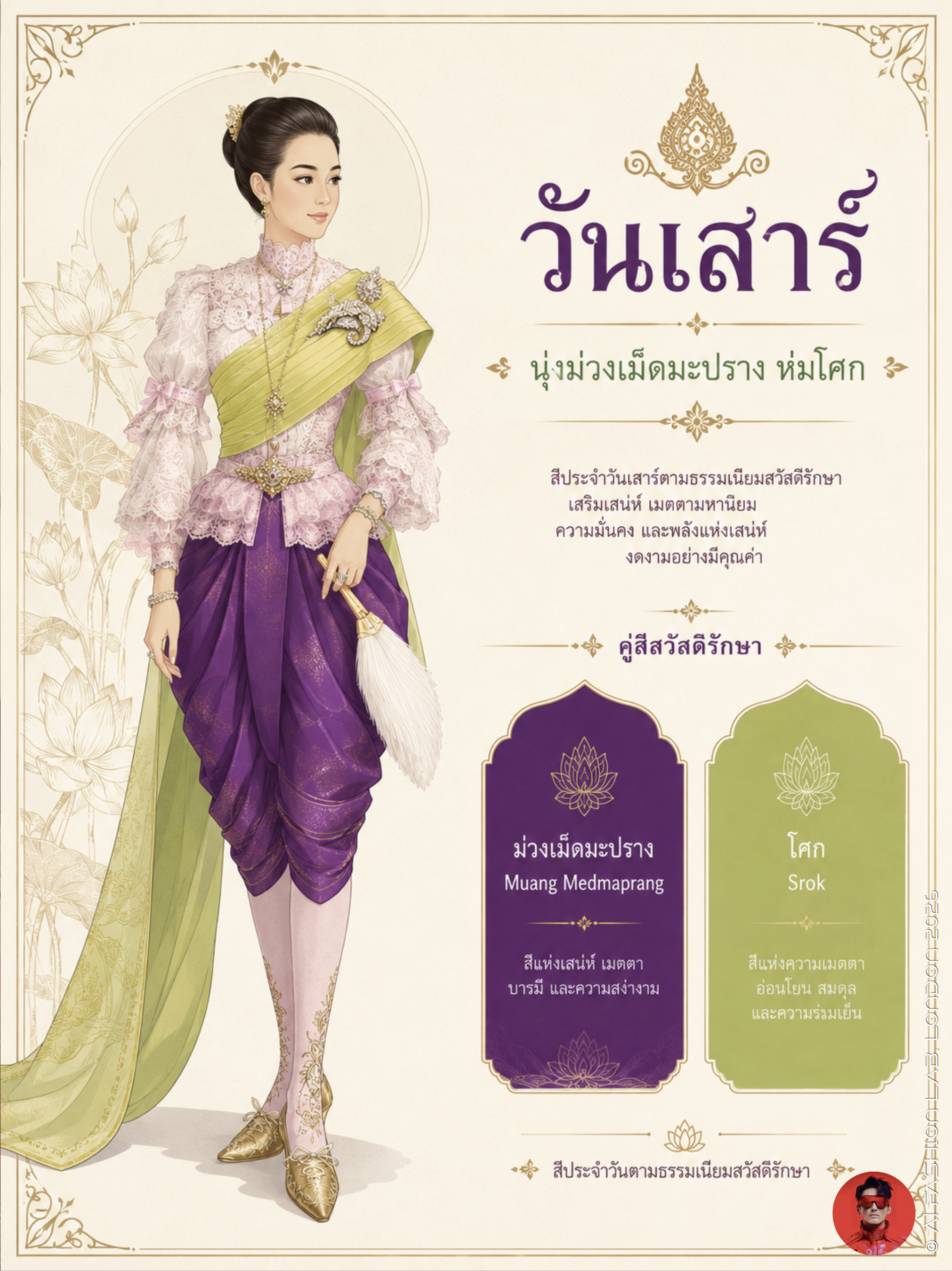
สำหรับวันนี้คือ วันเสาร์: นุ่งม่วงเม็ดมะปราง ห่มโศก
_____
👗ธรรมเนียมสวัสดิรักษา: การนุ่งผ้าสีประจำวัน
การนุ่งห่มสีตามวัน หรือที่เรียกว่า “สวัสดิรักษา” เป็นธรรมเนียมที่ปรากฏในราชสำนักไทยมาตั้งแต่สมัยรัตนโกสินทร์ตอนต้น โดยสตรีฝ่ายในจะนุ่งโจงกระเบนและห่มสไบให้เข้าคู่ตามสีประจำวัน คติความเชื่อนี้สะท้อนให้เห็นถึงความสัมพันธ์ระหว่างการแต่งกายและจักรวาลวิทยาไทยที่ผูกพันกับ “พระเคราะห์” หรือดาวประจำวัน
วันอาทิตย์ – สีแดง สื่อถึงพระอาทิตย์ผู้มีกายสีแดง
วันจันทร์ – สีเหลืองหรือสีขาวนวล สื่อถึงพระจันทร์ผู้มีกายสีเหลืองนวล
วันอังคาร – สีม่วงหรือชมพูแก่ มาจากพระอังคารผู้มีกายสีม่วง
วันพุธ – สีเขียว สื่อถึงพระพุธผู้มีกายสีเขียว
วันพฤหัสบดี – สีแสดหรือเหลืองแกมเขียว จากพระพฤหัสบดีผู้มีกายสีแสด
วันศุกร์ – สีฟ้าหรือคราม จากพระศุกร์ผู้มีกายสีฟ้า
วันเสาร์ – สีดำหรือม่วงแก่ จากพระเสาร์ผู้มีกายสีดำ
การเลือกสีผ้านุ่งและผ้าห่มจึงถูกมองว่าเป็น การเสริมสิริมงคล ให้แก่ผู้สวมใส่ และถือเป็นธรรมเนียมที่สืบต่อมาในราชสำนักเรื่อยจนถึงสมัยรัชกาลที่ ๕
ในเอกสารเก่าและคำบอกเล่ายังมีการบันทึกชื่อสีที่ใช้จริงในราชสำนัก ซึ่งมีความละเมียดละไมเกินกว่าคำเรียกสีทั่วไป เช่น
🟡⚪วันจันทร์: นุ่งสีนวล ห่มมอคราม / นุ่งน้ำเงินนกพิราบอ่อน ห่มจำปาแดง
🟢🟣วันอังคาร: นุ่งสีน้ำหมาก ห่มโศก (สีตองอ่อน) / นุ่งโศก ห่มม่วงพวงอังกาบ
🟢🟡วันพุธ: นุ่งสีเขียวดิน ห่มเหลืองจำปา
🟠🟢วันพฤหัสบดี: นุ่งสีแสด ห่มเขียวตองอ่อน / นุ่งสีเขียวไพร ห่มแดงชาด
🔵🟡วันศุกร์: นุ่งสีคราม ห่มจันทร์
🟣🟢วันเสาร์: นุ่งม่วงเม็ดมะปราง ห่มโศก
🟢🔴วันอาทิตย์: นุ่งเขียว ห่มแดง / นุ่งสีลิ้นจี่ ห่มโศกอ่อน / นุ่งผ้าลายสีลิ้นจี่หรือสีเลือดหมู ห่มโศก
_____
📜🖋️สวัสดิรักษาในวรรณกรรมและบทกวี
ธรรมเนียมนี้ยังถูกบันทึกไว้ในวรรณกรรมคำสอนที่เรียกว่า “สวัสดิรักษาคำฉันท์” ซึ่งเดิมเป็นร้อยกรองที่เข้าใจยาก ต่อมา สุนทรภู่ กวีเอกแห่งรัชกาลที่ ๒ ได้นำมาแต่งใหม่เป็นกลอนสุภาษิต เพื่อถวายสมเด็จเจ้าฟ้าอาภรณ์ พระราชโอรสในรัชกาลที่ ๒ โดยกลอนดังกล่าวได้อธิบายสีมงคลของแต่ละวันไว้อย่างไพเราะ เช่น
“อนึ่งภูษาผ้าทรงณรงค์รบ
ให้มีครบเครื่องเสร็จทั้งเจ็ดสี วันอาทิตย์สิทธิโชคโฉลกดี
เอาเครื่องสีแดงทรงเป็นมงคล
เครื่องวันจันทร์นั้นควรสีนวลขาว
จะยืนยาวชันษาสถาผล อังคารม่วงช่วงงามสีครามปน
เป็นมงคลขัตติยาเข้าราวี
เครื่องวันพุธสุดดีด้วยสีแสด
กับเหลือบแปดปนประดับสลับสี วันพฤหัสจัดเครื่องเขียวเหลืองดี
วันศุกร์สีเมฆหมอกออกสงคราม
วันเสาร์ทรงดำจึงล้ำเลิศ
แสนประเสริฐเสี้ยนศึกจะนึกขาม หนึ่งพาชีขี่ขับประดับงาม
ให้ต้องตามสีสันจึงกันภัย”
_____
👗⏳ รูปทรงแฟชั่นสตรีในทศวรรษ 1880
(The 1880s Fashion Silhouette)
หากมองในบริบทของแฟชั่นตะวันตก ทศวรรษ 1880 เป็นช่วงที่ silhouette ของสตรีถูกกำหนดอย่างชัดเจนด้วยเสื้อท่อนบนเข้ารูป คอเสื้อสูง เอวคอด และโครงสร้างกระโปรงที่เน้นปริมาตรด้านหลัง ซึ่งในยุโรปมักสัมพันธ์กับแฟชั่นแบบ bustle หรือกระโปรงเสริมโครงด้านหลัง
รูปทรงสำคัญของแฟชั่นสตรีตะวันตกในทศวรรษนี้คือ ช่วงลำตัวที่รัดกระชับด้วยคอร์เซ็ต ทำให้เอวดูเล็กและลำตัวตั้งตรง เสื้อท่อนบนมักเข้ารูปแนบกับร่างกาย มีคอสูง และแขนเสื้อโดยทั่วไปยังไม่ขยายใหญ่เท่าช่วงทศวรรษ 1890 ส่วนกระโปรงด้านหน้ามักค่อนข้างเรียบหรือแคบ ขณะที่ด้านหลังมีการจับเดรป การซ้อนผ้า หรือเสริมโครงให้เกิดปริมาตร เป็น silhouette ที่เน้นความสง่างาม ความเป็นระเบียบ และวินัยของร่างกายแบบวิกตอเรียน
อย่างไรก็ตาม เมื่อแฟชั่นตะวันตกเข้ามาสู่ราชสำนักสยาม รูปทรงเหล่านี้มิได้ถูกนำมาใช้แบบเต็มชุดตะวันตกเสมอไป หากถูกปรับให้เข้ากับเครื่องแต่งกายไทย โดยเฉพาะการสวมเสื้อแบบตะวันตกกับโจงกระเบนและสไบ การแต่งกายของสตรีฝ่ายในจึงมิใช่การลอกเลียนแฟชั่นยุโรปโดยตรง แต่เป็นการเลือกใช้องค์ประกอบบางส่วน เช่น เสื้อคอสูง ลูกไม้ แขนเสื้อแบบตะวันตก และโครงสร้างช่วงไหล่หรือช่วงอก มาผสมกับรูปแบบการนุ่งห่มของสยาม
ในภาพสร้างสรรค์ชุดนี้ เราจึงเห็นการตีความ silhouette ของสตรีราชสำนักสยามผ่านการผสมผสานระหว่างเสื้อแบบตะวันตก โจงกระเบนสีม่วงเม็ดมะปราง และสไบสีโศก ซึ่งสัมพันธ์กับธรรมเนียมสวัสดิรักษาในราชสำนัก ขณะที่เสื้อท่อนบนมีรายละเอียดลูกไม้ ระบาย และแขนเสื้อที่ได้รับแรงบันดาลใจจากแฟชั่นยุโรปช่วงปลายคริสต์ศตวรรษที่ 19
_____
👚🌸 จากทศวรรษ 1880 สู่ทศวรรษ 1890: การเปลี่ยนผ่านของแขนเสื้อ
ในช่วงปลายทศวรรษ 1880 ไปสู่ทศวรรษ 1890 แฟชั่นตะวันตกเริ่มเปลี่ยนจากเสื้อท่อนบนที่ค่อนข้างเข้ารูปและแขนเสื้อแคบ ไปสู่การเน้นปริมาตรบริเวณหัวไหล่มากขึ้น การเปลี่ยนแปลงนี้นำไปสู่แฟชั่นแขนพองขนาดใหญ่ที่กลายเป็นเอกลักษณ์ของทศวรรษ 1890
โดยเฉพาะในช่วงกลางทศวรรษ 1890 เสื้อแขนพองแบบแขนหมูแฮม หรือ Leg-of-Mutton Sleeve กลายเป็นรูปทรงสำคัญของยุค แขนเสื้อจะขยายใหญ่บริเวณหัวไหล่และค่อย ๆ แคบลงสู่ข้อมือ เมื่อสวมคู่กับคอร์เซ็ตรัดเอวและกระโปรงทรงเอไลน์ จะทำให้เกิด silhouette ที่เน้นความกว้างของไหล่ ความเล็กของเอว และความสมดุลระหว่างช่วงบนกับช่วงล่างของร่างกาย
ในราชสำนักสยาม แฟชั่นแขนเสื้อแบบนี้ถูกปรับใช้ร่วมกับโจงกระเบนและสไบสีสวัสดิรักษา เกิดเป็นรูปแบบการแต่งกายที่งดงามและเฉพาะตัว สตรีฝ่ายในสามารถรับแฟชั่นตะวันตกเข้ามาโดยไม่จำเป็นต้องละทิ้งโครงสร้างการแต่งกายแบบไทย แขนเสื้อที่พองใหญ่หรือมีระบายจึงเพิ่มความรู้สึกทันสมัย ขณะที่โจงกระเบนและสไบยังคงยืนยันอัตลักษณ์ของราชสำนักสยาม
_____
👚🧵 แขนเสื้อแบบระบายซ้อนชั้น
(Manches à volants superposés / Tiered Flounce Sleeves)
เมื่อเข้าสู่ช่วงปลายทศวรรษ 1890 โดยเฉพาะราว ค.ศ. 1897 หรือ พ.ศ. 2440 แฟชั่นสตรีในปารีสเริ่มเปลี่ยนจากแขนหมูแฮมขนาดใหญ่ไปสู่รูปแบบที่อ่อนหวานและละเมียดละไมมากขึ้น หนึ่งในรูปแบบที่พบได้ในนิตยสารแฟชั่นฝรั่งเศส คือแขนเสื้อแบบระบายซ้อนชั้น หรือ Manches à volants superposés / Tiered Flounce Sleeves
แขนเสื้อชนิดนี้ใช้ลูกไม้ ผ้าโปร่ง หรือผ้าบางซ้อนกันหลายชั้น ไล่จากหัวไหล่ลงมาสู่ช่วงแขน เกิดเป็นความเบา ความพลิ้ว และความโรแมนติกมากกว่าความแข็งแรงของแขนหมูแฮมในช่วงก่อนหน้า รูปทรงเช่นนี้ถือเป็นสะพานสำคัญจากแฟชั่นปลายวิกตอเรียนไปสู่ความอ่อนหวานของแฟชั่นสมัยเอ็ดเวิร์ดเดียนในต้นคริสต์ศตวรรษที่ 20
หากนำมาอ่านร่วมกับแฟชั่นราชสำนักสยาม จะเห็นว่าแขนเสื้อระบายซ้อนชั้นสามารถเข้ากับการแต่งกายแบบไทยได้อย่างน่าสนใจ เพราะให้ความหรูหราและความทันสมัยแก่เสื้อท่อนบน ขณะเดียวกันก็ยังปล่อยให้โจงกระเบนและสไบทำหน้าที่เป็นโครงสร้างหลักของเครื่องแต่งกาย
_____
🟣🍃 สวัสดิรักษา แฟชั่นยุโรป และการแต่งกายฝ่ายในสมัยรัชกาลที่ ๕
การแต่งกายของสตรีฝ่ายในในสมัยรัชกาลที่ ๕ จึงสะท้อนสองมิติสำคัญพร้อมกัน
หนึ่ง คือคติความเชื่อเรื่องสวัสดิรักษา ผ่านการเลือกสีผ้านุ่งและผ้าห่มให้สัมพันธ์กับวัน เช่น วันเสาร์ซึ่งกำหนดให้นุ่งม่วงเม็ดมะปรางและห่มโศก
สอง คือการรับกระแสแฟชั่นตะวันตก ผ่านเสื้อคอสูง ลูกไม้ แขนเสื้อแบบยุโรป แขนพอง แขนระบาย และโครงสร้างช่วงลำตัวแบบวิกตอเรียนที่ถูกปรับให้เหมาะสมกับบริบทไทย
การนุ่งห่มสีตามวันและการรับแฟชั่นตะวันตกจึงไม่ใช่สิ่งที่ขัดแย้งกัน หากเป็นภาพแทนของความสามารถของราชสำนักสยามในการผสมผสานธรรมเนียมดั้งเดิมกับความเป็นสมัยใหม่ สตรีฝ่ายในมิได้เพียงรักษาธรรมเนียมการแต่งกายเพื่อเสริมสิริมงคล แต่ยังเลือก ปรับ และแปลความแฟชั่นยุโรปให้กลายเป็นภาษาการแต่งกายแบบสยามที่งดงามและมีเอกลักษณ์
___________________
Sawasdiraksa and Fashion in the Siamese Court Saturday : Wearing Purple Medmaprang and Draping Light Green Srok
This AI-restored and AI-created image collection presents a royal photograph of Queen Sri Bajarindra, the Queen Mother (สมเด็จพระศรีพัชรินทราบรมราชินีนาถ พระบรมราชชนนีพันปีหลวง), believed to have been taken during the middle period of the reign of King Chulalongkorn, Rama V (พระบาทสมเด็จพระจุลจอมเกล้าเจ้าอยู่หัว รัชกาลที่ ๕), around BE 2420 / c. 1880.
This image series reimagines the traditional daily colour pairings known as Sawasdiraksa (สวัสดิรักษา), a courtly convention practised during the reign of Rama V.
For today, the colour pairing is for
Saturday:wearing muang medmaprang (ม่วงเม็ดมะปราง) and draping srok (โศก).
_____
👗 The Sawasdiraksa Tradition: Wearing Colours According to the Day
The practice of wearing colours according to the day, known as Sawasdiraksa (สวัสดิรักษา), appears in the Thai royal court from the early Rattanakosin period onwards. Women of the Inner Court would wear the chongkraben (โจงกระเบน)and drape the sabai (สไบ) in colour combinations corresponding to each day of the week. This belief reflects the relationship between dress and Thai cosmology, especially its association with the phra khro (พระเคราะห์), or planetary deities governing each day.
Sunday – red, associated with the Sun deity, whose body is red. Monday – yellow or soft white, associated with the Moon deity, whose body is pale yellow. Tuesday – purple or deep pink, associated with Mars, whose body is purple. Wednesday – green, associated with Mercury, whose body is green. Thursday – orange or yellowish green, associated with Jupiter, whose body is orange. Friday – blue or indigo, associated with Venus, whose body is blue. Saturday – black or deep purple, associated with Saturn, whose body is black.
The choice of colour for the lower cloth and shoulder cloth was therefore understood as a way of enhancing auspiciousness for the wearer. It remained a continuing tradition in the royal court into the reign of Rama V.
Old documents and oral accounts also record the actual colour names used in the court. These colour terms are far more refined and subtle than ordinary colour descriptions, for example:
🟡⚪ Monday: wearing nuan (สีนวล) and draping mo khram (มอคราม) / wearing pale pigeon-blue and draping champa daeng (จำปาแดง).
🟢🟣 Tuesday: wearing nam mak (สีน้ำหมาก) and draping srok (โศก, pale banana-leaf green) / wearing srok and draping muang phuang angkap (ม่วงพวงอังกาบ).
🟢🟡 Wednesday: wearing earthy green and draping champa yellow.
🟠🟢 Thursday: wearing orange and draping pale banana-leaf green / wearing forest green and draping vermilion red.
🔵🟡 Friday: wearing indigo and draping chan (จันทร์).
🟣🟢 Saturday: wearing muang medmaprang (ม่วงเม็ดมะปราง) and draping srok (โศก).
🟢🔴 Sunday: wearing green and draping red / wearing lychee red and draping pale srok / wearing a patterned cloth in lychee red or oxblood and draping srok.
_____
📜🖋️ Sawasdiraksa in Literature and Poetry
This tradition was also recorded in didactic literature known as Sawasdiraksa Kham Chan (สวัสดิรักษาคำฉันท์). Originally, this was a difficult poetic composition. Later, Sunthorn Phu (สุนทรภู่), the celebrated poet of the reign of Rama II, rewrote it as a didactic poem for Prince Aphorn (สมเด็จเจ้าฟ้าอาภรณ์), a son of King Rama II. The poem describes the auspicious colours of each day in elegant verse:
“One should prepare garments for royal or martial dress, complete in all seven colours. On Sunday, red brings fortune and auspiciousness; red garments should be worn as a blessing. For Monday, soft white is proper, bringing long life and lasting prosperity. On Tuesday, purple with a shade of blue is auspicious for princes going into battle. Wednesday’s dress is best in orange, with iridescent colours interwoven and arranged. On Thursday, green and yellow should be prepared; on Friday, misty cloud-grey is suited to war. On Saturday, black should be worn, supreme and excellent, so that enemies will fear and hesitate. Even the horse ridden into battle should be beautifully adorned, its colours correctly matched, so that danger may be averted.”
_____
👗⏳ The Female Fashion Silhouette of the 1880s
(The 1880s Fashion Silhouette)
In the context of Western fashion, the 1880s were a decade in which the female silhouette was clearly defined by a fitted bodice, a high collar, a narrow waist, and a skirt structure that emphasised volume at the back. In Europe, this was closely associated with the bustle, or a skirt form supported by a structure at the rear.
The key features of Western women’s fashion in this decade included a tightly corseted torso, which made the waist appear small and the body upright. The bodice was usually closely fitted to the body, with a high neckline, while the sleeves had not yet expanded to the exaggerated size seen in the 1890s. The front of the skirt was often relatively smooth or narrow, while the back was arranged with drapery, layered fabric, or structural support to create volume. It was a silhouette that emphasised elegance, order, and the bodily discipline of Victorian femininity.
However, when Western fashion entered the Siamese court, these silhouettes were not always adopted as complete Western outfits. Instead, they were adapted to suit Thai dress conventions, especially through the combination of Western-style blouses with chongkraben and sabai. The dress of women in the Inner Court was therefore not a direct imitation of European fashion, but a selective incorporation of certain elements, such as high-necked blouses, lace, Western-style sleeves, and the structure of the shoulders or bodice, into Siamese modes of dress.
In this creative image series, we see an interpretation of the Siamese court silhouette through the combination of a Western-style blouse, a muang medmaprang chongkraben, and a srok sabai, associated with the Sawasdiraksa tradition of the royal court. At the same time, the upper garment features lace, ruffles, and sleeves inspired by European fashion of the late nineteenth century.
_____
👚🌸 From the 1880s to the 1890s: The Transition of Sleeves
From the late 1880s into the 1890s, Western fashion began to shift from relatively fitted bodices and narrow sleeves towards a greater emphasis on volume at the shoulder. This change led to the large puffed sleeves that became one of the defining features of the 1890s.
By the middle of the 1890s, the large puffed sleeve known as the Leg-of-Mutton Sleeve had become one of the key forms of the period. The sleeve expanded dramatically at the shoulder and gradually narrowed towards the wrist. When worn with a tightly corseted waist and an A-line skirt, it created a silhouette that emphasised broad shoulders, a small waist, and a visual balance between the upper and lower body.
In the Siamese court, this sleeve fashion was adapted for use with the chongkraben and the sabai in Sawasdiraksa colours. The result was a distinctive and elegant form of dress. Women of the Inner Court were able to incorporate Western fashion without abandoning the structure of Thai dress. Large puffed sleeves or ruffled sleeves added a sense of modernity, while the chongkraben and sabai continued to affirm the identity of the Siamese court.
_____
👚🧵 Tiered Flounce Sleeves
(Manches à volants superposés / Tiered Flounce Sleeves)
By the late 1890s, especially around 1897 / BE 2440, women’s fashion in Paris began to move away from large Leg-of-Mutton Sleeves towards a softer and more delicate form. One style found in French fashion magazines was the tiered flounce sleeve, or Manches à volants superposés.
This type of sleeve used lace, net, or fine fabric layered in several tiers from the shoulder down along the arm. It created a sense of lightness, movement, and romance, in contrast to the stronger, more architectural shape of the earlier Leg-of-Mutton Sleeve. This form can be understood as an important bridge between late Victorian fashion and the softer femininity of Edwardian fashion in the early twentieth century.
When read alongside Siamese court fashion, tiered flounce sleeves are particularly interesting because they could be harmoniously incorporated into Thai dress. They added luxury and modernity to the upper garment, while still allowing the chongkraben and sabai to remain the principal structural elements of the outfit.
_____
🟣🍃 Sawasdiraksa, European Fashion, and Inner Court Dress during the Reign of Rama V
The dress of women in the Inner Court during the reign of Rama V therefore reflected two important dimensions at the same time.
First, it reflected the belief system of Sawasdiraksa, through the selection of the lower cloth and shoulder cloth according to the colour of each day. Saturday, for example, prescribed the pairing of muang medmaprang and srok.
Second, it reflected the reception of Western fashion, through high-necked blouses, lace, European-style sleeves, puffed sleeves, ruffled sleeves, and Victorian bodice structures adapted to suit the Thai context.
Wearing colours according to the day and adopting Western fashion were therefore not contradictory practices. Rather, they reveal the ability of the Siamese court to combine inherited tradition with modernity. Women of the Inner Court did not merely preserve auspicious dress customs; they also selected, adapted, and translated European fashion into a Siamese language of dress that was elegant, distinctive, and culturally meaningful.
Small date note, พ.ศ. ๒๔๒๐ is 1877, while 1880 is พ.ศ. ๒๔๒๓. For the English version, I kept your intended broad dating as “BE 2420 / c. 1880,” but for publication I would suggest either “around BE 2420 / c. 1877” or “around BE 2423 / c. 1880.”
___________________
เรียนเชิญกด Subscribe ได้ที่ลิงก์นี้ครับ เพื่อร่วมติดตามงานสร้างสรรค์ต้นฉบับ งานวิจัยประวัติศาสตร์แฟชั่น และผลงานอนุรักษ์มรดกวัฒนธรรมด้วยเทคโนโลยี AI ของ AI Fashion Lab, London ซึ่งมุ่งตีความอดีตผ่านมิติใหม่ของการบูรณะภาพ การสร้างสรรค์ภาพ และการเล่าเรื่องด้วยศิลปะเชิงดิจิทัล https://www.facebook.com/aifashionlab/subscribe/
#aifashionlab #AI #aiartist #aiart #aifashion #aifashiondesign #aifashionstyling #aifashiondesigner #fashion #fashionhistory #historyoffashion #fashionstyling #fashionphotography #digitalfashion #digitalfashiondesign #digitalcostumedesign #digitaldesign #digitalaiart #ThaiFashionHistory #ThaiFashionAI #thailand #UNESCO