History of Fashion
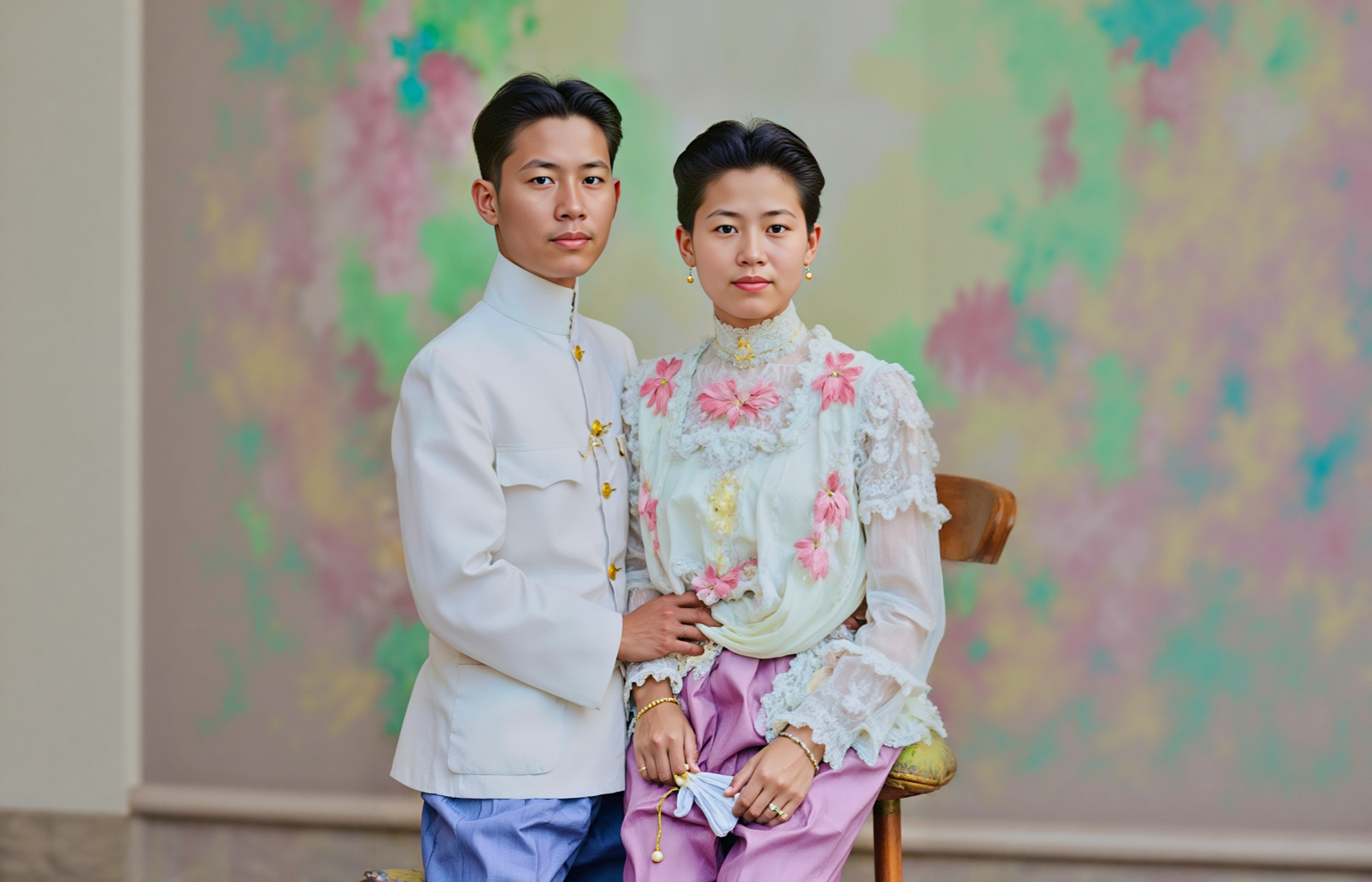
Fashion and Social Transition: Western Influence on Monogamy in Siam Through AI-Generated Studio Portraiture in Pastel Tones
Pastel Tones as an Artistic Interpretation
This AI-generated collection has been designed in pastel tones as a deliberate artistic interpretation. Utilising pastel tones in this collection evokes feelings of romance and modernity, aligning well with the themes of evolving social norms and intimate companionship depicted in this work.
Pastel hues are often associated with sentimentality, renewal, and tenderness, making them a fitting choice to reinterpret early 20th-century Siamese studio portraiture. While traditional Siamese photography typically featured monochrome or sepia tones, this collection reimagines these historical moments with soft, delicate colours that enhance the emotional depth of the subjects.
Pastels are also frequently linked to expressions of love and devotion, making them particularly suited to portrayals of couples. February, widely recognised for Valentine’s Day, embraces soft, romantic colours, reinforcing the sentiment of companionship and modern relationships. By applying pastel hues to this collection, the images subtly highlight the transition from traditional family structures to Western-influenced monogamous ideals, adding a layer of warmth and contemporary artistic vision.
Early 20th-Century Siamese Fashion: Adaptation and Western Influence
During the late 19th and early 20th centuries, Siam experienced significant social and cultural transformations, particularly through interactions with Western powers. European diplomatic customs, Victorian fashion, and British-educated elites influenced the visual representation of status and modernity, leading to shifts in how the Siamese elite dressed and presented themselves.
Men’s Fashion: Attire as a Symbol of Modernity
Men’s fashion during this period was directly influenced by European military and bureaucratic uniforms. The Raj pattern jacket, typically white with a Mandarin collar and gold buttons, became a symbol of modern governance and refinement. It was commonly worn with chong kraben or silk trousers, while aristocrats and high-ranking officials often accessorised with pocket watches or ceremonial sashes to emphasise their alignment with progressive ideals.
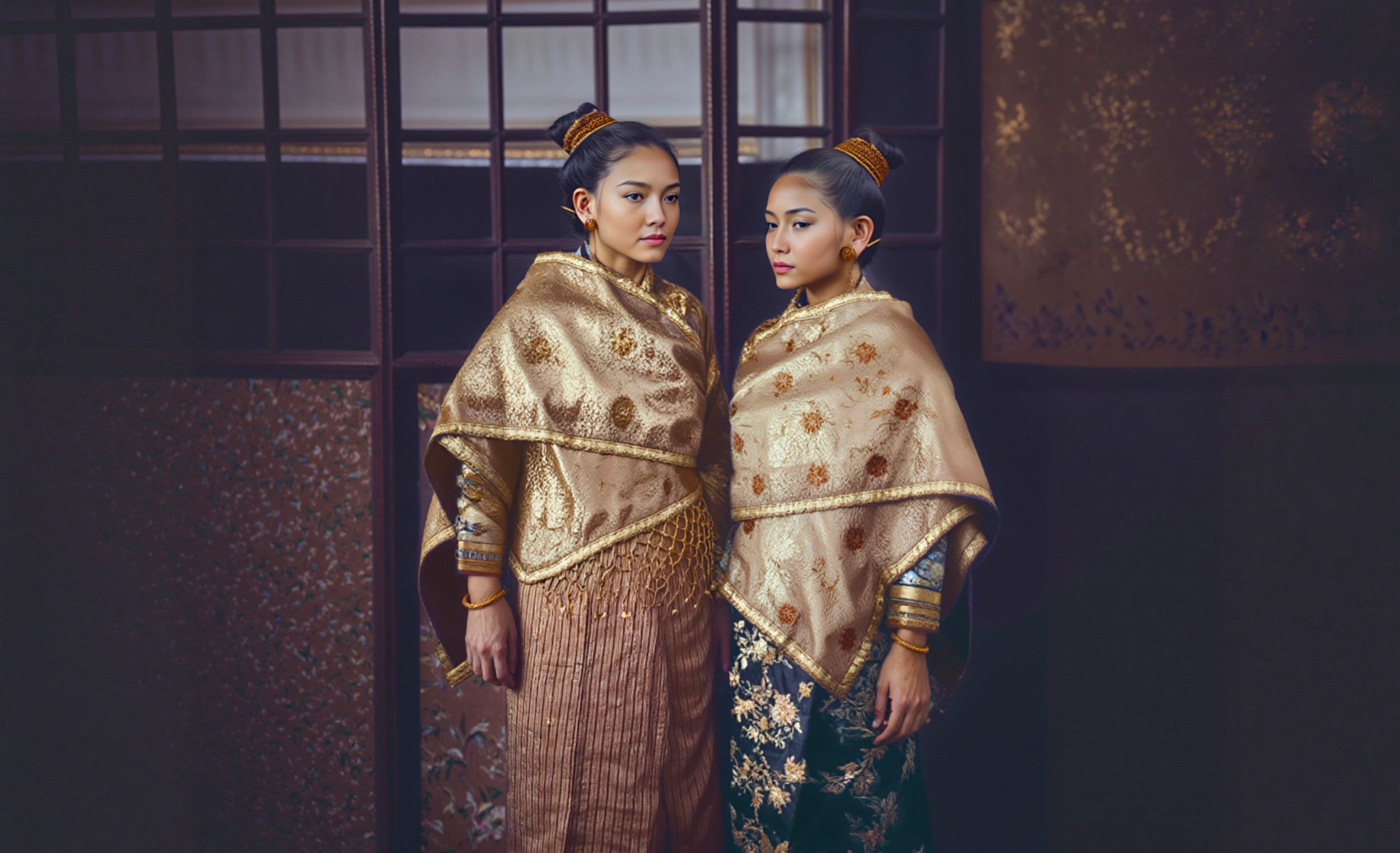
Refinement and Elegance: The Fashion of Luang Prabang’s Noblewomen, Circa 1920s
The noblewomen of Luang Prabang’s Royal Court embodied sophistication through their ceremonial attire, blending traditional Lao textiles with influences from China and India. Their fashion, marked by meticulous craftsmanship and cultural symbolism, reflected rank, occasion, and the rich heritage of the Lan Xang Hom Khao kingdom.
The Signature Attire: "Salabap" and the Elegance of Overlapping Panels
The defining feature of noblewomen’s attire was the "Salabap", a fitted long-sleeved blouse with overlapping front panels, often crafted from fine silk and adorned with intricate embroidery in gold or silver thread. The embroidery patterns included floral and geometric motifs, inspired by Chinese and Indian textile traditions, signifying status and artistic refinement.
This was paired with the Sinh (Phra Phusa), a traditional silk wrap skirt, meticulously woven with metallic threads to create shimmering effects. Colours such as deep blue, royal purple, emerald green, and maroon were favoured, symbolising wisdom, prosperity, and spiritual significance. The combination of Salabap and Sinh defined the court’s distinctive aesthetic, differentiating it from other Lao regions.
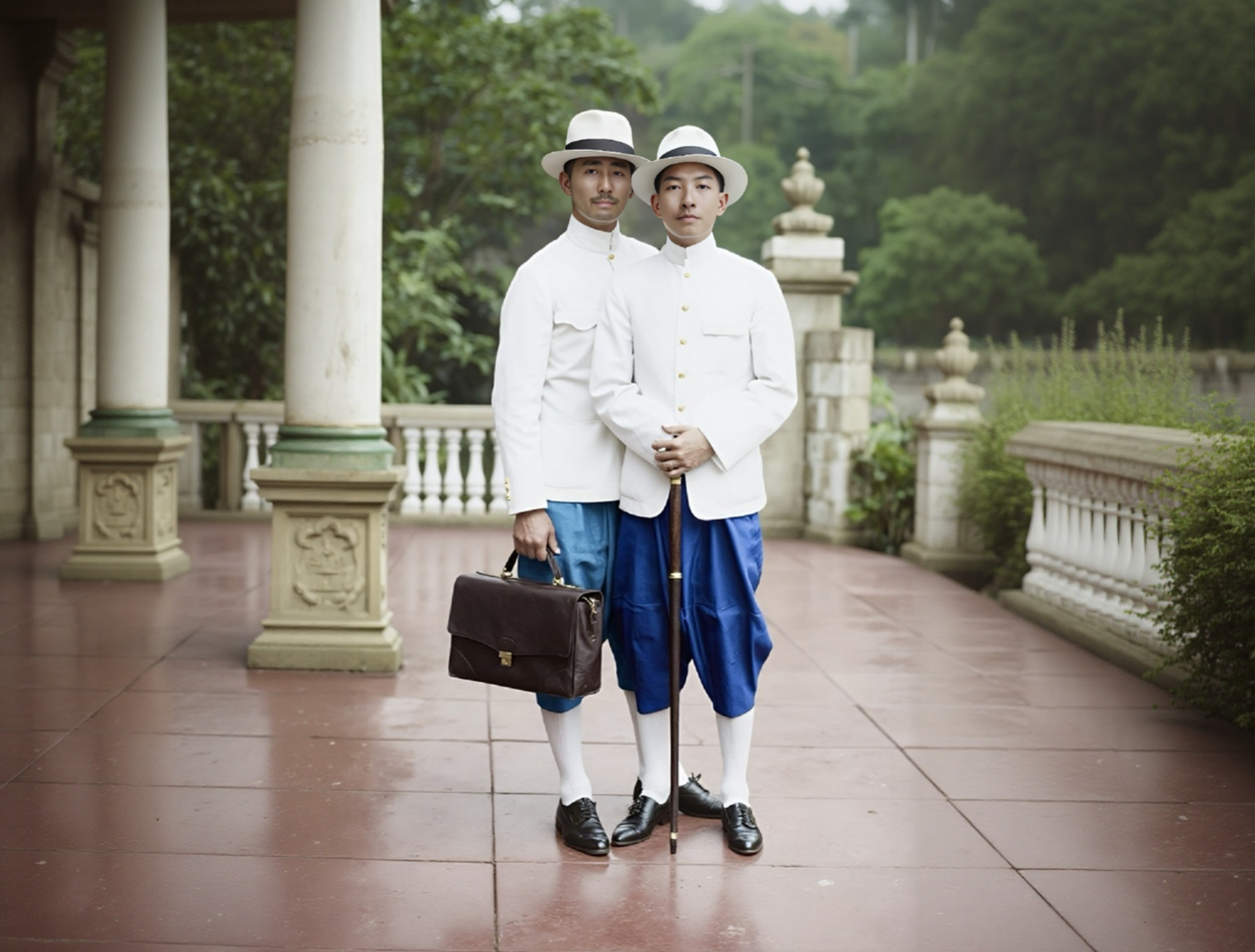
Men’s Fashion in Bangkok (1890–1910): The Era of Westernisation and Victorian Masculinity
Siam’s transition to Western clothing was not merely aesthetic but deeply tied to geopolitical survival. As European colonial powers expanded in Southeast Asia, adopting Western attire signified Siam’s sovereignty and modernity. The ruling elite deliberately aligned with European dress codes to counter colonial narratives that depicted non-Western nations as ‘uncivilised.’ The widespread adoption of structured uniforms, hats, and footwear reinforced Siam’s image as a progressive, sovereign kingdom that could stand on equal footing with European powers. This period marked a significant turning point in Siamese fashion, where traditional elements blended with European aesthetics to reflect a rapidly modernising society. The Rāja tunic, Jong Kraben, European hats, moustaches, walking sticks, and stockings were not just fashion choices but powerful symbols of a new era in Siamese governance and masculinity.
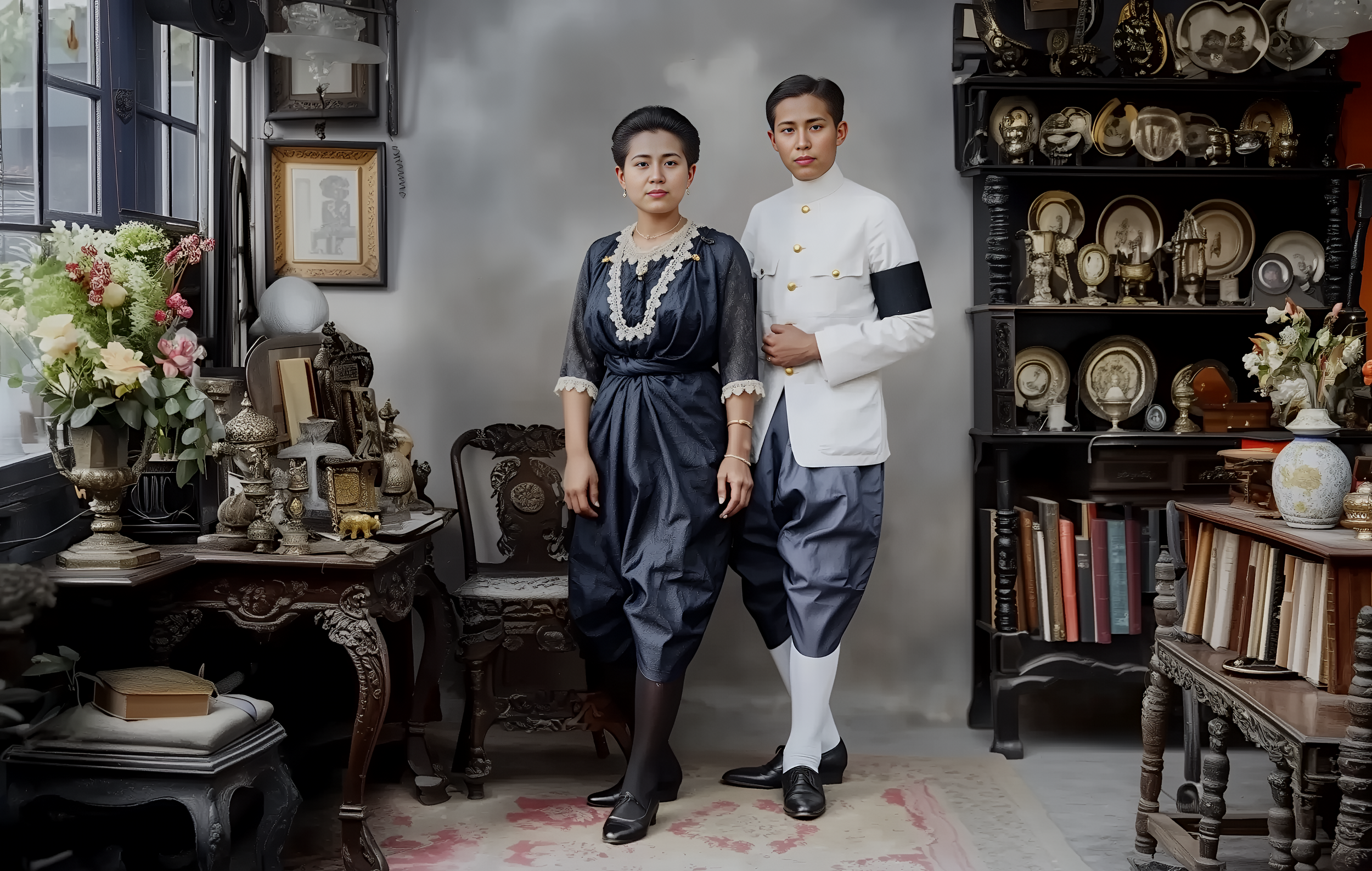
Thai Women's Mourning Fashion During the Reign of King Rama V
Was Black the Traditional Mourning Colour?
In traditional Thai customs, the primary mourning colour was white, particularly for funeral ceremonies, especially those of the monarchy and nobility. In the past, mourning practices also included shaving one’s head as a sign of deep grief and respect for the deceased monarch.
However, in the late 19th and early 20th centuries, black began to emerge as a mourning colour in the Thai royal court, influenced by Western mourning traditions. This period coincided with Thailand’s modernisation under King Chulalongkorn (Rama V).
The use of black mourning attire in royal funerals was first introduced during the reign of King Mongkut (Rama IV)and later became standard in the Thai royal court after King Chulalongkorn passed away in 1910 (B.E. 2453).
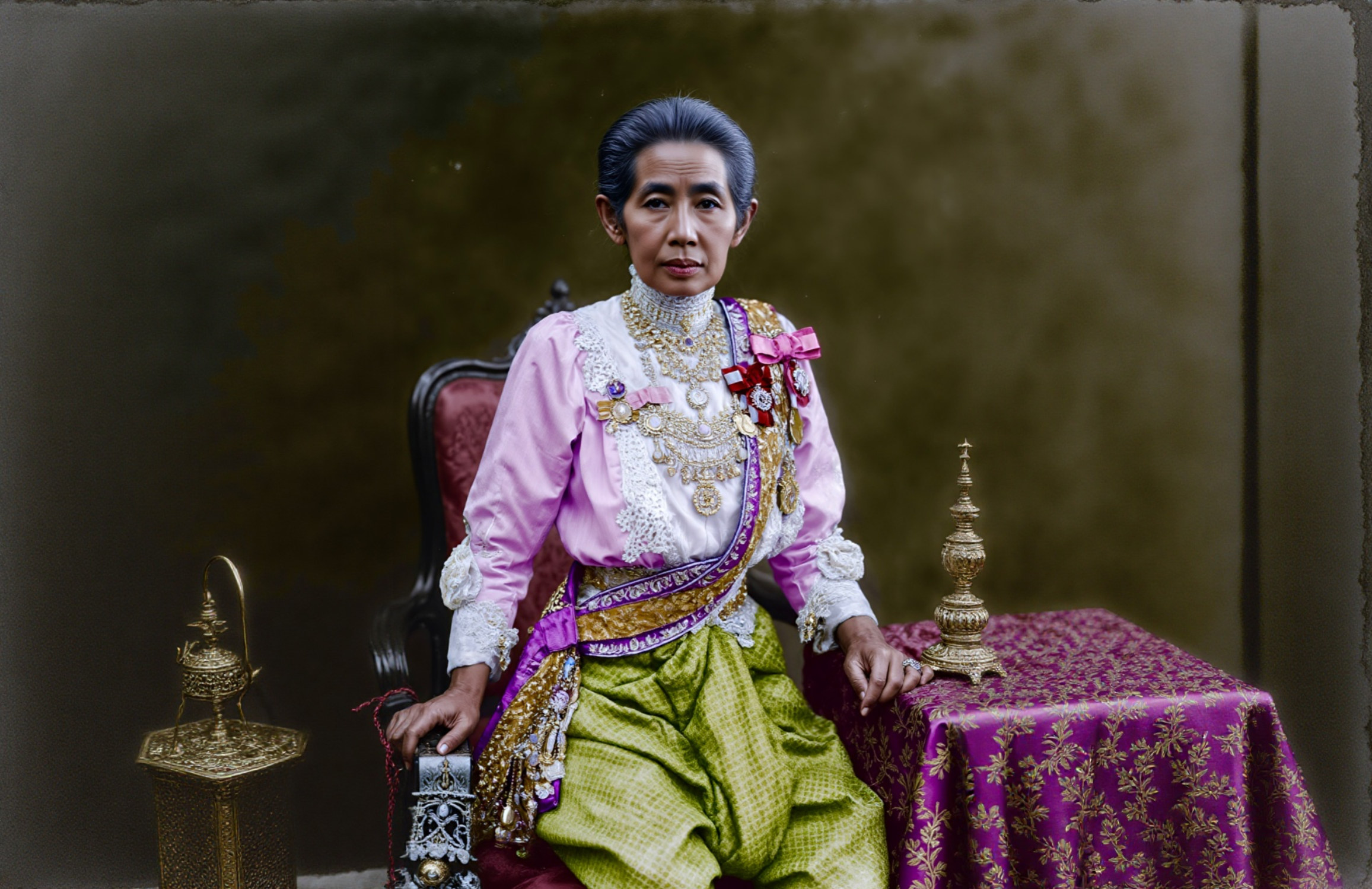
Fashion of Senior Ladies of the Inner Court during the Reign of King Chulalongkorn: Developing AI for Realistic Image Generation
Fashion of Senior Ladies of the Inner Court during the Reign of King Chulalongkorn: Developing AI for Realistic Image Generation
I have created AI-generated fashion images across various eras, but I rarely focus on older women’s fashion. This time, I explored the fashion of senior ladies of the inner court during the reign of King Rama V. Most of them were likely royal daughters of King Rama IV or early consorts during the early reign of King Rama V. Their clothing was influenced by Edwardian and late Victorian fashion, evident in the high-necked blouses adorned with lace and gold embroidery, which were popular in European royal courts. Meanwhile, the traditional Thai wrap skirt (pha nung) retained its authenticity, featuring luxurious brocade or silk fabrics in deep navy, silver, and gold—colours often associated with high-ranking court ladies.
AI Development Process and Achieving Realism
To accurately depict senior ladies of the inner court, the AI models had to be trained meticulously to understand clothing structures, body proportions, traditional hairstyles, and facial expressions that reflect their noble status. Special attention was given to the traditional updo hairstyles, the placement of royal decorations, and the draping of sashes and medals to ensure authenticity.
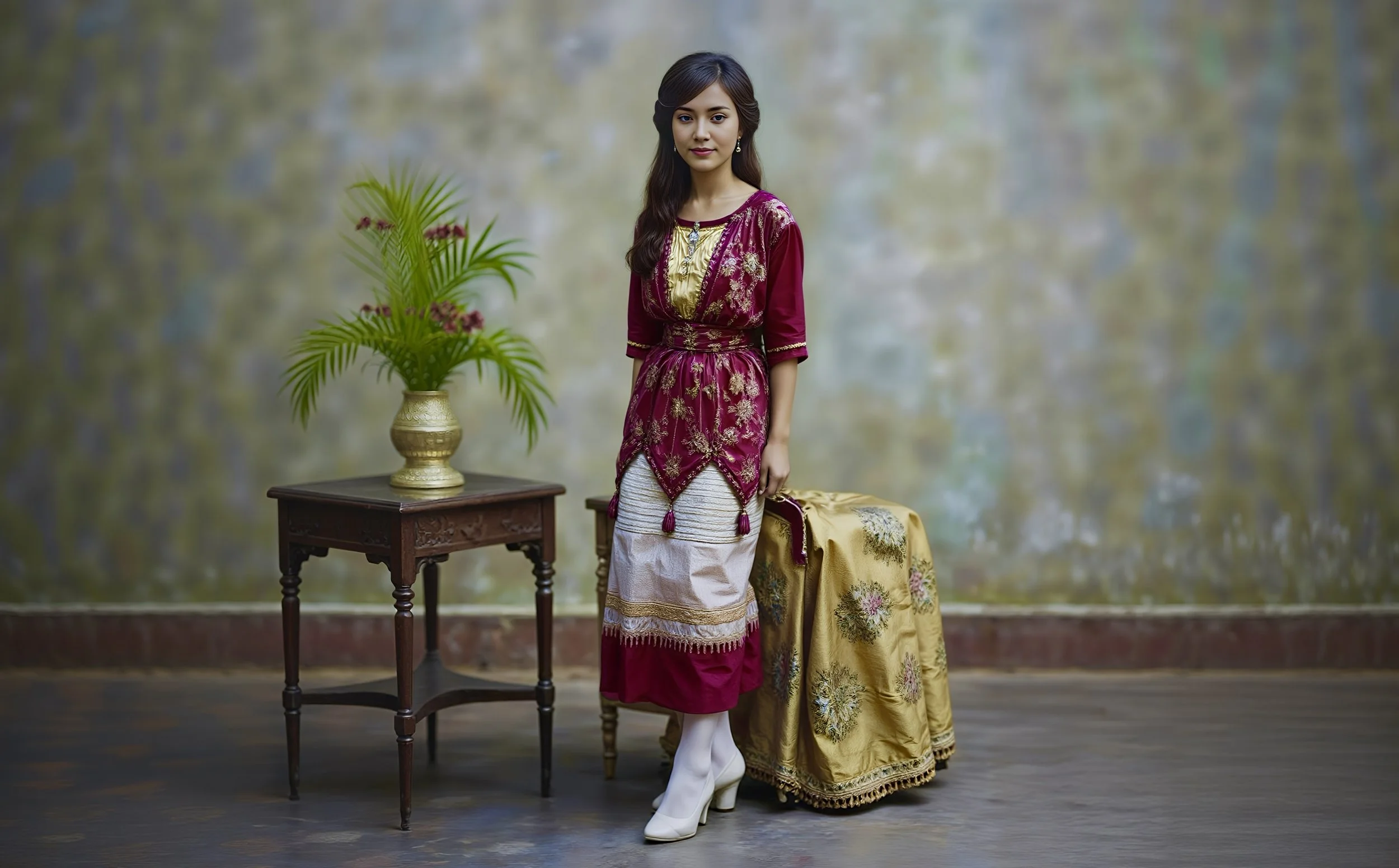
Long Hair and Pha-Sin: Siamese Women’s Fashion During the Mid Reign of King Vajiravudh (1915–1920)
Long Hair and Pha-Sin: Siamese Women’s Fashion During the Mid Reign of King Vajiravudh (1915–1920)
During the mid-reign of King Vajiravudh (Rama VI, 1915–1920), the fashion of Siamese aristocratic women evolved alongside global trends. Post-war styles gradually merged with the late Teens fashion era (1915–1919), which emphasised simplicity, a straight silhouette, lower waistlines, and shorter skirts that no longer reached the floor. This transformation reflected the global shift towards a modern aesthetic that prioritised mobility and practicality in women’s everyday attire.
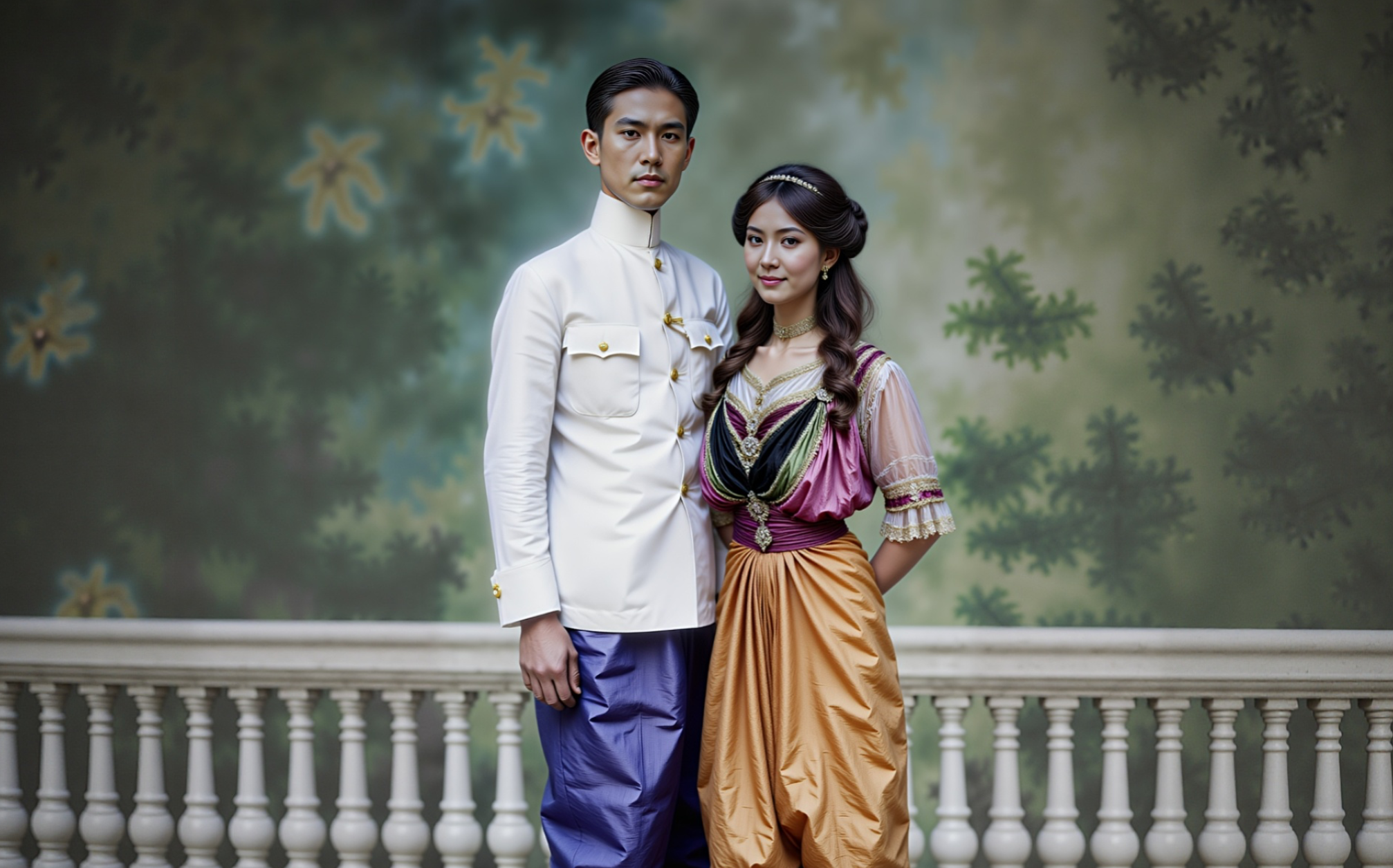
Long Hair and Modernity: The Transformation of Siamese Women’s Fashion During the Reign of King Vajiravudh
During the reign of King Vajiravudh (Rama VI, 1910–1925), the fashion of Siamese aristocratic women evolved alongside global trends. Late Edwardian styles gradually merged with the Teens fashion era (1911–1919), which embraced simpler, more fluid silhouettes. While Western tailoring remained influential, Thai women adapted elements to suit their traditions, incorporating draped fabrics in place of the traditional shoulder sash (sabais) while continuing to wear jong kraben and elegant jewellery that reflected their noble status.
Western women’s fashion at the time transitioned from high-necked blouses to wide-necked, lace-adorned designs with three-quarter sleeves, offering both comfort and sophistication. These garments, known as lingerie blouses, were often made from muslin or delicately embroidered cotton. Their airy and graceful aesthetic gained popularity worldwide, including in Siam, where women integrated them with traditional attire. Hairstyles also reflected Western influences, with women favouring meticulously styled updos. A common look featured soft curls framing the face, leading to a high chignon or leaving the ends gently curled at the back. Some variations incorporated pearl headbands, jewelled hairpins, or ribbons, enhancing their regal and elegant appearance.
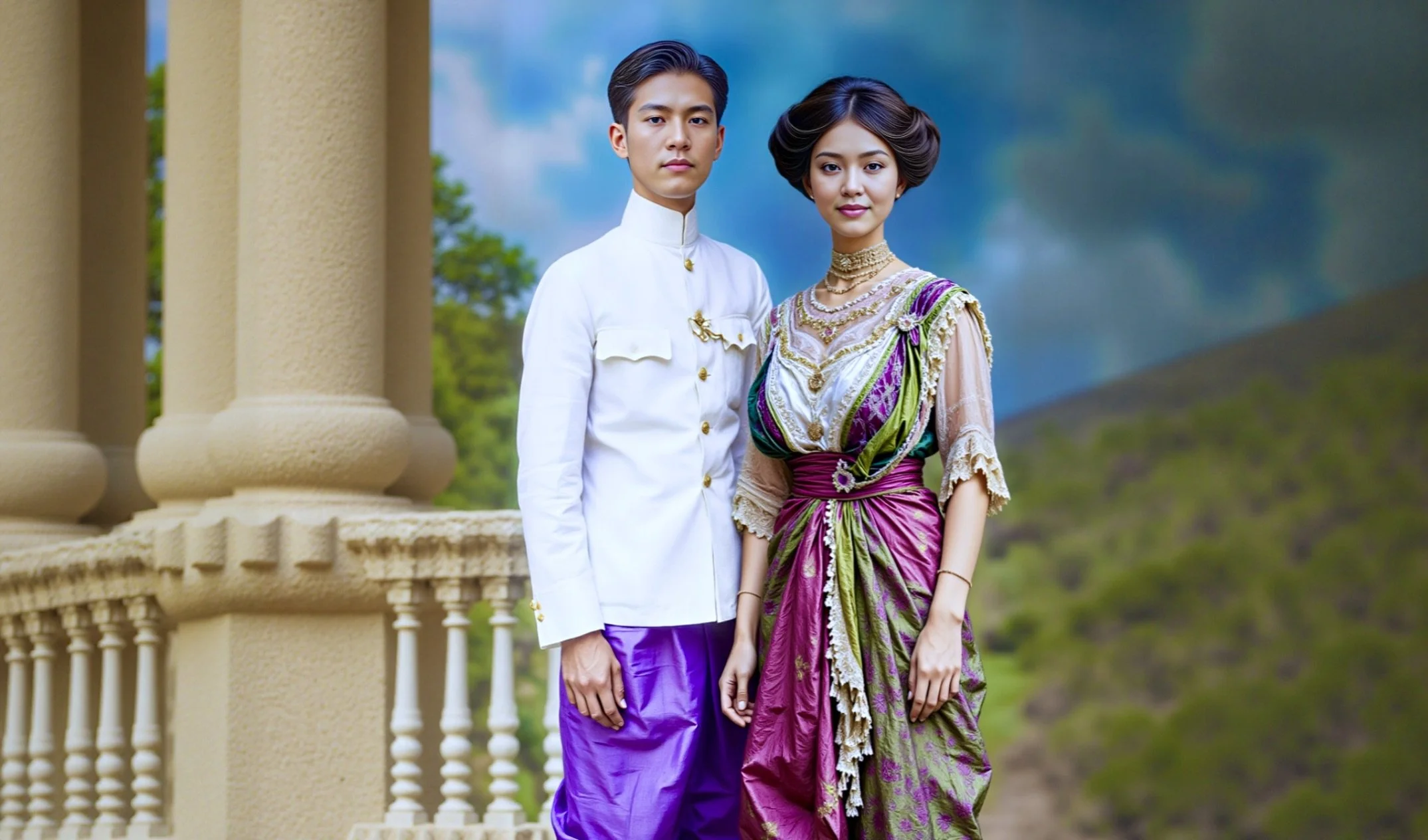
Siamese Women's Fashion in the 1910s: A Fusion of Western Style and Thai Identity
Siamese Women's Fashion in the 1910s ‘The Late Edwardian Style’: A Fusion of Western Style and Thai Identity
During the 1910s, Western women's fashion transitioned from high-necked blouses to wide-necked, lace-adorned blouses with three-quarter sleeves, offering greater comfort and elegance. These garments, known as lingerie blouses, were typically made from muslin or finely embroidered cotton. Their airy and graceful aesthetic influenced fashion worldwide, including in Siam, where women adapted them to complement traditional attire.
Hairstyles also reflected Western influences, with women favouring neatly styled updos that paired well with delicate lace-trimmed blouses, enhancing a sophisticated and modern look. Rather than fully adopting Western dress, Siamese women integrated Edwardian-style blouses with jong kraben, the traditional Thai wraparound lower garment. This fusion created an ensemble that embodied both Western refinement and Thai heritage. The lightweight fabrics suited the tropical climate, while lace and embroidery showcased the intricacy of Thai textile craftsmanship.
A Transition to a New Era
During the reign of King Vajiravudh (Rama VI, 1910–1925), the fashion of Siamese aristocratic women evolved alongside global trends. Late Edwardian styles gradually blended into the Teens fashion era (1910–1919), which embraced simpler and more flowing silhouettes. While retaining Western tailoring influences, Thai women adapted the styles by incorporating draped fabrics in place of the traditional shoulder sash (sabais), while maintaining the use of jong kraben and regal jewellery.
Men’s fashion also reflected Western influences. The Raj pattern jacket (Ratcha Pratan), inspired by Indian court attire, became a standard uniform for government officials and was commonly worn with jong kraben. The colours of these garments often signified official ranks, with navy blue (si kram tha) denoting positions in the Ministry of Finance and Foreign Affairs.
A Unique Cultural Synthesis
Siamese women’s fashion in the 1910s exemplified a seamless fusion of Western modernity and traditional Thai identity. Although European styles influenced their attire, the jong kraben remained a fundamental element of dress. AI-generated images vividly illustrate this cultural synthesis, portraying how Siamese women adapted Western trends while preserving their heritage. This era represents a fascinating moment in Siamese fashion history, marking a transition between tradition and modernity.
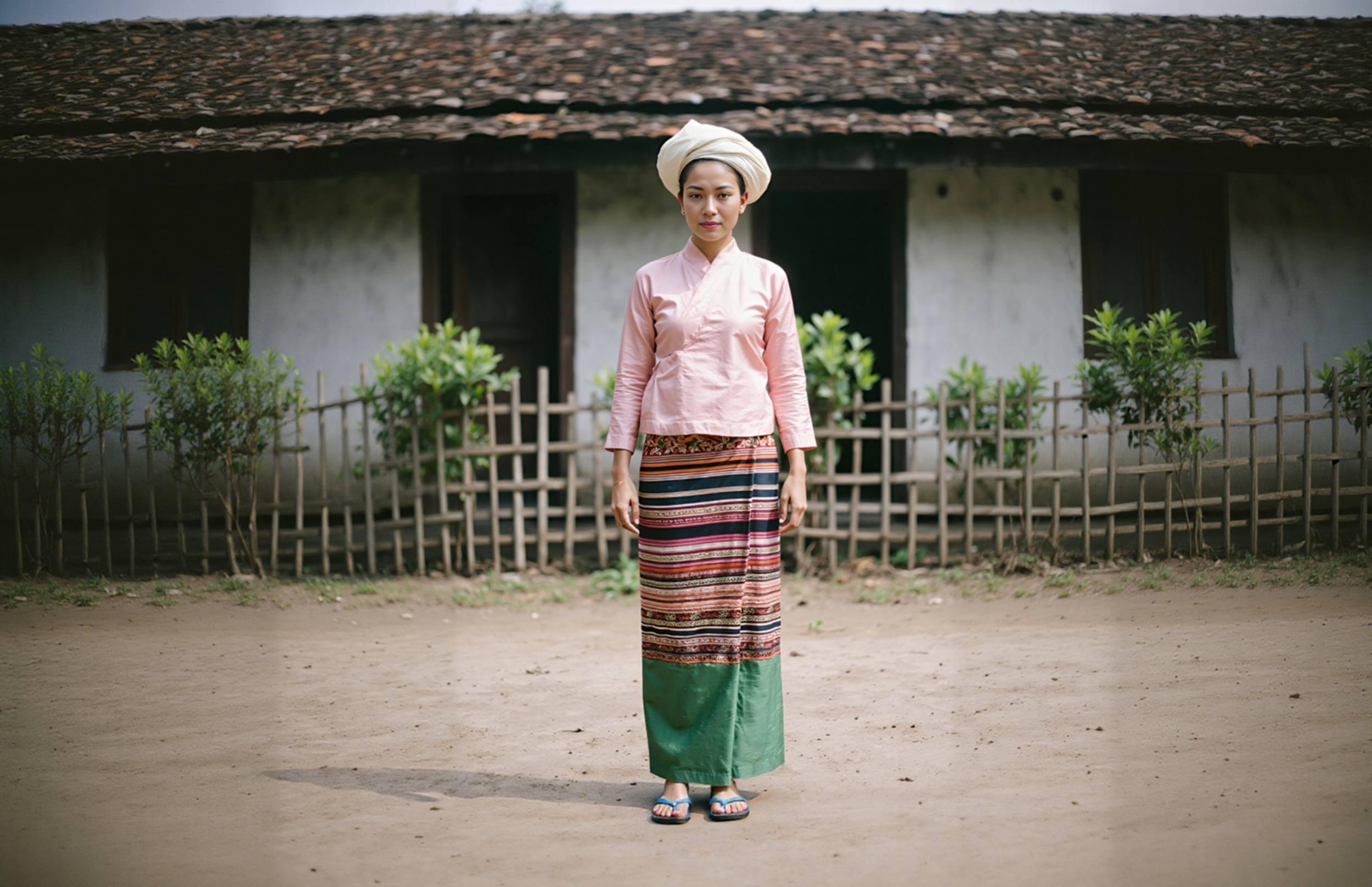
Tai Khün or Tai Khün Textiles
Tai Khün or Tai Khün Textiles
Tai Khün textiles share similarities with Tai Lü textiles. Tai Khün women traditionally wear a Seua Pad (เสื้อปั้ด), a fitted, cropped, long-sleeved blouse, along with a Sin Ta (ซิ่นตา), a woven tubular skirt with horizontal stripes. The skirt is sewn with two seams and features a contrasting waistband and hem in solid green, indigo, black, or purple fabric.
During the winter, Tai Khün women wear a Seua Puk (เสื้อปุก), a long-sleeved Seua Pad lined with cotton for warmth, resembling a quilted jacket.
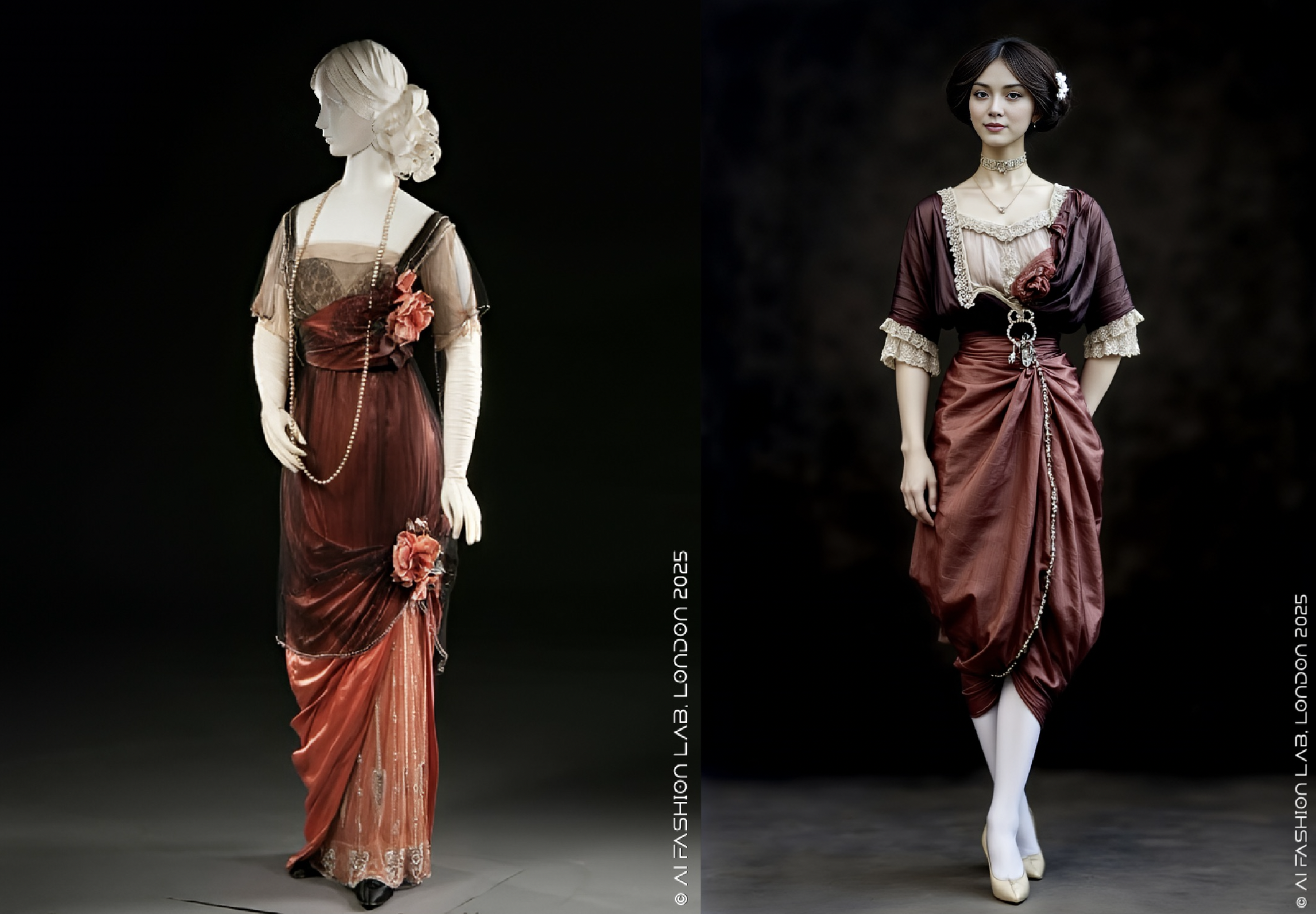
Late Edwardian Fashion in Siam: A Comparison of Western and Thai Attire During the Early Reign of King Rama VI (1910-1915) (1 of 2)
The early reign of King Vajiravudh (Rama VI) marked a period of transformation in women’s fashion in Siam, influenced by Western trends, particularly Late Edwardian fashion, which gradually evolved into the Teens era (1911-1919, aligning with the years ending in -11 to -19, much like the term teenager in English). Upper-class women and the royal court in Siam began to integrate European styles with Thai aesthetics in a refined manner. AI-generated images, based on historical Siamese photographs and Edwardian fashion sources, beautifully illustrate this evolution. While the garments retained Western silhouettes and detailing, they incorporated Thai elements such as diagonal sashes, chongkraben, and royal court accessories, resulting in a uniquely hybridised style.
While Western Edwardian fashion in the late 1910s featured lightweight fabrics, sheer overlays, and softly draped gowns, transitioning away from rigid structures, Siamese fashion of the same period retained chongkraben as a key component, often paired with delicate lace blouses or silk tops influenced by European styles. AI-generated representations may not always depict chongkraben in full detail, but the upper half of the attire still reflects the aesthetics of the Late Edwardian and early Teens era. In the early years of King Rama VI’s reign, high lace collarsremained popular for formal court occasions, mirroring European fashion trends. However, as Western styles evolved, modern Siamese women, particularly those educated abroad or involved in European-style social events, embraced lower necklines and fluid draped fabrics, which became hallmarks of the Teens era.
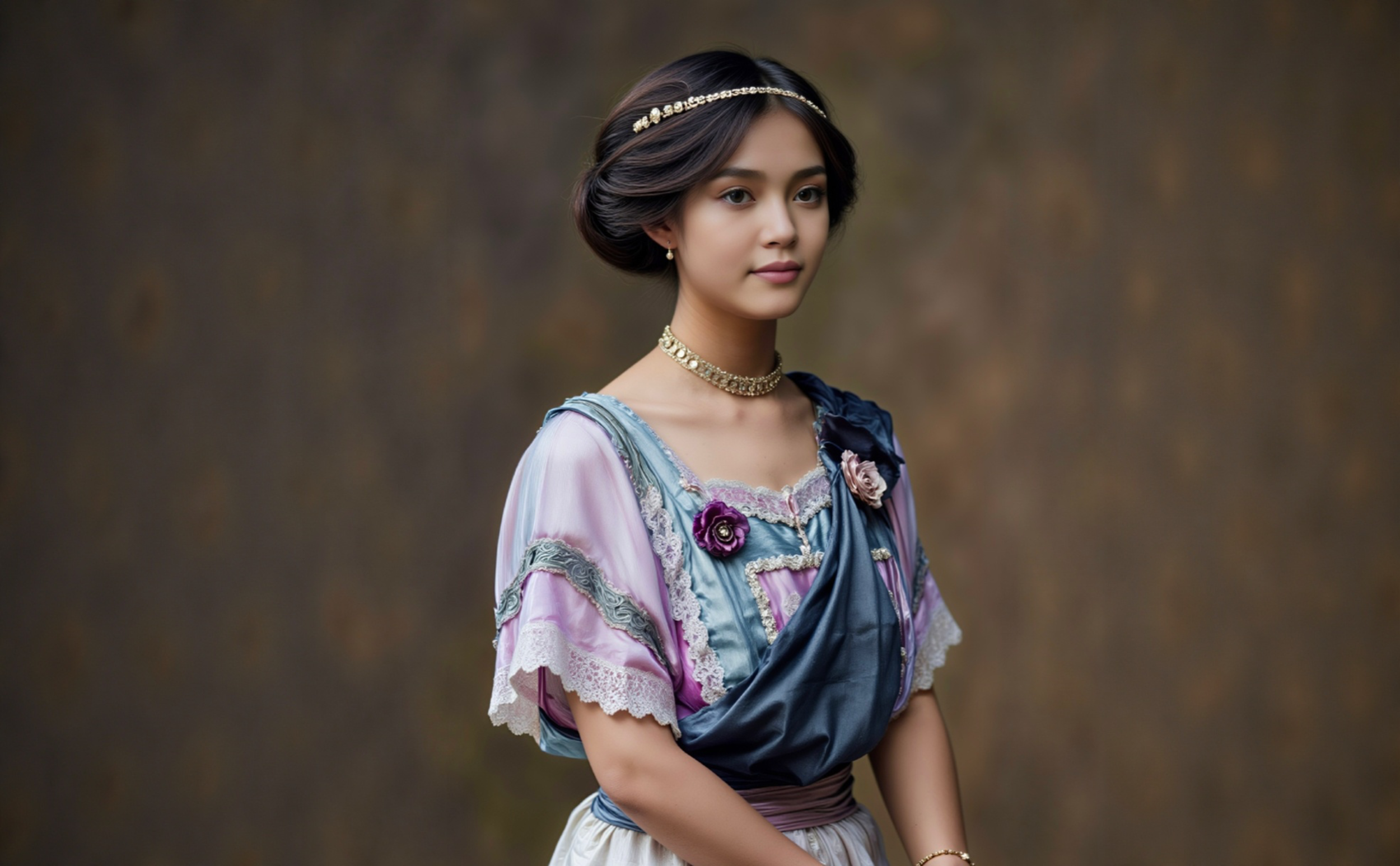
Late Edwardian Elegance in Siam: Fashion During the Early Reign of King Rama VI (1910-1915)
The AI-enhanced images offer a fascinating glimpse into how Siamese women of the early Rama VI era might have fully embraced Teens-era fashion, merging it with their own heritage. The gradual shift from high-collared blouses to lower necklines, the rise of upswept Western-inspired hairstyles, and the continued presence of chongkraben and Thai embellishments reflect a society in transition. This era of Thai fashion was not merely an imitation of Western trends but an artistic and cultural dialogue, resulting in an elegant, globally influenced style that remained deeply rooted in Siamese identity.
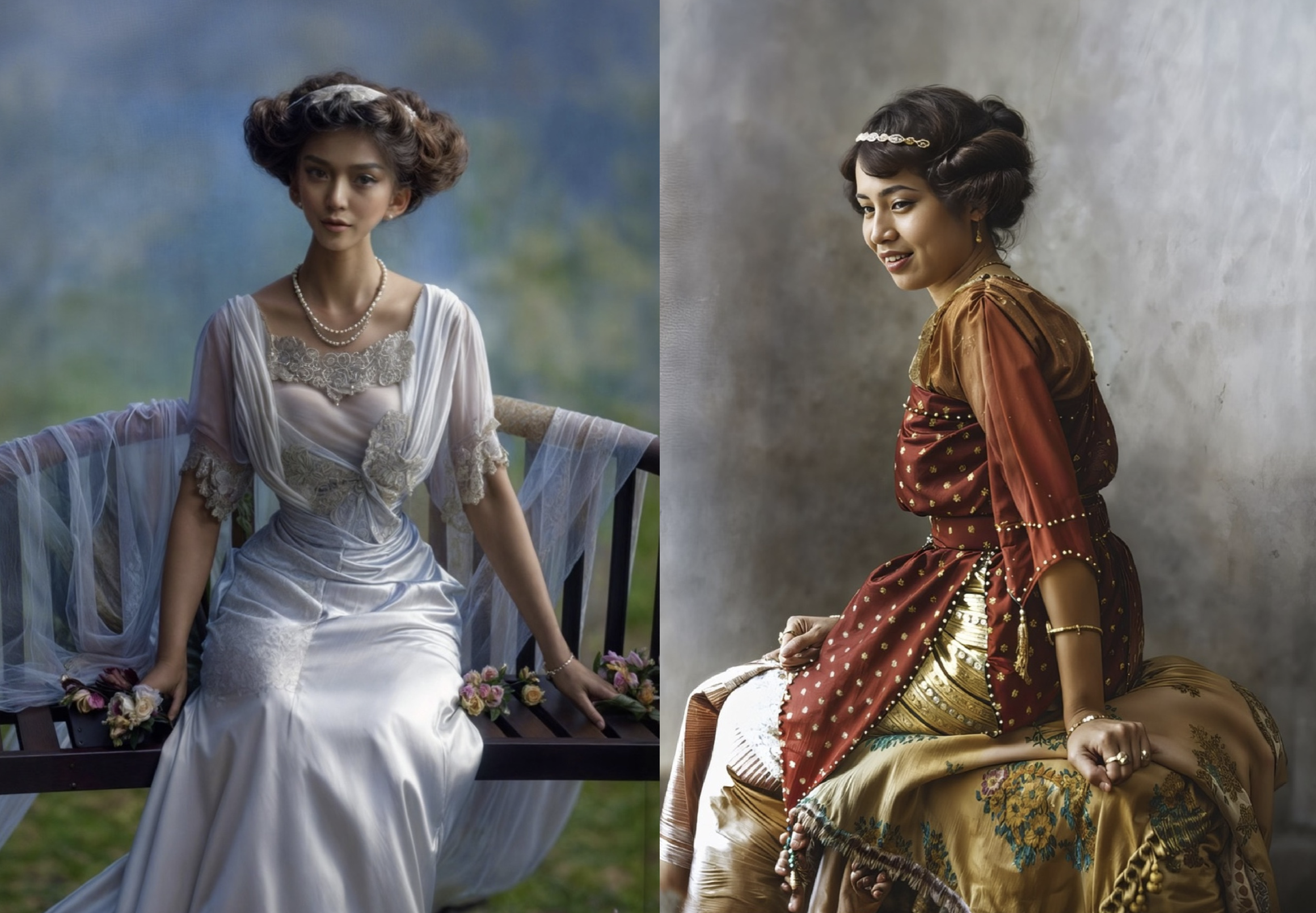
Workflow for Training AI to Model Early King Rama VI Era Fashion
This is my workflow for training an AI model to create fashion representations from the early reign of King Rama VI (1910–1925). I have focused on the early period (1910–1915), which was still influenced by late Edwardian fashion. The defining elements of this era's fashion include intricate women's blouses and distinctive hairstyles.
Although Thai women of this era commonly wore blouses paired with chongkraben (traditional wrap pants), I have selected Western original images as reference points to achieve a more accurate silhouette. During the AI training process, I will combine colourised photographs of Thai fashion from the Rama VI era (sourced from the National Archives of Thailand) with Western original fashion images. This approach ensures the best results in terms of both historical accuracy and realistic period silhouettes.
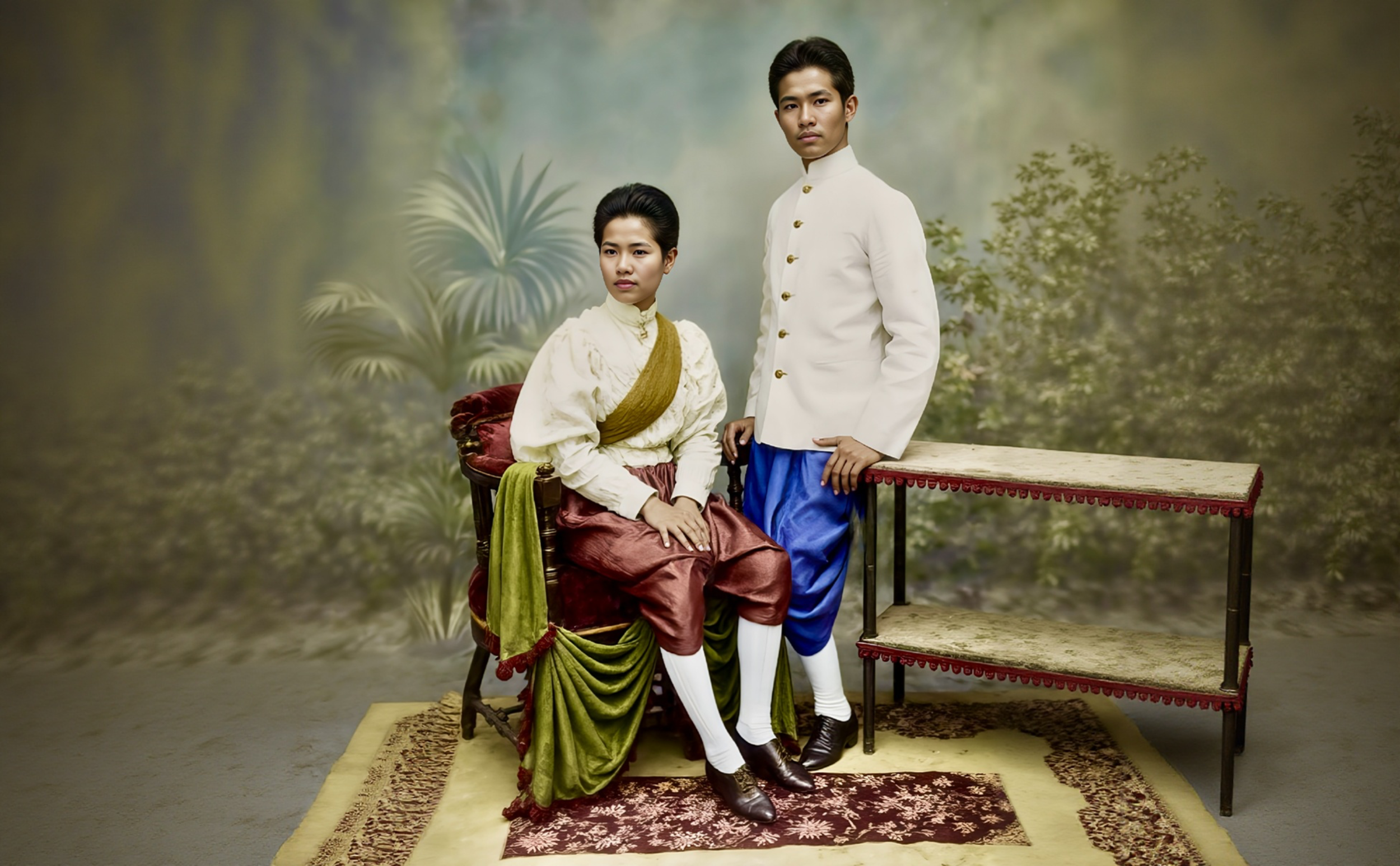
Thai Fashion During the Later Reign of King Chulalongkorn (Rama V), circa 1900
During the later reign of King Chulalongkorn (Rama V) around 1900, Thai women’s fashion transitioned from the extravagant leg-of-mutton sleeves of the 1890s to a more refined silhouette. Sleeves returned to a natural size, while the high collar neckline, popularised by Queen Alexandra of England, became a dominant feature. Blouses, often made of lace or silk, were structured yet delicate, following Western influences. These were typically paired with the สไบจีบ (Sabai Jeep), a pleated shawl draped diagonally across the body, adding a distinct Thai refinement to the attire. The lower garment remained the ผ้านุ่ง (phaa nung) or โจงกระเบน (chong kraben), with silk and fine brocade materials used for formal occasions.
Men’s fashion was largely defined by the เสื้อราชประแตน (Raj-Pattern shirt), a high-collared, buttoned-front shirt introduced after King Chulalongkorn’s visit to India in 1873. Originally inspired by Indian court dress, it became standard attire for government officials and aristocrats. The Raj-Pattern shirt was always paired with โจงกระเบน (chong kraben), a traditional lower garment neatly folded and tucked. The colour of chong kraben often signified an individual’s governmental department. A notable example was สีกรมท่า (Si Krom Tha)—a deep navy blue worn by officials of Krommathā (Department of Financial and Foreign Affairs). This association led to สีกรมท่า becoming a recognised term for navy blue in Thai. Other official shades included สีขาบ and สีน้ำเงินแก่, which were similarly dark blue and linked to governance.
Women’s hairstyles remained short. The ทรงดอกกระทุ่ม (Song Dok Krathum) was particularly popular, featuring a short, rounded bob resembling the krathum flower. Siamese women wore their hair short; only Lao or Lanna women kept their hair long and often wore ผ้าซิ่น (pha-sin), the tubular skirt, instead of โจงกระเบน (chong kraben). Some young and modern girls also started to wear their hair long and began styling it in upswept Western-inspired hairstyles, reflecting changing fashion influences.
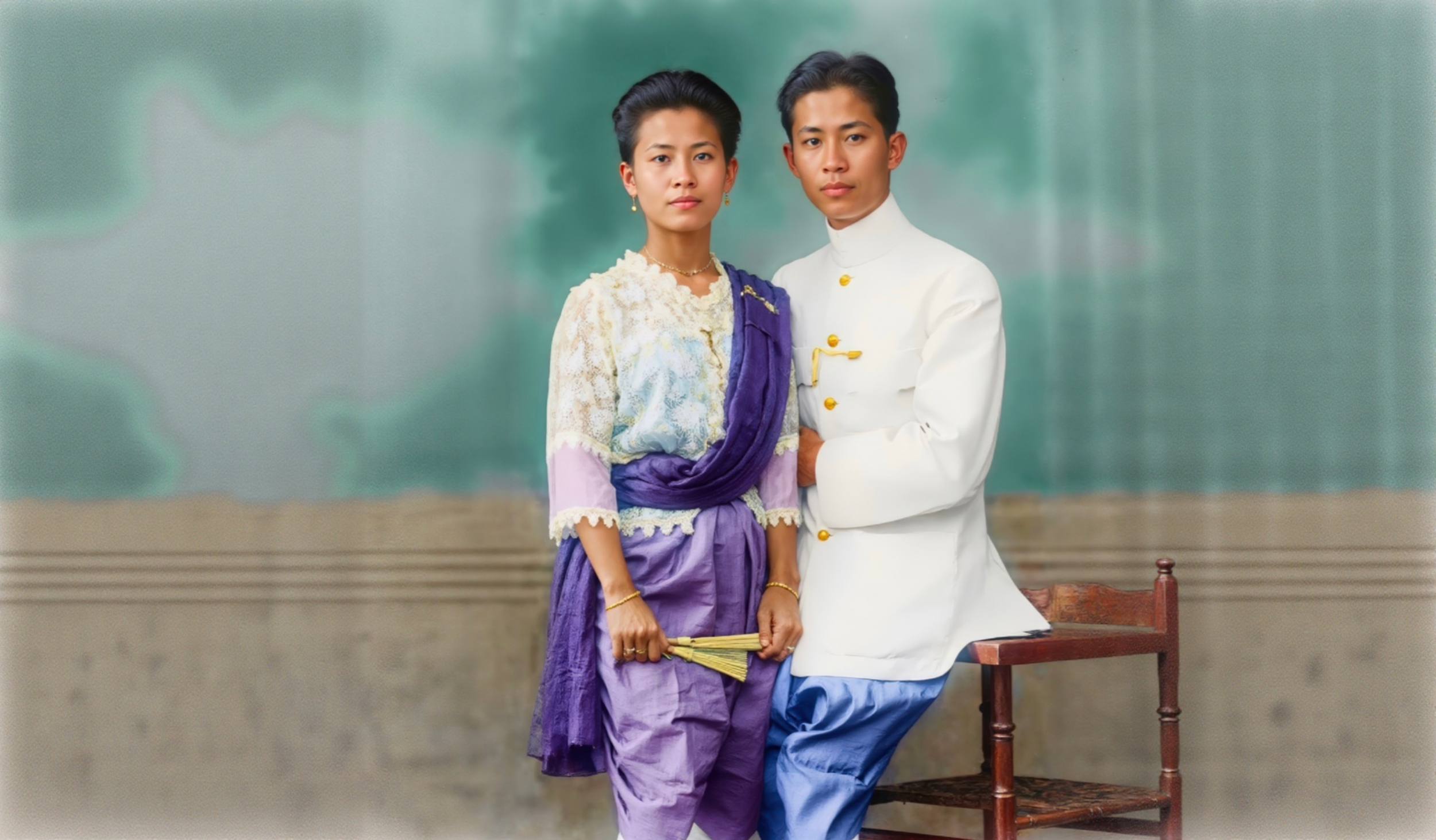
Early Rama VI and Late Edwardian Fashion: The Influence on Early 20th-Century Siamese Women’s Attire
During the 1910s, Western women's fashion transitioned from high-necked blouses to wide-necked, lace-adorned blouses with three-quarter sleeves, offering greater comfort and elegance. Known as "lingerie blouses," these garments were typically made of muslin or fine cotton with delicate embroidery and pintucks. Their lightweight, airy aesthetic influenced fashion worldwide, including in Siam, where women adapted them to complement their traditional attire.
Siamese women had embraced short hairstyles since the early Rattanakosin era, in contrast to Western women, who often wore elaborate updos. The "Dok Krathum" hairstyle, popular since the mid-19th century, was valued for its practicality and suitability for the hot climate. By the 1910s, this short hairstyle perfectly complemented the soft, lace-trimmed blouses, creating a look that was both modern and distinctly Siamese.
Rather than fully adopting Western fashion, Siamese women paired Edwardian-style blouses with traditional chong kraben, a wrapped lower garment. This fusion balanced Western sophistication with Thai identity, as the lightweight fabrics suited the tropical climate, while the lace and embroidery echoed the craftsmanship found in traditional Thai textiles. This combination became a signature look among Siam’s elite women.
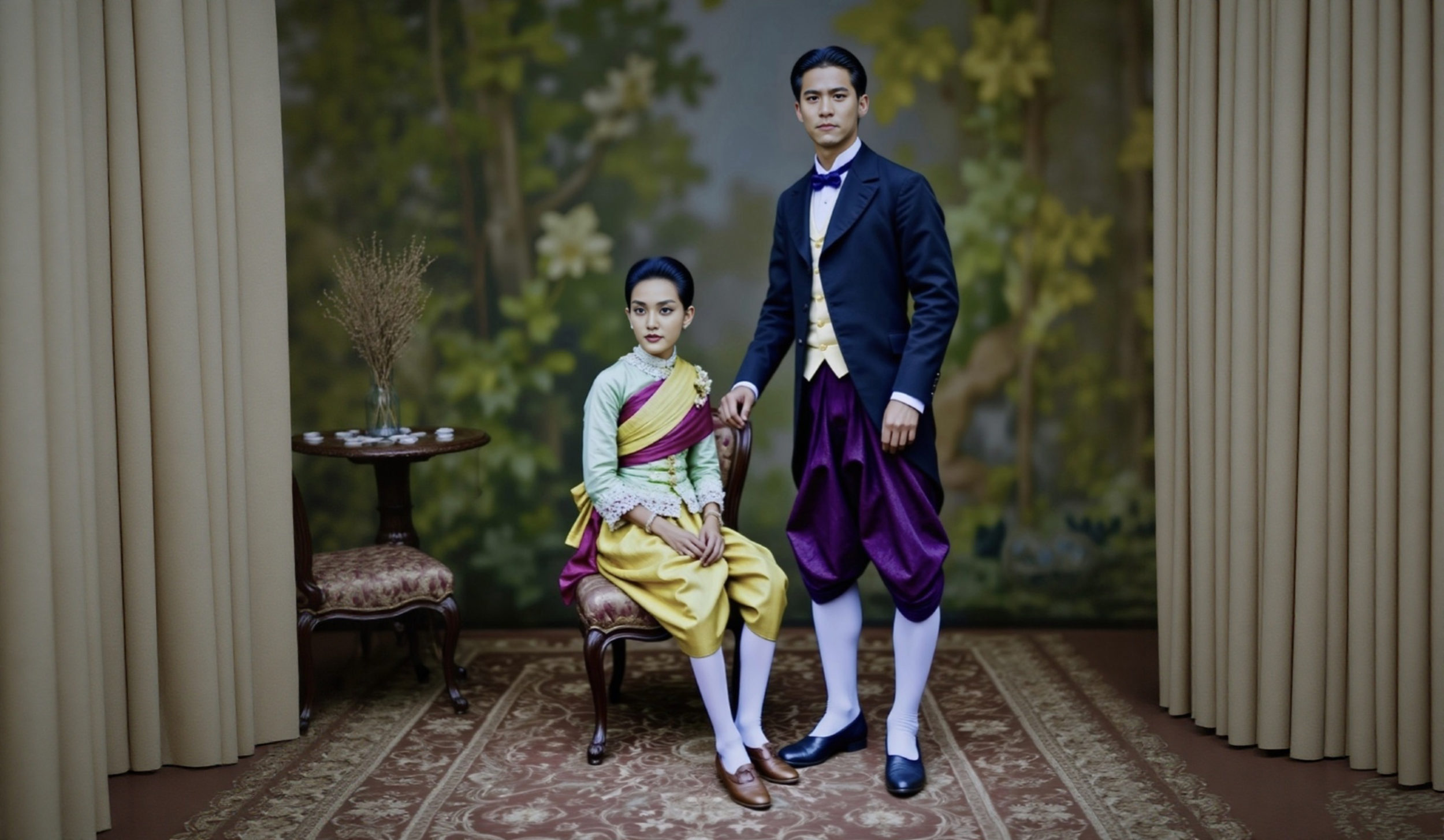
The Evolution of Fashion During the Early Reign of King Rama V (1868–1880)
During the early reign of King Chulalongkorn (1868–1880), Siamese fashion underwent significant changes, incorporating Western influences while preserving Thai identity. For men, Western-style shirts, cravats, and bow ties became popular, often paired with jong kraben (wrapped trousers) instead of European-style trousers. Formal occasions called for double-breasted coats, long tailcoats, and frock coats adorned with brass or gold buttons. Footwear shifted from barefoot customs to black leather shoes and white stockings, symbolising nobility and modernity. Hairstyles evolved from the Mahad Thai cropped style to slicked-back or side-parted looks, reflecting European bureaucratic fashion.
Western fashion was adopted as a diplomatic tool to present Siam as a modern nation while retaining elements of Thai tradition, such as jong kraben and Thai silk. This balance allowed the elite to project an image of progress without losing their cultural heritage. The fusion of styles played a crucial role in reinforcing Siam’s sovereignty and status on the global stage.
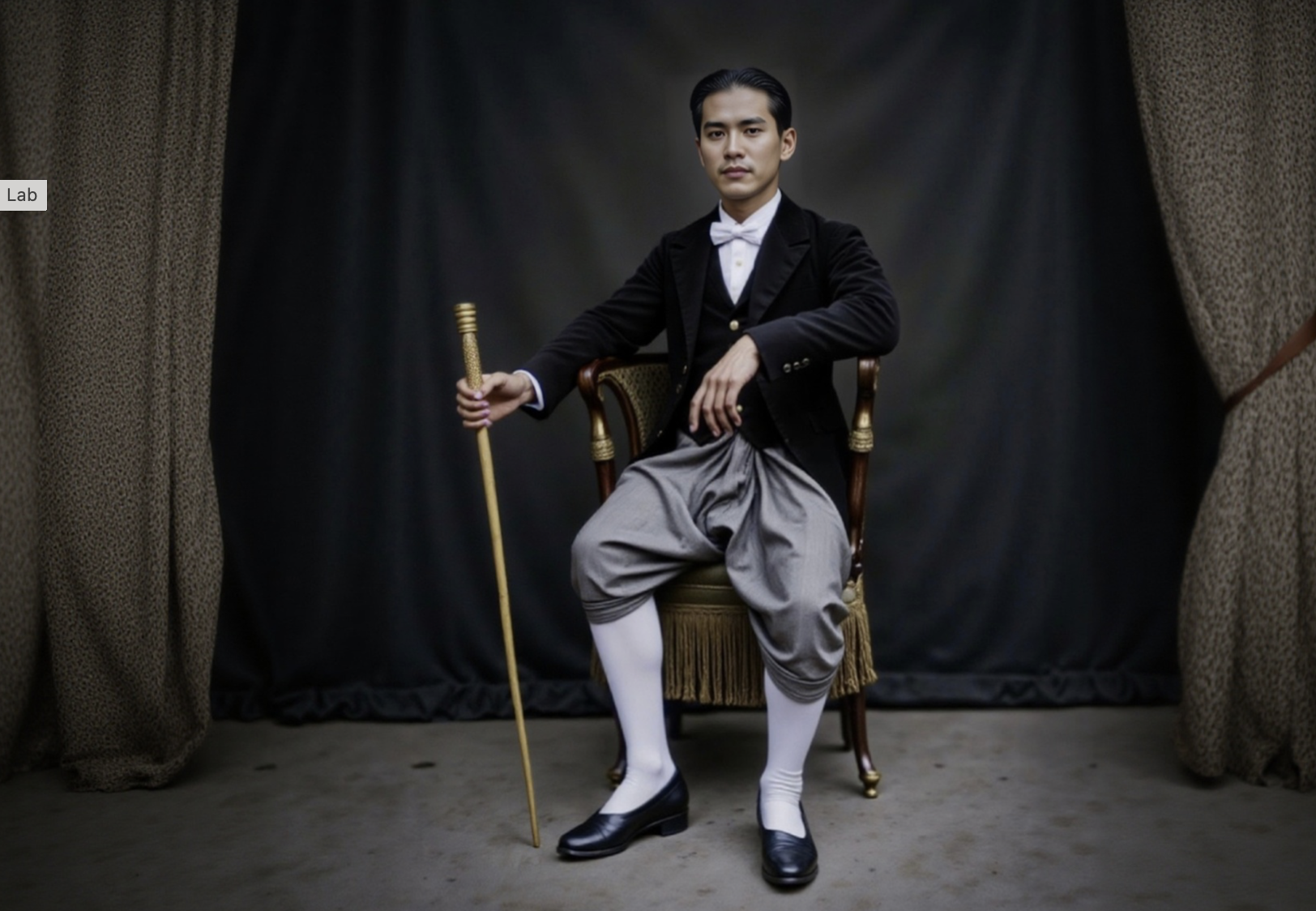
Hybridisation of Western and Siamese Fashion in King Rama IV’s Reign: A Transition Towards Modernity
During the reign of King Rama IV (1851–1868), Siamese noblemen and male members of the royal family embraced a hybrid fashion style that combined Western upper garments with traditional chong kraben (wrapped silk trousers).This sartorial shift was influenced by diplomatic relations with Europe, reflecting Siam’s efforts to modernise while maintaining its distinct cultural identity. Noblemen adopted white soft-collared shirts, often paired with cravats, stocks, or bow ties, replacing the traditional bare chest or silk wrap-around styles.
For formal occasions, noblemen wore waistcoats and Western-style coats, such as double-breasted frock coats, tailcoats, or short front coats adorned with brass buttons. Despite these Western influences, they continued to wear chong kraben instead of European trousers, using luxurious silk fabrics in deep blues, purples, and gold with intricate patterns. A significant departure from tradition was the adoption of white stockings and leather shoes, which contrasted sharply with the barefoot norm of everyday Siamese life. Footwear was a clear marker of status and Western influence, as common people rarely wore shoes outside of royal or elite circles.
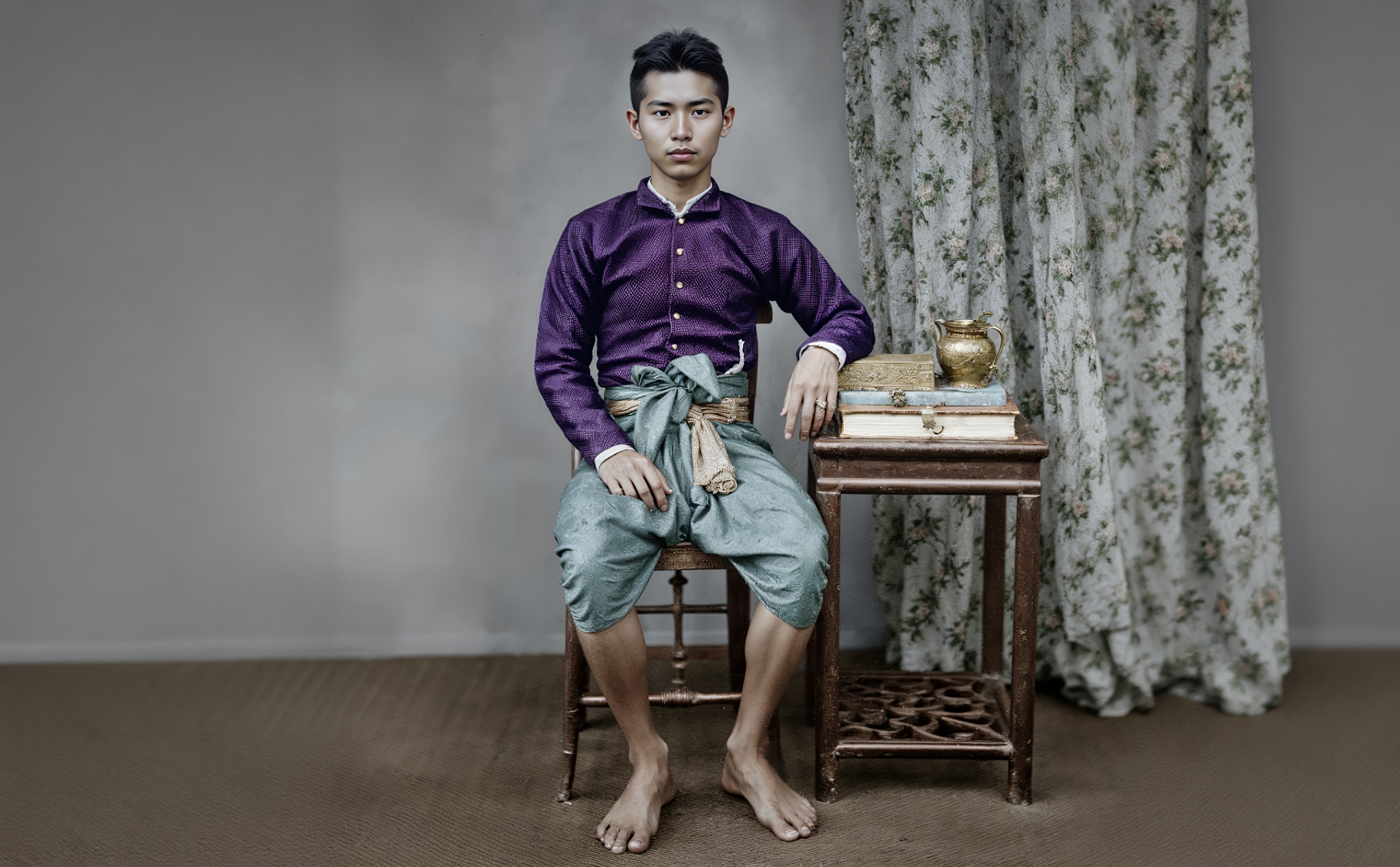
The Evolution of Male Attire in Early Rattanakosin: A Visual Collection of Men Wearing Shirts
As Siam transitioned from the late Ayutthaya period into the early Rattanakosin era, traditional clothing customs remained deeply ingrained in society. For men, the prevailing style consisted of jongkraben (traditional wrap-around trousers) and draped cloth, with the absence of shirts being a common and accepted practice. However, the reign of King Mongkut (Rama IV) marked a pivotal shift in male attire, introducing the widespread adoption of shirts, which significantly altered Siamese fashion norms.
This collection visually explores the transformation of male dress, particularly the introduction of shirts, as influenced by King Mongkut’s reforms. The shift began with his decree requiring court officials to wear shirts during royal audiences, breaking with the long-standing tradition of appearing bare-chested.
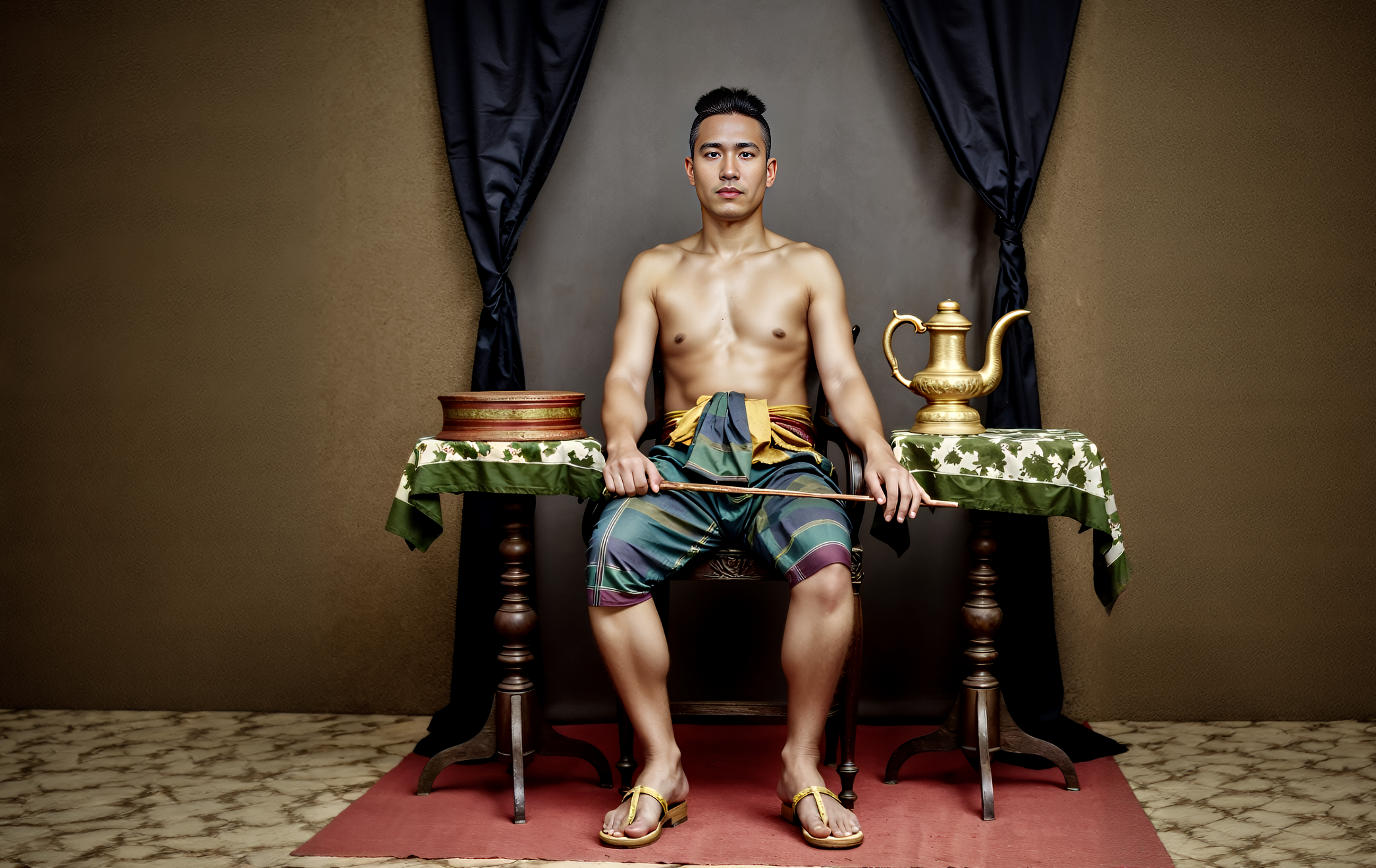
The Evolution of Male Attire in Early Rattanakosin: From Traditional Practices to Transformation under King Rama IV
In the early Rattanakosin era, Siam was emerging from the turbulence of war and embarking on a period of reconstruction. The cultural fabric of society remained deeply rooted in the traditions of late Ayutthaya, evident in its laws, governance, and notably, its modes of dress. During this time, the prevailing style for men was to don jongkraben(traditional wrap-around trousers) and draped cloth, with the absence of a shirt being customary. However, a decisive shift from these established norms began to take shape during the reign of King Mongkut (Rama IV), heralding a new chapter in Siamese sartorial customs.
King Mongkut introduced a significant reform to the courtly dress code, mandating that officials wear shirts during royal audiences—a departure from the longstanding tradition of shirtlessness. In a royal address, he remarked:
“...One day, court officials assembled at the Royal Pavilion for an audience. At that time, it was customary for attendees to appear without shirts. His Majesty observed that those without shirts seemed almost naked, their bodies marred by blemishes or glistening with perspiration, which he found unsightly and unhygienic. He therefore decreed that henceforth, all who attended court must wear shirts...” (Chronicles of Rattanakosin, King Rama IV, compiled by Chao Phraya Thipakorawong Mahakosathibodi)
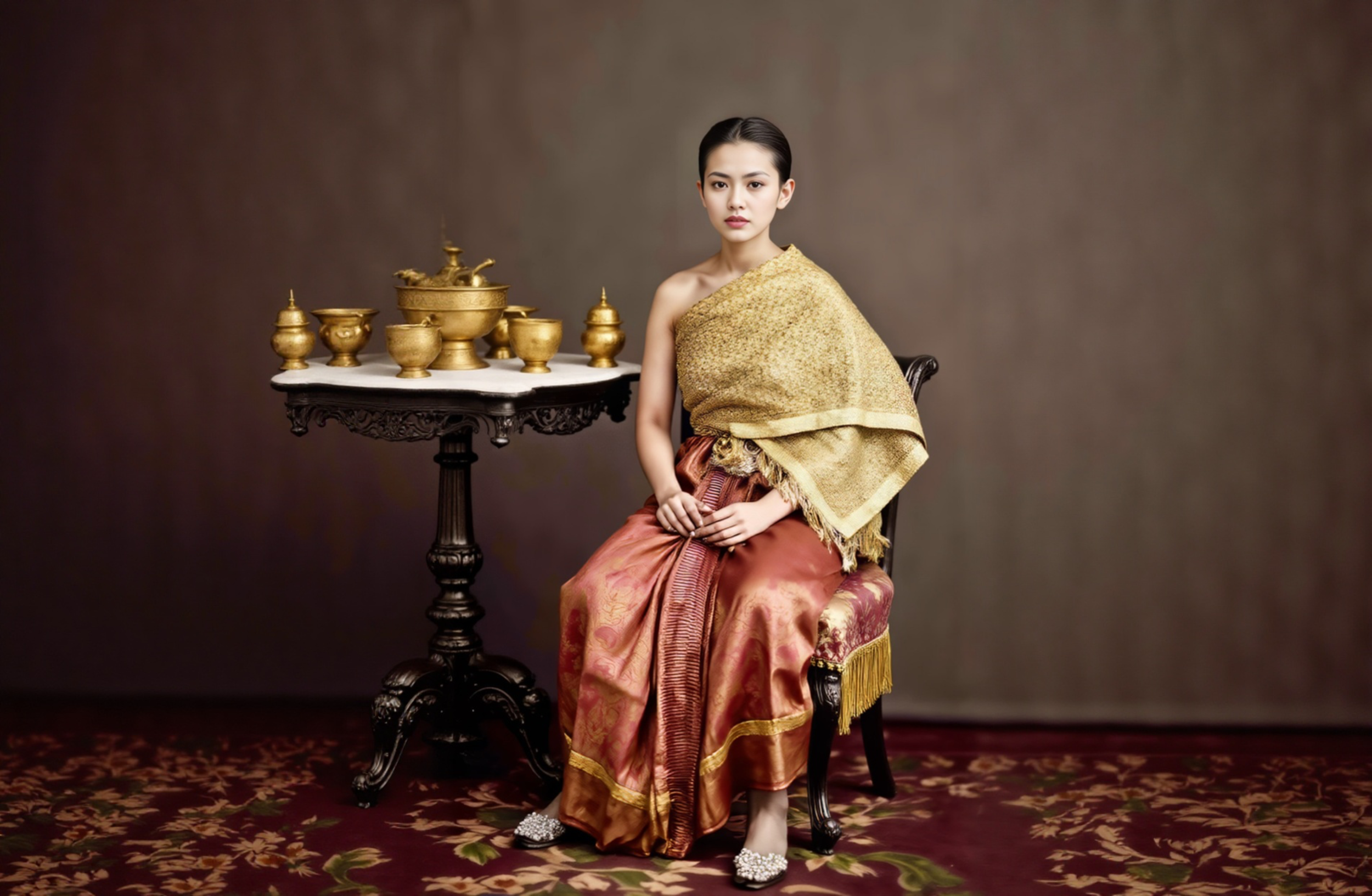
The Art of Courtly Attire: “Nung Yok Hom Tad” in the Reign of King Rama IV
ศิลปะแห่งการแต่งกายในราชสำนัก: “นุ่งยกห่มตาด” สมัยรัชกาลที่ ๕
พึ่งเทรนโมเดล AI เสร็จเรียบร้อยครับ! ครั้งนี้ใช้ฐานข้อมูลที่รวบรวมจากรูปภาพสมัยต้นรัชกาลที่ ๕ เพื่อจำลองการแต่งกายแบบราชสำนักในยุคนั้น โดยเฉพาะการ "นุ่งยกห่มตาด" ซึ่งเป็นศิลปะการแต่งกายที่สะท้อนถึงความสง่างามและเอกลักษณ์ของเจ้านายในราชสำนักในช่วงเวลานั้น
อยากชวนเพื่อน ๆ แสดงความคิดเห็น:
รายละเอียดในชุดที่ AI จำลองมานั้นสมจริงแค่ไหน? หรือควรปรับปรุงจุดใดเพิ่มเติม?
ถ้านำรูปแบบการแต่งกายนี้มาปรับใช้ในแฟชั่นสมัยใหม่ เพื่อน ๆ คิดว่าน่าจะเหมาะกับโอกาสแบบไหน?
ภาพตัวอย่างด้านล่างคือผลงานที่ได้จากการสร้างด้วย AI (AI-enhanced creations) หวังว่าจะได้รับคำแนะนำและข้อคิดเห็นดี ๆ จากทุกคนครับ!
ปล. การแต่งกายในยุคนั้นมีรายละเอียดที่น่าสนใจ ตั้งแต่ลวดลายผ้าทอ ไปจนถึงการเลือกสีที่สื่อถึงสถานะในสังคม หากใครมีข้อมูลหรืออยากแชร์ไอเดียเพิ่มเติม สามารถแสดงความคิดเห็นได้เลยครับ!
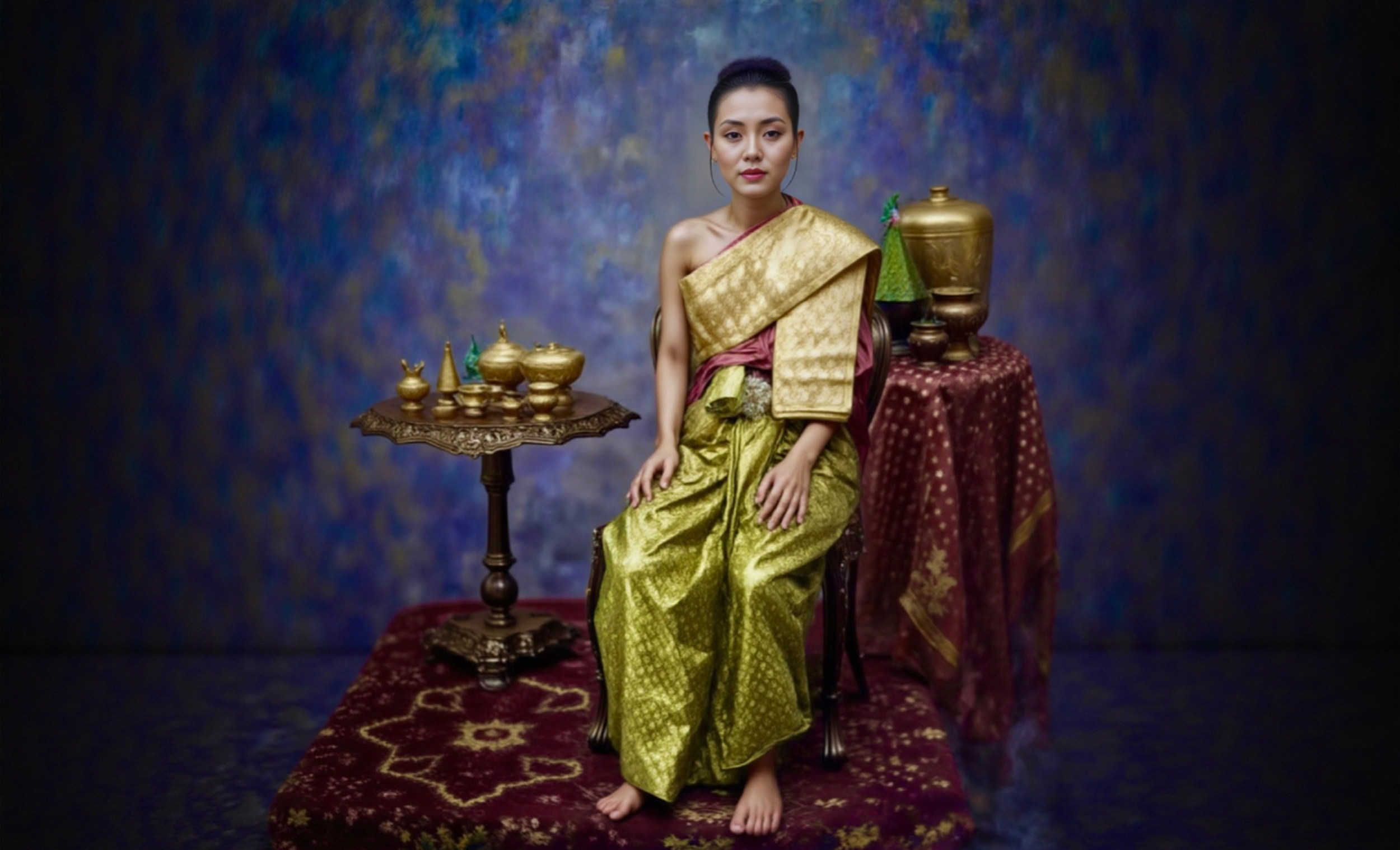
The Art of Courtly Attire: “Nung Yok Hom Tad” in the Reign of King Rama IV
The attire of women in the royal court during the early Rattanakosin period was an exquisite art form, seamlessly blending elegance with symbolic meaning. Court ladies often adorned themselves with brocade silk or gold-patterned fabrics, meticulously crafted with intricate designs by master artisans. These were complemented by diagonal silk shawls made from embroidered or satin fabrics, expertly folded to create pleats of refined beauty. Hairstyles were styled short on all sides of the head, with a distinctive tuft-like crown at the top and long, flowing, soft strands extending gracefully from the sideburns, further enhancing their delicate and sophisticated appearance. This meticulous attention to detail in dress and grooming went far beyond mere fashion—it served as a powerful symbol of status, grace, and appropriateness for various ceremonial and courtly occasions.