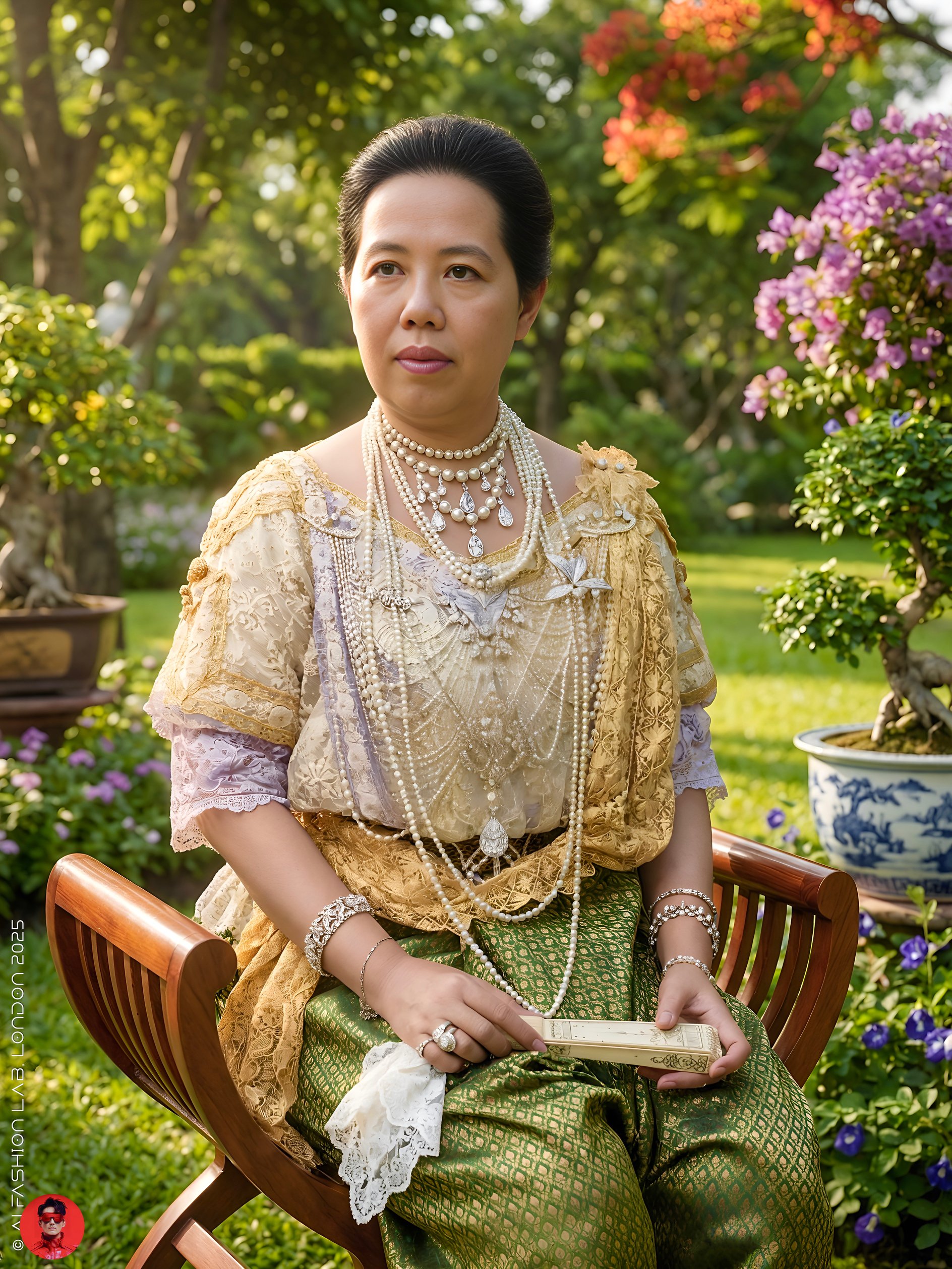
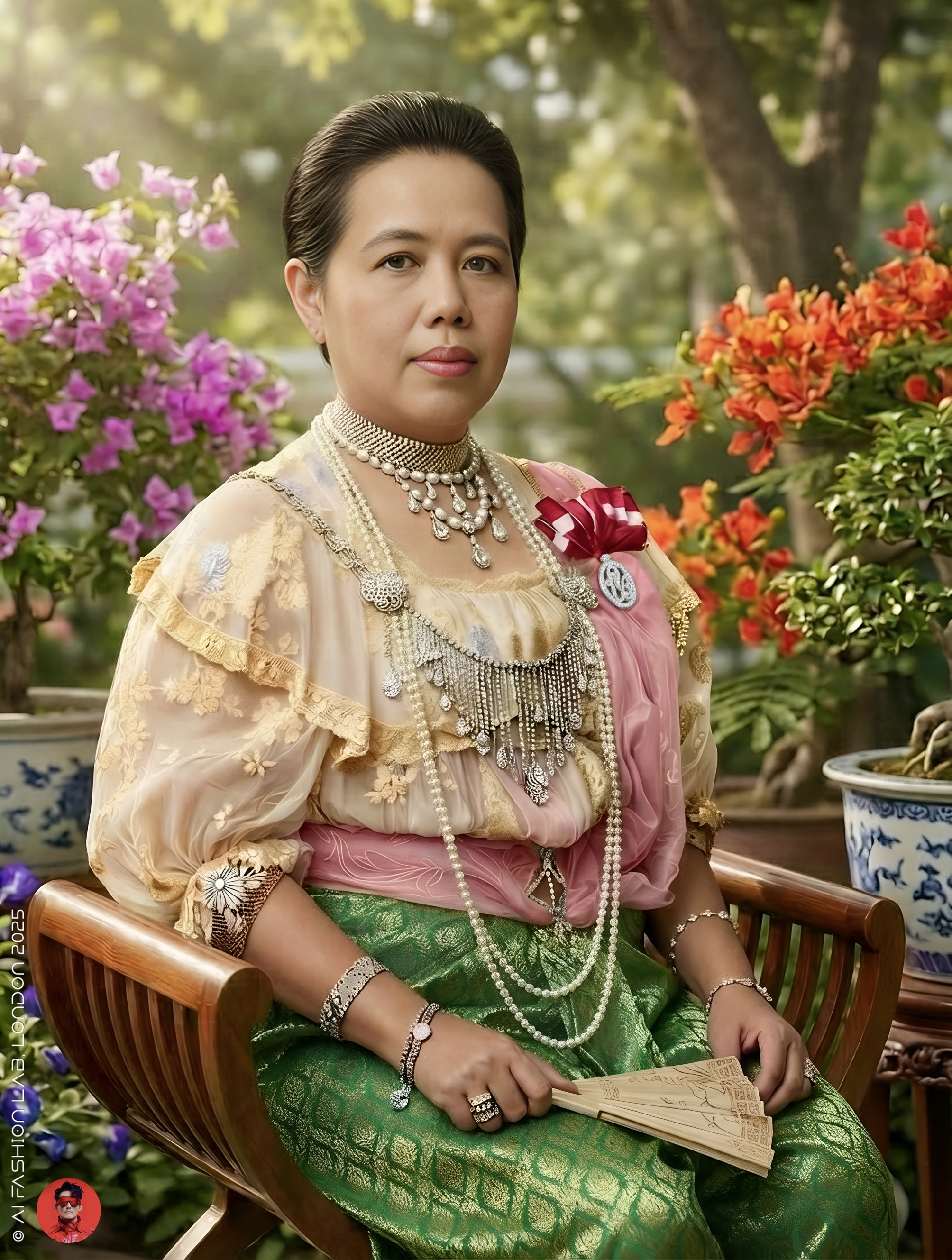
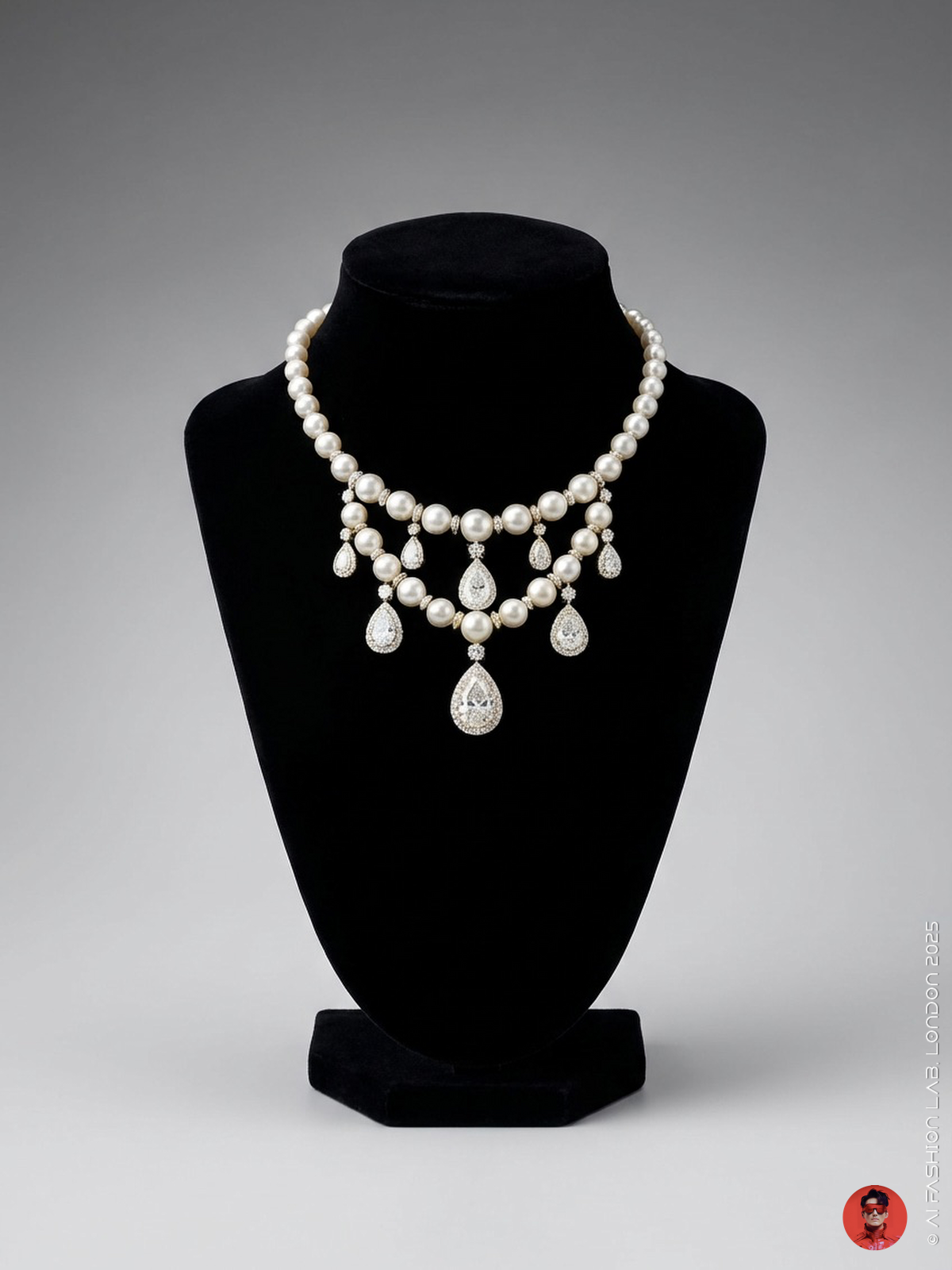
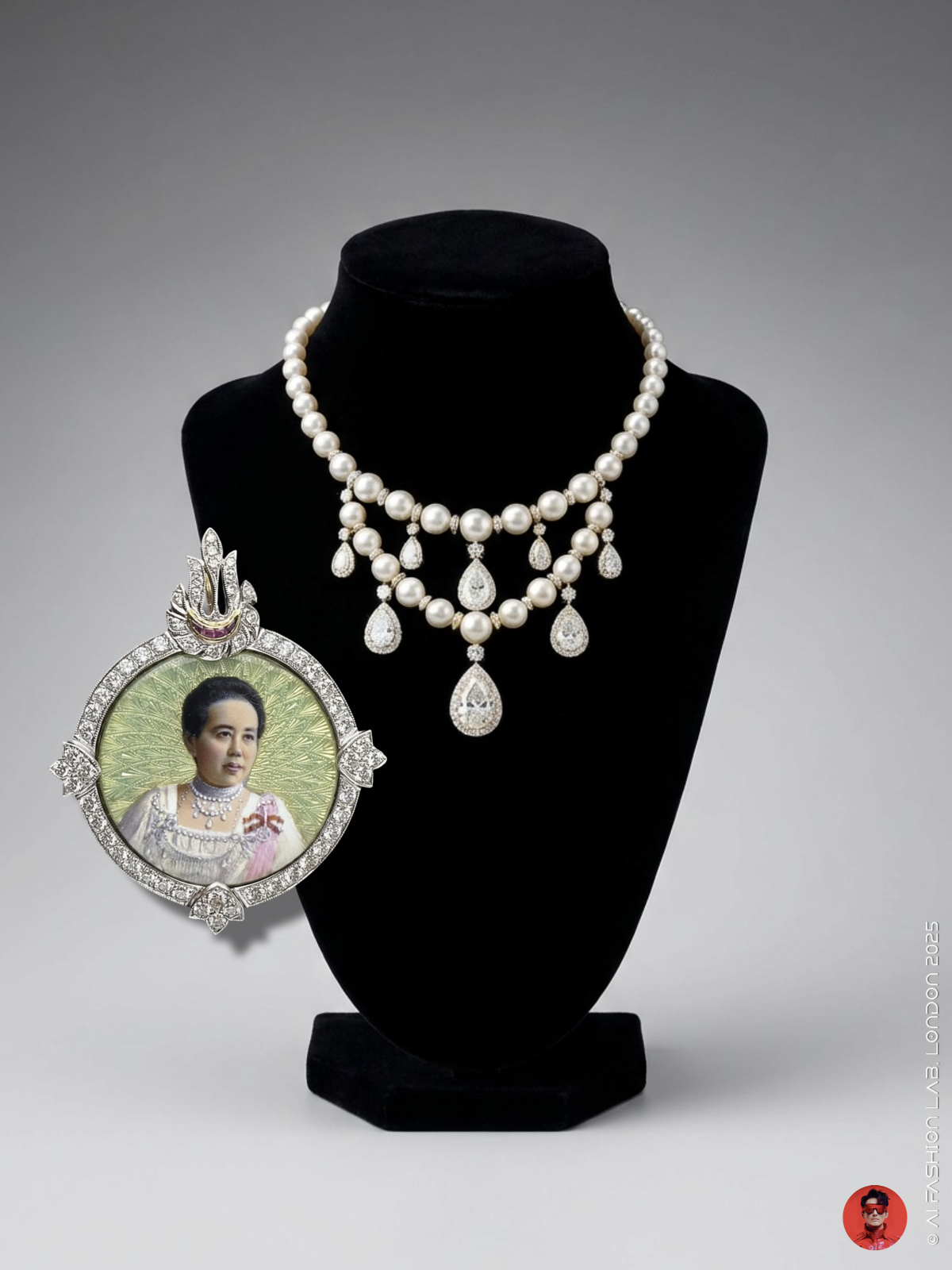
สมเด็จพระศรีพัชรินทราบรมราชินีนาถ และสร้อยพระศอมุกแบบสองชั้นประดับเพชรทรงหยดน้ำ
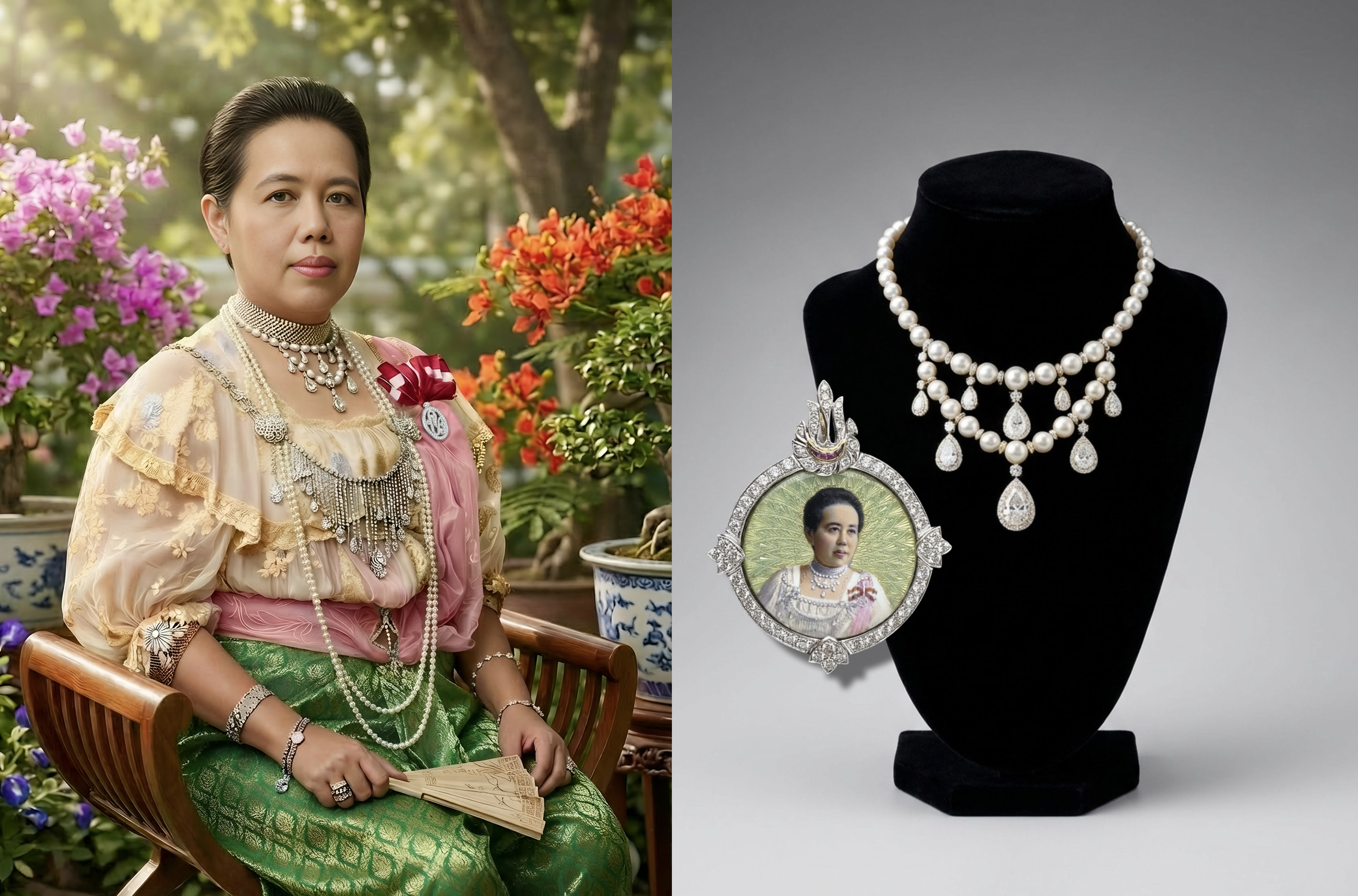
สมเด็จพระศรีพัชรินทราบรมราชินีนาถ และสร้อยพระศอมุกแบบสองชั้นประดับเพชรทรงหยดน้ำ
ภาพที่ได้รับการบูรณะและสร้างสรรค์ขึ้นด้วยเทคโนโลยี AI นี้ เป็นพระฉายาลักษณ์ของ สมเด็จพระศรีพัชรินทราบรมราชินีนาถ พระบรมราชชนนีพันปีหลวง เพื่อแสดงถึง สร้อยพระศอมุกแบบสองชั้นประดับเพชรทรงหยดน้ำ ซึ่งเป็นเครื่องประดับที่ทรงโปรด และทรงประดับในพระฉายาลักษณ์หลายองค์ โดยมีความแตกต่างเพียงในรายละเอียดของเครื่องประดับอื่นที่ทรงเลือกประดับเพิ่มเติมในแต่ละครั้ง
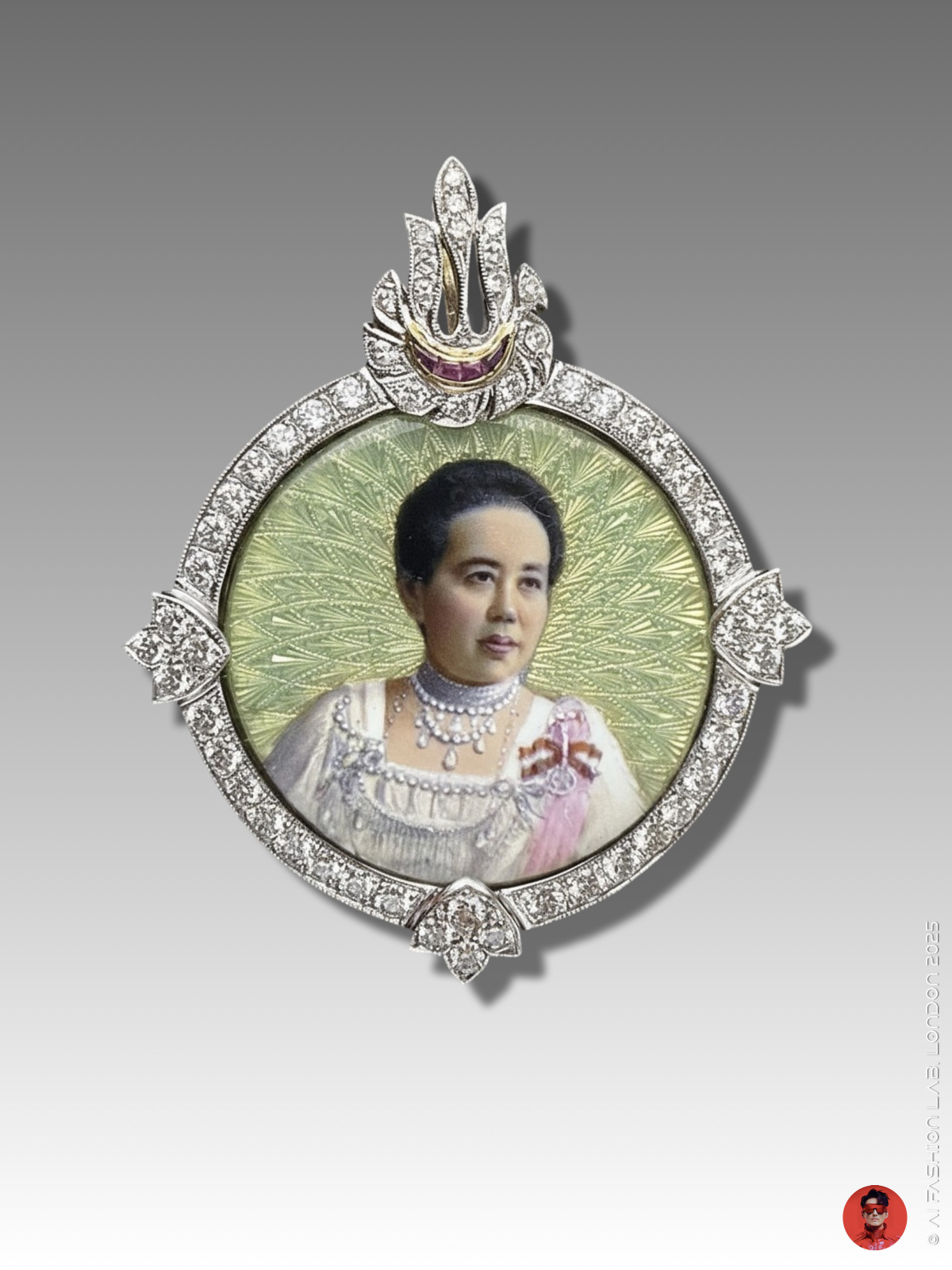
สร้อยพระศอมุกประดับเพชรทรงหยดน้ำองค์นี้ ยังปรากฏอยู่บน เข็มกลัดพระฉายาสาทิสลักษณ์แบบลงยาราชาวดี ล้อมด้วยกรอบเพชรอีกด้วย
พระฉายาลักษณ์ต้นฉบับทั้งสององค์ คาดว่าฉายขึ้นในช่วงปลายรัชกาลที่ ๕ ถึง ต้นรัชกาลที่ ๖ ระหว่างประมาณ พ.ศ. ๒๔๔๘–๒๔๕๘ (ค.ศ. 1905–1915) ซึ่งเป็นยุคที่ยังคงมีหลักฐานทางภาพถ่ายที่งดงามและสมบูรณ์หลงเหลืออยู่เป็นจำนวนมาก
ฉลองพระองค์ เป็นสไตล์ ลูกไม้แบบปลายยุคเอ็ดเวิร์ดเดียน (Late Edwardian) หรือช่วงต้นของ ยุคทีนส์ (Early Teens)ลักษณะเด่นคือ คอเสื้อต่ำและแขนเสื้อสามส่วน ประดับด้วยผ้าลูกไม้พาดคล้ายแพรสะพาย และมี ผ้าสไบลูกไม้พาดพระอังสาโดยติดเข็มกลัดบริเวณพระอุระด้านซ้าย แล้วปล่อยชายผ้าทิ้งยาวลงทางด้านขวา พระองค์ทรง นุ่งโจงกระเบน และทรงถือ ผ้าเช็ดพระพักตร์ลูกไม้ ซึ่งช่วยเสริมความอ่อนช้อยและงดงามให้กับองค์ประกอบโดยรวม
พระองค์ทรงประดับฉลองพระองค์ด้วย สร้อยพระศอมุกแบบสองชั้นประดับเพชรทรงหยดน้ำ ซึ่งปรากฏในพระฉายาลักษณ์ทั้งสององค์ พร้อมทั้งทรงสวมเครื่องประดับอันหลากหลาย เช่น สร้อยพระศอมุกเส้นยาว และ สร้อยพระศอเพชรซ้อนกันหลายเส้น ตามแบบนิยมในตะวันตก รวมถึง เข็มกลัดเพชร และ เครื่องประดับเพชรน้ำงามอีกหลายชิ้น อันสะท้อนถึง พระเกียรติยศและรสนิยมอันประณีตล้ำเลิศ ของสมเด็จพระบรมราชินีนาถในยุคนั้น
___________________
ความมั่งคั่งของสมเด็จพระศรีพัชรินทราบรมราชินีนาถนั้น นายแพทย์ประจำพระองค์ซึ่งเป็นแพทย์ชาวอังกฤษ ชื่อ นพ.มัลคาล์ม สมิธ ได้บันทึกถึงรายได้ของพระองค์ไว้ว่า
“...พระราชทรัพย์ที่มีอยู่อย่างมากมายของพระองค์ นอกเหนือจากเบี้ยหวัดเงินปีที่ทรงได้รับพระราชทานอยู่เป็นประจำแล้ว สมเด็จพระพันปีหลวงทรงมีรายได้ของพระองค์เองอีกส่วนหนึ่ง เป็นรายได้ที่เกิดจากพระราชทรัพย์ส่วนพระองค์ ซึ่งข้าพระเจ้าประมาณการจากที่พระองค์เคยตรัสไว้ให้ข้าพเจ้าฟังว่า รายได้ทั้งหมดเมื่อรวมกันแล้วน่าจะตกประมาณ 80,000-90,000 ปอนด์ต่อปี...”
ด้วยเหตุที่พระองค์ทรงเป็นอัครมเหสีที่ดำรงพระอิสริยยศเป็น “สมเด็จพระนางเจ้าพระบรมราชินีนาถ” เคยทรงว่าราชการในตำแหน่งผู้สำเร็จราชการแทนพระองค์ พระบาทสมเด็จพระจุลจอมเกล้าเจ้าอยู่หัว พระบรมราชสวามีถึงสองครั้งสองครา สมเด็จพระศรีพัชรินทราบรมราชินีนาถ จึงทรงมีเครื่องประดับอันงดงามและมีค่าสูงยิ่ง สำหรับทรงในโอกาสและวาระต่างๆ เป็นจำนวนมาก เช่น
ชุดเพชรลูกกลม เป็นลูกน้ำขาวแท้เม็ดใหญ่ เรียงรอบพระศอเหมือนเฟื่องระย้าซ้อนสองชั้น มีรัดเกล้ารูปดอกเบญจมาศเพชรสำหรับคาดรอบพระเศียร เข้าชุดกับเข็มกลัดดอกเบญจมาศระย้า เพชรใหญ่เป็นช่อมีสามดอกพระวลัยกรเพชรลายละเอียดโปร่งทั้งสองข้าง และพระธำมรงค์เพชรเข้าชุดกัน นอกจากนี้ยังทรงมีเครื่องประดับชุดใหญ่ๆ อีกจำนวนหนึ่ง คือ
ชุดเพชรรูปกลมขนาดใหญ่ เป็นสร้อยสังวาลเครื่องเพชรสามชั้น รอบพระศอเรียงกันตามลำดับเล็กใหญ่เป็นแถว สำหรับประดับเมื่อทรงเครื่องเต็มยศอย่างขัตติยนารี (สร้อยพระศอองค์นี้ คือ สร้อยเพรชแม่เศรษฐี อันเลื่องลือ)
ชุดเพชรรูปหยดน้ำ เป็นสร้อยพระศอระย้าเพชรสลับกับไข่มุกเม็ดใหญ่น้ำงาม โดยเม็ดเพชรน้ำหยดนั้นมีขนาดใหญ่เป็นพิเศษน้ำงามบริสุทธิ์มีกระบังเพชรรูปเพชรน้ำหยดกับไข่มุกเข้าชุดกัน ประกอบกับสร้อยสังวาลระย้าเพชรสลับไข่มุก มีรัศมีกว้างกระจายเต็มพระอุระ (ชุดนี้คือชุดเครื่องเพชรรูปหยดนำ้สลับมุก ในภาพประกอบ)
ชุดทับทิมเป็นทับทิมเนื้อพิเศษสุดสีแดงสด เจียระไนเป็นรูปหัวใจรูปเหลี่ยมรูปไข่ ประกอบลวดลายมงคลเพชรมีทั้งสร้อยพระศอสังวาลระย้าลายนกเพชรประกอบทับทิม กำไลต้นพระพาหา พระกุณฑล พระวลัยกร พระธำมรงค์ทับทิมมงคลเพชร เข็มรูปตัวแมลงหัวเข็มขัดประกอบทับทิมชั้นยอด
ชุดมรกต ประกอบด้วยมรกตสี่เหลี่ยมขนาดใหญ่ คุณภาพเยี่ยมน้ำเขียวขจีสดใส ทั้งสร้อยพระศอ พาหุรัดสวมต้นพระพาหา วลัยกรและพระธำมรงค์ เข้าชุดกับเข็มกลัดรูปต่างๆ อันเป็นมรกตประดับเพชรเป็นที่กล่าวกันว่ามรกตชุดนี้ เป็นอัญมณีมีค่ามีราคาสูงสุดในภูมิภาคตะวันออกเลยทีเดียว
เครื่องประดับชุดนิลอันมีค่า เป็นชุดนิลสีน้ำเงินเข้ม มงคลเพชร ประกอบด้วยก้านและลวดลายกนกเพชร มีนิลไพลินสีผักตบเป็นเครื่องประดับชุดไพลิน เป็นสร้อยสังวาลครบชุดวิจิตรตระการตามาก
นอกจากนี้ สมเด็จพระศรีพัชรินทราบรมราชินีนาถ ทรงรวบรวมไข่มุกไว้เป็นจำนวนมากหลายสีหลายขนาด ตั้งแต่ใหญ่ไปหาเล็ก เป็นสร้อยพระสังวาลเฟื่องไข่มุกเม็ดขนาดใหญ่สามชิ้น มีตุ้มเพชรห้อยเป็นระยะๆ จะทรงประกอบกับไข่มุกอื่นๆ ซึ่งมีทั้งไข่มุกสีกุหลาบอ่อน ไข่มุกสีเหลืองน้ำผึ้ง และไข่มุกคุณภาพเยี่ยมอีกจำนวนหนึ่ง
สมเด็จพระศรีพัชรินทราบรมราชินีนาถ ทรงโปรดปรานในเครื่องประดับอัญมณีเป็นอย่างยิ่ง นอกจากจะทรงได้รับพระราชทานเป็นของขวัญของฝากจากพระบาทสมเด็จพระจุลจอมเกล้าเจ้าอยู่หัว พระบรมราชสวามี ซึ่งจะเห็นได้ว่าทุกครั้งที่เสด็จประพาสต่างประเทศจะทรงเอาพระทัยใส่ หาอัญมณีมีค่าสุดกลับมาฝากและพระราชทานพระอัครมเหสีอยู่เสมอมิได้ขาด ไม่นับรวมกับที่สมเด็จพระศรีพัชรินทราบรมราชินีนาถ ทรงสะสมซื้อหามาด้วยพระราชทรัพย์ส่วนพระองค์ และมีผู้สรรมาทูลเกล้าฯ ถวาย และยังทรงได้รับเป็นของขวัญจากประมุขประเทศต่างๆ เช่น มงกุฎหรือรัดเกล้าเพชรจากเอมเปรสแห่งรัสเซีย หรือวลัยกรนิลน้ำงามมงคลเพชรจากเอ็มเปรสแห่งอิตาลี
เครื่องประดับอัญมณีอันมีค่ามากมายมหาศาลของสมเด็จพระศรีพัชรินทราบรมราชินีนาถ ที่อยู่ในความรับผิดชอบดูแลรักษาของ เจ้าจอม ม.ร.ว.แป้ม มาลากุล นั้น พระเจ้าวรวงศ์เธอพระองค์เจ้าจุลจักรพงษ์ ทรงเล่าไว้ในพระนิพนธ์เรื่องเกิดวังปารุสก์ว่า
“...ถ้าจะเสด็จไปงานใด ข้าหลวงจะต้องเอาเครื่องเพชรของท่านมาถวายทั้งหมดให้ทรงเลือก นอกจากเครื่องใหญ่จริงๆ ซึ่งไม่มีเก็บไว้ที่วังพญาไท เพราะเครื่องชุดใหญ่ๆ นั้น เก็บรักษาไว้ที่ในพระบรมมหาราชวัง ถึงกระนั้นเครื่องย่อยๆ ของท่านก็ดูคล้ายๆ กับร้านขายเครื่องเพชรร้านใหญ่ๆ ในมหานครหลวงในยุโรป ข้าหลวงต้องขนมาเป็นถาดๆ หลายๆ ถาด บางทีถาดเดียวจะมีแต่ธำมรงค์เพชรพลอยต่างๆ ตั้ง 60 วง"
___________________
นอกจากนี้ เครื่องเพชรที่ทรงสวมใส่ยังแสดงให้เห็นถึง อิทธิพลของศิลปะแบบเอ็ดเวิร์เดียนและอาร์ตนูโว (Edwardian and Art Nouveau style jewellery) ซึ่งเน้นความอ่อนช้อยของเส้นสายและแรงบันดาลใจจากธรรมชาติ พระองค์ทรงเลือกเครื่องเพชรในรูปแบบที่เป็นที่นิยมในยุคนั้น เช่น
1. สร้อยพระศอมุกแบบ Sautoir — สร้อยมุกเส้นยาวที่มักประดับพู่ห้อยปลาย
2. สร้อยพระศอเพรชแบบ Lavalier — สร้อยเพชรมีจี้ห้อยระย้าอันยาวและประณีต
3. และ เครื่องประดับลายดอกไม้ ใบไม้ และกลีบดอก (floral and leaf motifs) ซึ่งเป็นเอกลักษณ์ของศิลปะแบบอาร์ตนูโวที่กำลังรุ่งเรืองในช่วงต้นคริสต์ศตวรรษที่ ๒๐
ความสง่างามในยุคเอ็ดเวิร์เดียน และ La Belle Époque
ในยุโรป ยุคเอ็ดเวิร์เดียนเป็นที่รู้จักกันในนามว่า La Belle Époque ซึ่งเป็นช่วงเวลาแห่งความมั่งคั่ง ความหรูหรา และความรื่นรมย์ของชนชั้นสูง ภายใต้การนำของ สมเด็จพระเจ้าเอ็ดเวิร์ดที่ ๗ (King Edward VII) ผู้ทรงโปรดปรานความฟุ่มเฟือยและรสนิยมทางศิลปะอันหรูหรา
แม้รัชสมัยของพระองค์จะสั้น แต่ก็เต็มไปด้วยความเจิดจรัส พระองค์ทรงมีชื่อเสียงในฐานะ กษัตริย์ผู้รักความสนุกและการละเล่น (light-hearted, gambling playboy) และรสนิยมแห่งความหรูหรานี้เองที่มีอิทธิพลอย่างมากต่อโลกแห่งแฟชั่นและอัญมณี
ในช่วงเวลานั้น พระเจ้าเอ็ดเวิร์ดทรงจัดพระราชพิธีบรมราชาภิเษกอันยิ่งใหญ่ โดยมีพระราชวงศ์และชนชั้นสูงจากทั่วโลกมาร่วมงาน ต่างแข่งขันกันแต่งกายให้สง่างามที่สุด นอกจากนี้ยังทรงจัดงานเลี้ยงเต้นรำและงานสังคมราตรี (soirées) อันหรูหราอย่างต่อเนื่อง ส่งผลให้เกิดความต้องการเครื่องประดับอันวิจิตรเพิ่มขึ้นอย่างมหาศาล ในหมู่ชนชั้นสูง การแสดงออกถึงฐานะและความมั่งคั่งผ่านเครื่องเพชรพลอยถือเป็นเรื่องปกติ — และไม่มีสิ่งใดจะสะท้อนยุคสมัยนั้นได้ชัดเจนเท่า “เครื่องเพชรสไตล์เอ็ดเวิร์เดียน” ซึ่งผสานทั้งความหรูหรา ความละเอียด และความอ่อนช้อยไว้ในชิ้นเดียวกัน
___________________
คาร์เทียร์: ช่างอัญมณีแห่งราชสำนักเอ็ดเวิร์เดียน
คาร์เทียร์ (Cartier) ก่อตั้งขึ้นในช่วงกลางคริสต์ศตวรรษที่ ๑๙ และได้รับการยอมรับอย่างสูงในช่วงต้นคริสต์ศตวรรษที่ ๒๐ จนกลายเป็นสัญลักษณ์แห่งนวัตกรรมและความประณีตสูงสุดของยุโรป แบรนด์ยิ่งมีชื่อเสียงมากขึ้นเมื่อได้รับการแต่งตั้งให้เป็น ช่างอัญมณีประจำราชสำนักของสมเด็จพระเจ้าเอ็ดเวิร์ดที่ ๗ ซึ่งทรงขนานนามคาร์เทียร์ว่า “The jeweller of kings and the king of jewellers” — “ช่างอัญมณีแห่งกษัตริย์ และกษัตริย์แห่งช่างอัญมณี”
คาร์เทียร์มีแนวทางที่เน้นทั้งความงามเชิงแฟชั่นและเทคนิคเชิงช่างขั้นสูง โดยเป็นผู้บุกเบิกการนำ โลหะแพลทินัม (Platinum) มาใช้ในงานอัญมณี ซึ่งทำให้สามารถสร้างเครื่องเพชรที่มีโครงสร้างบางเบาและซับซ้อนอย่างที่ไม่เคยมีมาก่อน เกิดเป็นกระแสแฟชั่นที่เรียกว่า “White on White” — การผสมผสานระหว่างเพชรและแพลทินัมที่ขาวบริสุทธิ์ กลายเป็นเอกลักษณ์ของยุคเอ็ดเวิร์เดียนตั้งแต่ต้นคริสต์ศตวรรษที่ ๒๐ จนถึงการเริ่มต้นของสงครามโลกครั้งที่ ๑ ในปี ค.ศ. 1914
อิทธิพลของคาร์เทียร์ขยายไปไกลเกินยุโรป — ในระหว่างการเสด็จประพาสยุโรปของ พระบาทสมเด็จพระจุลจอมเกล้าเจ้าอยู่หัว พระองค์ได้ทรงซื้อเครื่องเพชรจากคาร์เทียร์ เพื่อพระราชทานแด่ สมเด็จพระศรีพัชรินทราบรมราชินีนาถ เครื่องประดับเหล่านี้ไม่เพียงแสดงถึงพระราชนิยมในศิลปะตะวันตก แต่ยังสะท้อนให้เห็นถึง การเปิดรับวัฒนธรรมโลกและรสนิยมร่วมสมัยของราชสำนักสยามในยุค La Belle Epoque อีกด้วย
___________________
วัสดุและเทคนิค (Materials & Techniques)
เครื่องเพชรในยุคเอ็ดเวิร์เดียนมีลักษณะ อ่อนช้อย งดงาม และประณีตละเอียดลออ ผลิตโดยช่างอัญมณีฝีมือชั้นสูงที่ให้ความสำคัญกับความคงทนและความประณีตมากกว่าการผลิตด้วยเครื่องจักร ถือเป็น การหวนคืนสู่ความเป็นงานศิลป์ทำมือ หลังยุคอุตสาหกรรม
แรงบันดาลใจสำคัญมาจากศิลปะจากศตวรรษที่ ๑๘ โดยเฉพาะลวดลายแบบ โบว์ พวงดอกไม้ ริบบิ้น และลูกไม้ (bows, garlands, ribbons, and lace) ซึ่งสะท้อนความโรแมนติกแบบเฟมินีนที่สังคมสมัยนั้นชื่นชม
แพลทินัม เป็นโลหะที่ได้รับความนิยมสูงสุด เนื่องจากมีความแข็งแรงพอสำหรับสร้างสรรค์เครื่องเพชรแบบบางเบาและซับซ้อนอย่างเครื่องเพชร “ลูกไม้เพชร” (lace jewellery) ที่เข้ากันได้ดีกับ เฉดสีพาสเทลของแฟชั่นสตรีในยุคนั้น
หลังจากการก่อตั้งบริษัท De Beers Consolidated Mines Ltd. ในปี ค.ศ. 1888 เพชรกลายเป็นอัญมณีที่หาได้ง่ายขึ้น และมีการพัฒนาเทคนิคการเจียระไนรูปแบบใหม่ ๆ อย่างต่อเนื่องในชิ้นเดียวกัน อย่างไรก็ตาม ไข่มุก (pearls) ยังคงเป็นสัญลักษณ์สูงสุดของความมั่งคั่ง เพราะในขณะนั้นมีมูลค่าสูงกว่าเพชร การประดับไข่มุกและเพชรร่วมกันจึงถือเป็นยอดแห่งรสนิยม
___________________
เทคนิคตกแต่งยอดนิยมในยุคนั้น ได้แก่
1. Invisible setting — เทคนิคที่ทำให้เพชรดูราวกับลอยอยู่บนผิวกาย
2. Filigree setting — การขึ้นลายลูกไม้ด้วยเส้นโลหะขนาดเล็กและเม็ดโลหะละเอียด
3. Millegrain technique — การประดับขอบเพชรด้วยเม็ดโลหะละเอียดเป็นจุดเล็ก ๆ ทำให้เครื่องเพชรดูนุ่มนวลและมีมิติ
สร้อยคอและรูปแบบการประดับ (Necklaces and Adornment)
เมื่อแนวคอเสื้อของสตรีเริ่มเปิดมากขึ้นหลังยุควิกตอเรียน เครื่องประดับและสร้อยคอจึงกลายเป็นส่วนสำคัญของแฟชั่นในสังคมชั้นสูง โดยมีหลายรูปแบบที่ได้รับความนิยม เช่น
1. Colliers de chien (Dog Collars) — สร้อยคอแบบช็อกเกอร์ทำจากริบบิ้น ประดับเข็มกลัดหรืออัญมณี
2. Chokers — สร้อยมุกหลายเส้นร้อยชิดลำคอ
3. Sautoirs — สร้อยมุกหรือสร้อยลูกปัดเส้นยาว มักมีพู่ระย้าที่ปลายทั้งสองด้าน ห้อยยาวต่ำกว่าเอว
4. Lavalier — สร้อยเพชรมีจี้ห้อยระย้าอันยาวและประณีต
คาร์เทียร์ ยังได้ออกแบบสร้อยคอแบบ Lavalier สองชั้น (Double-Pendant Lavalier) ซึ่งต่อมารู้จักกันในชื่อ Négligée Necklace ตามชื่อนักแสดงหญิงชาวฝรั่งเศส เอฟ ลาวาลิแยร์ (Ève Lavallière) ส่วนแบรนด์ บูเชรอง (Boucheron) มีแบบอันเป็นเอกลักษณ์คือสร้อยมุกคั่นเพชรที่ออกแบบโดย ปอล เลอกรองด์ (Paul LeGrand)
อย่างไรก็ตาม เมื่อสงครามโลกครั้งที่ ๑ ปะทุขึ้นในปี ค.ศ. 1914 วัสดุมีค่าทั้งหมดรวมถึงแพลทินัมถูกนำไปใช้ในอุตสาหกรรมสงคราม ความหรูหราและความฟุ้งเฟ้อของยุคเอ็ดเวิร์เดียนจึงสิ้นสุดลง — นับเป็นการปิดฉาก “ยุคแห่งความรื่นรมย์ของโลกตะวันตก (The Hedonistic Edwardian Era)” อย่างสมบูรณ์
___________________
Her Majesty Queen Saovabha Phongsri and the Double-Strand Pearl Necklace with Diamond Teardrop Pendants
This AI-restored and imaginatively re-created image presents Queen Saovabha Phongsri, Her Majesty the Queen Mother of Siam, with particular emphasis on one of her most favoured jewels: a double-strand pearl necklace adorned with diamond teardrop pendants. This necklace appears repeatedly in her photographic portraits, differing only in the accompanying jewels she chose to wear on each occasion.
The same pearl-and-diamond motif is also seen on her enamelled miniature portrait brooch, executed in royal champlevé enamel and framed by diamonds—further evidence of how this design language permeated her personal jewellery collection.
The original photographs on which these restorations are based are believed to date from the early reign of King Rama VI, approximately B.E. 2454–2458 (1911–1915)—a period remarkably rich in surviving photographic records of exceptional quality.
Dress and Silhouette: Late Edwardian / Early Teens Fashion
Her Majesty’s attire reflects late Edwardian or Early Teens (c. 1911–1915) fashion. The defining features include a lower neckline and three-quarter-length sleeves, richly decorated with lace. A lace panel is draped diagonally across the bodice like a sash, complemented by a lace shoulder drape (sabai-style) fastened with a brooch at the left side of the chest, with the fabric cascading down the right side.
She wears a chong kraben, and holds a lace handkerchief, lending softness and grace to the overall composition. The ensemble is completed with a layered arrangement of jewels: the double-strand pearl necklace with diamond teardrop pendants, long pearl strands, and multiple diamond necklaces worn in succession, following contemporary Western fashion. Diamond brooches and other fine jewels underscore both her royal status and her exceptionally refined taste.
The Wealth of Queen Saovabha Phongsri and Her Jewellery Collection
The extraordinary wealth of Queen Saovabha Phongsri, Queen Mother of Siam, was recorded by her personal physician, the British doctor Malcolm Smith, who noted her income as follows:
“…In addition to the substantial annual allowance regularly granted to Her Majesty, the Queen Mother possessed a further source of personal income derived from her own private estates. From what Her Majesty herself once told me, I estimate that her total income amounted to approximately £80,000–£90,000 per annum…”
By virtue of her position as Queen Consort bearing the title “Her Majesty the Queen”, and having twice served as Regent on behalf of her royal consort King Chulalongkorn, Queen Saovabha Phongsri possessed an exceptionally vast and precious jewellery collection, intended for wear on a wide range of ceremonial and court occasions. Among the most notable sets were:
The Large Round Diamond Suite
A necklace of large, colourless diamonds arranged in two radiating tiers around the neck, accompanied by a diamond chrysanthemum-shaped headdress worn encircling the head. The suite was completed with a cascading chrysanthemum diamond brooch, diamond bracelets with delicate openwork on both sides, and matching diamond rings.The Three-Tier Diamond Necklace
A magnificent sangwan necklace composed of three graduated rows of large round diamonds encircling the neck, worn with full court dress as a royal lady of the highest rank. This celebrated jewel is known as the legendary “Mae Setthi” diamond necklace.The Teardrop Diamond and Pearl Suite
A radiating necklace of exceptionally large, pure teardrop-shaped diamonds alternating with fine-quality pearls. The diamonds and pearls were mounted in matching pendants and combined with a broad, spreading sangwan necklace covering the entire upper chest. This is the teardrop diamond and pearl suite illustrated in the accompanying image.The Ruby Suite
Featuring rubies of exceptional quality and vivid red colour, cut into heart, oval, and geometric forms, combined with auspicious diamond motifs. The set included a cascading ruby-and-diamond necklace with bird motifs, bracelets, earrings, bangles, rings, and a ruby-set brooch and belt buckle of the finest craftsmanship.The Emerald Suite
Composed of large square-cut emeralds of outstanding quality and vivid green hue, including necklaces, upper-arm ornaments, bracelets, rings, and brooches framed with diamonds. This emerald collection was reputed to be the most valuable emerald set in the entire Eastern region.The Dark Sapphire (Nil) and Blue Sapphire Suite
A precious set of deep-blue sapphires combined with diamonds, featuring scrolling and kanok-inspired motifs. The collection also included cornflower-blue sapphires mounted as a complete and highly ornate sangwan suite.The Pearl Collection
Queen Saovabha amassed an extensive collection of pearls in many sizes and colours, from very large to small. Among these were grand pearl sangwan necklaces composed of three exceptionally large pearls with diamond drops at intervals, worn in combination with other pearls, including blush-pink pearls, honey-yellow pearls, and numerous pearls of the highest quality.
Royal Taste and the Care of the Jewels
Queen Saovabha Phongsri had a profound love of fine jewellery. In addition to jewels presented to her by King Chulalongkorn—who, on every overseas journey, took great care to acquire precious gems to present to his Queen—she also personally purchased jewels with her own private funds. Many pieces were offered to her in tribute, while others were received as diplomatic gifts from foreign sovereigns, such as a diamond crown or tiara from the Empress of Russia, and a sapphire-and-diamond bracelet from the Empress of Italy.
The vast and invaluable jewellery collection of Queen Saovabha Phongsri was entrusted to the care of Mom Chao M.R.V. Paem Malakul, and its splendour was vividly recalled by Prince Chula Chakrabongse in his memoir Born in the Palace (Koet Wang Parusk), where he wrote:
“…Whenever she was to attend an event, the ladies-in-waiting would bring out all her jewels for her to choose from, except for the truly major pieces, which were not kept at Phaya Thai Palace but stored in the Grand Palace. Even so, her lesser jewels alone resembled the stock of a great jewellery house in a European capital. The attendants had to carry them out on tray after tray—sometimes a single tray would contain no fewer than sixty rings set with diamonds and precious stones.”
Together, these accounts offer a rare and vivid insight into the immense wealth, refined taste, and international stature of Queen Saovabha Phongsri, whose jewellery collection stood among the most magnificent of any royal court of her time.
Edwardian and Art Nouveau Jewellery Influences
The jewellery worn by Her Majesty reveals a strong affinity with Edwardian and Art Nouveau design, characterised by fluid lines and naturalistic inspiration. Favoured forms of the period—also reflected in her collection—include:
Sautoir necklaces — long pearl strands, often finished with tassels
Lavalier necklaces — delicate diamond necklaces with elongated, articulated pendants
Floral and leaf motifs — hallmarks of Art Nouveau, celebrating nature and femininity
Edwardian Elegance and La Belle Époque
In Europe, the Edwardian era is widely associated with La Belle Époque—an age of prosperity, luxury, and social pleasure among the elite, under the influence of King Edward VII. Although his reign was brief, it was marked by splendour and exuberance. Renowned for his love of entertainment and high society, Edward VII’s tastes profoundly shaped fashion and jewellery across Europe.
Grand coronations, glittering soirées, and lavish balls created immense demand for exquisite jewels. Displaying wealth and status through diamonds and pearls was not merely accepted but expected—nothing encapsulated the spirit of the age more perfectly than Edwardian jewellery, where opulence met technical finesse and airy elegance.
Cartier: Jeweller of the Edwardian Courts
Founded in the mid-19th century, Cartier rose to prominence in the early 20th century and became synonymous with innovation and supreme craftsmanship. Its reputation was sealed when Edward VII appointed Cartier Jeweller to the Royal Court, famously declaring it “the jeweller of kings and the king of jewellers.”
Cartier pioneered the use of platinum, enabling structures of unprecedented delicacy and complexity. This innovation led to the iconic “white on white” aesthetic—diamonds set in platinum—defining Edwardian jewellery from the early 1900s until the outbreak of the First World War in 1914.
Cartier’s influence extended far beyond Europe. During his European travels, King Chulalongkorn acquired jewels from Cartier as royal gifts for Queen Saovabha Phongsri. These pieces symbolised not only royal favour, but also Siam’s engagement with global culture and modern taste during La Belle Époque.
Materials and Techniques
Edwardian jewellery is distinguished by its lightness, intricacy, and artisanal quality, reflecting a return to hand craftsmanship after the Industrial Revolution. Designers drew inspiration from 18th-century ornament—bows, garlands, ribbons, and lace—expressing a romantic, feminine ideal.
Platinum became the metal of choice for its strength and subtle colour, ideal for creating lace-like diamond jewellery that harmonised with the pastel hues of women’s fashion.
Following the establishment of De Beers in 1888, diamonds became more accessible, and cutting techniques rapidly evolved. Nevertheless, pearls remained the ultimate symbol of wealth, often valued more highly than diamonds at the time. The pairing of pearls with diamonds thus represented the pinnacle of refined taste.
Popular techniques included:
Invisible setting — stones appearing to float without visible mounts
Filigree — intricate openwork using fine metal threads
Millegrain — tiny beaded edges softening the brilliance of diamonds
Necklines and Necklace Styles
As women’s necklines lowered after the Victorian era, necklaces assumed a central role in high-society fashion. Favoured styles included:
Colliers de chien (dog collars) — ribbon chokers adorned with jewels
Chokers — multiple strands of pearls worn close to the neck
Sautoirs — long pearl or bead necklaces, often with tassels, extending below the waist
Lavalier necklaces — elegant diamond pendants suspended from fine chains
Cartier developed the double-pendant Lavalier, later known as the Négligée necklace, named after the French actress Ève Lavallière. Meanwhile, Boucheron became renowned for pearl-and-diamond designs by Paul LeGrand.
The End of an Era
With the outbreak of the First World War in 1914, precious materials—particularly platinum—were diverted to military use. The opulence and indulgence of the Edwardian world abruptly faded, bringing a definitive close to what historians often describe as “the hedonistic Edwardian era.”
In this context, the jewels worn by Queen Saovabha Phongsri stand not merely as ornaments, but as enduring witnesses to a moment when Siamese royal elegance intersected seamlessly with the most sophisticated artistic expressions of the Western world.
___________________
เรียนเชิญกด Subscribe ได้ที่ลิงก์นี้ครับ เพื่อร่วมติดตามงานสร้างสรรค์ต้นฉบับ งานวิจัยประวัติศาสตร์แฟชั่น และผลงานอนุรักษ์มรดกวัฒนธรรมด้วยเทคโนโลยี AI ของ AI Fashion Lab, London ซึ่งมุ่งตีความอดีตผ่านมิติใหม่ของการบูรณะภาพ การสร้างสรรค์ภาพ และการเล่าเรื่องด้วยศิลปะเชิงดิจิทัล 🔗 https://www.facebook.com/aifashionlab/subscribe/
#aifashionlab #AI #aiartist #aiart #aifashion #aifashiondesign #aifashionstyling #aifashiondesigner #fashion #fashionhistory #historyoffashion #fashionstyling #fashionphotography #digitalfashion #digitalfashiondesign #digitalcostumedesign #digitaldesign #digitalaiart #ThaiFashionHistory #ThaiFashionAI #thailand #UNESCO