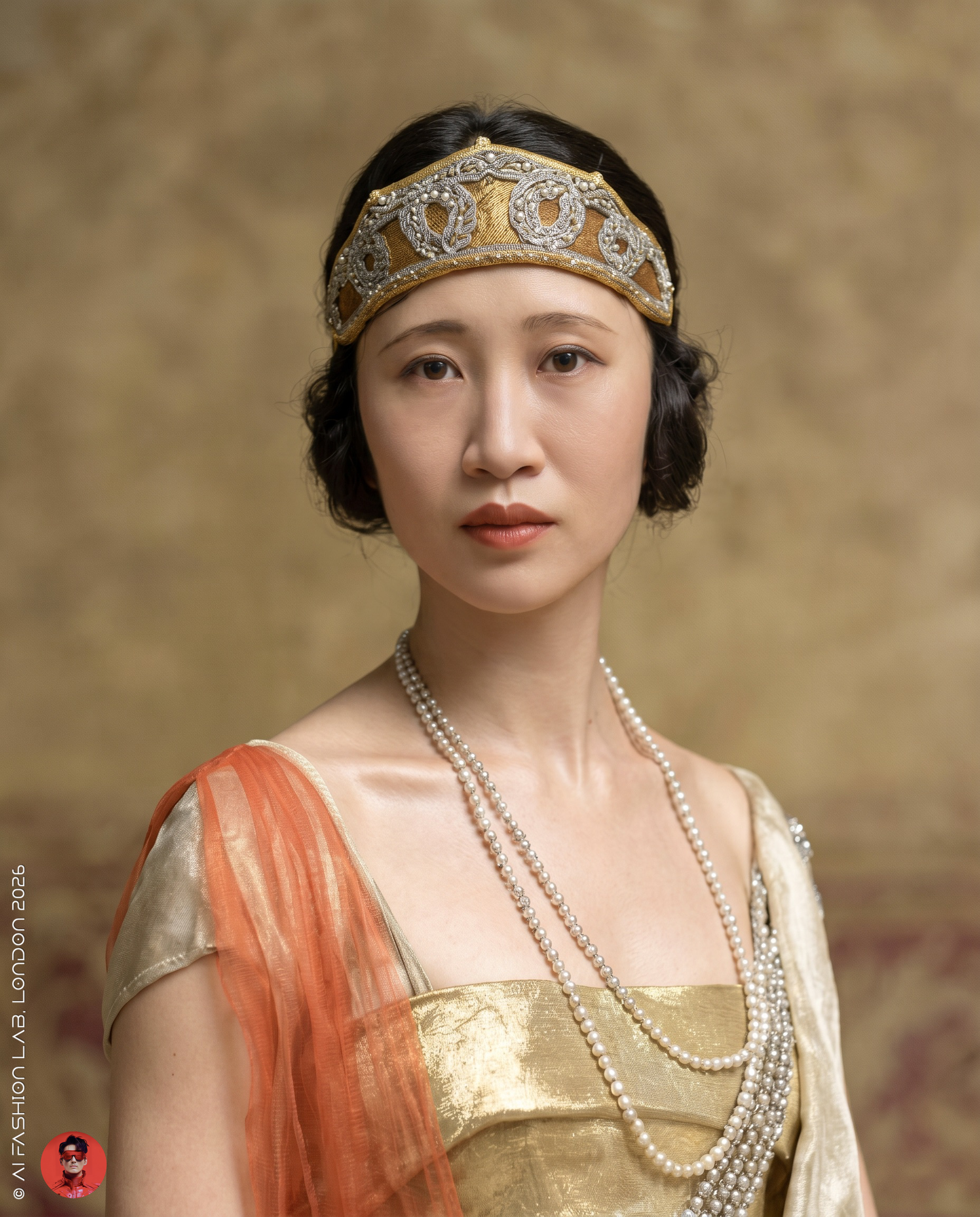
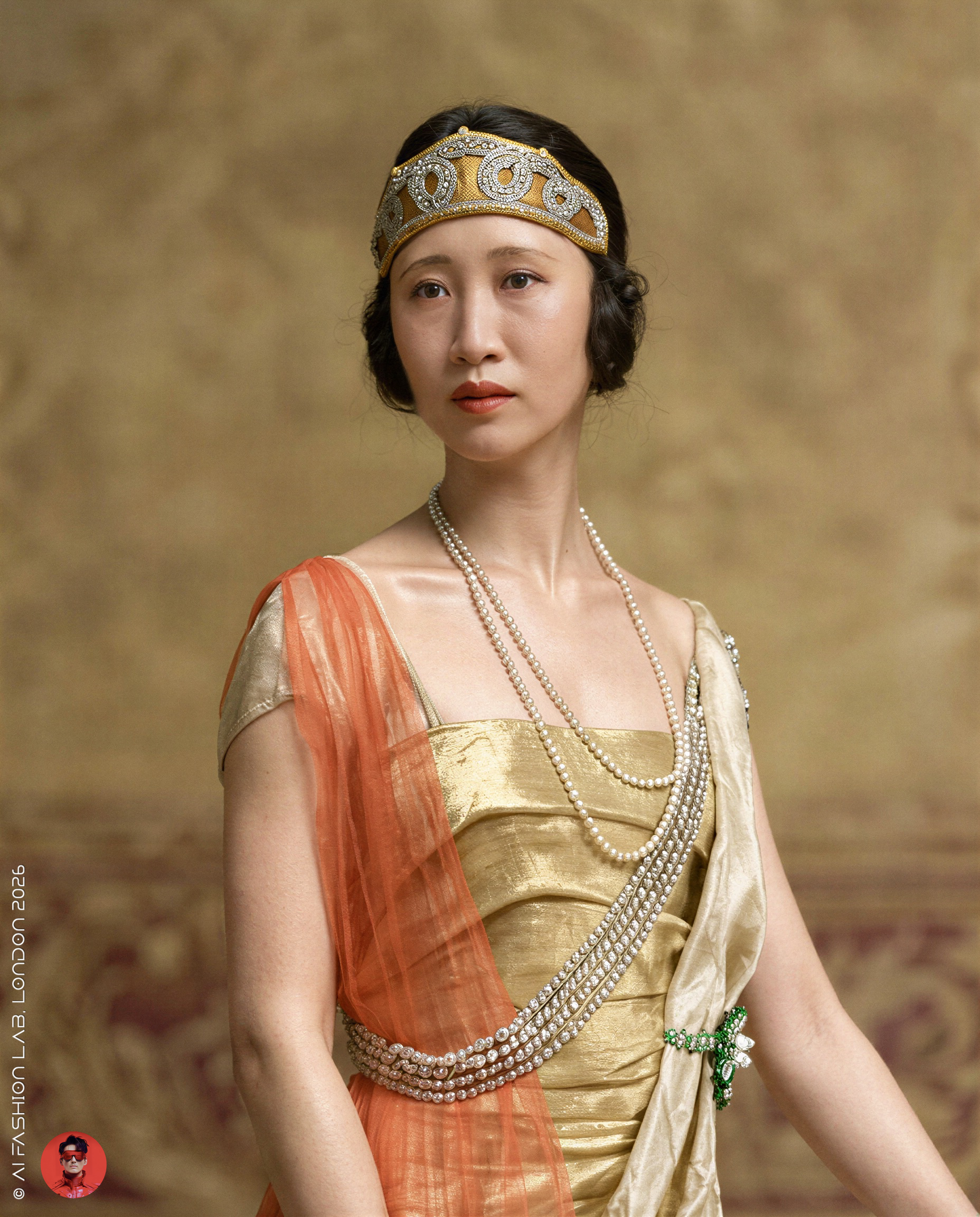
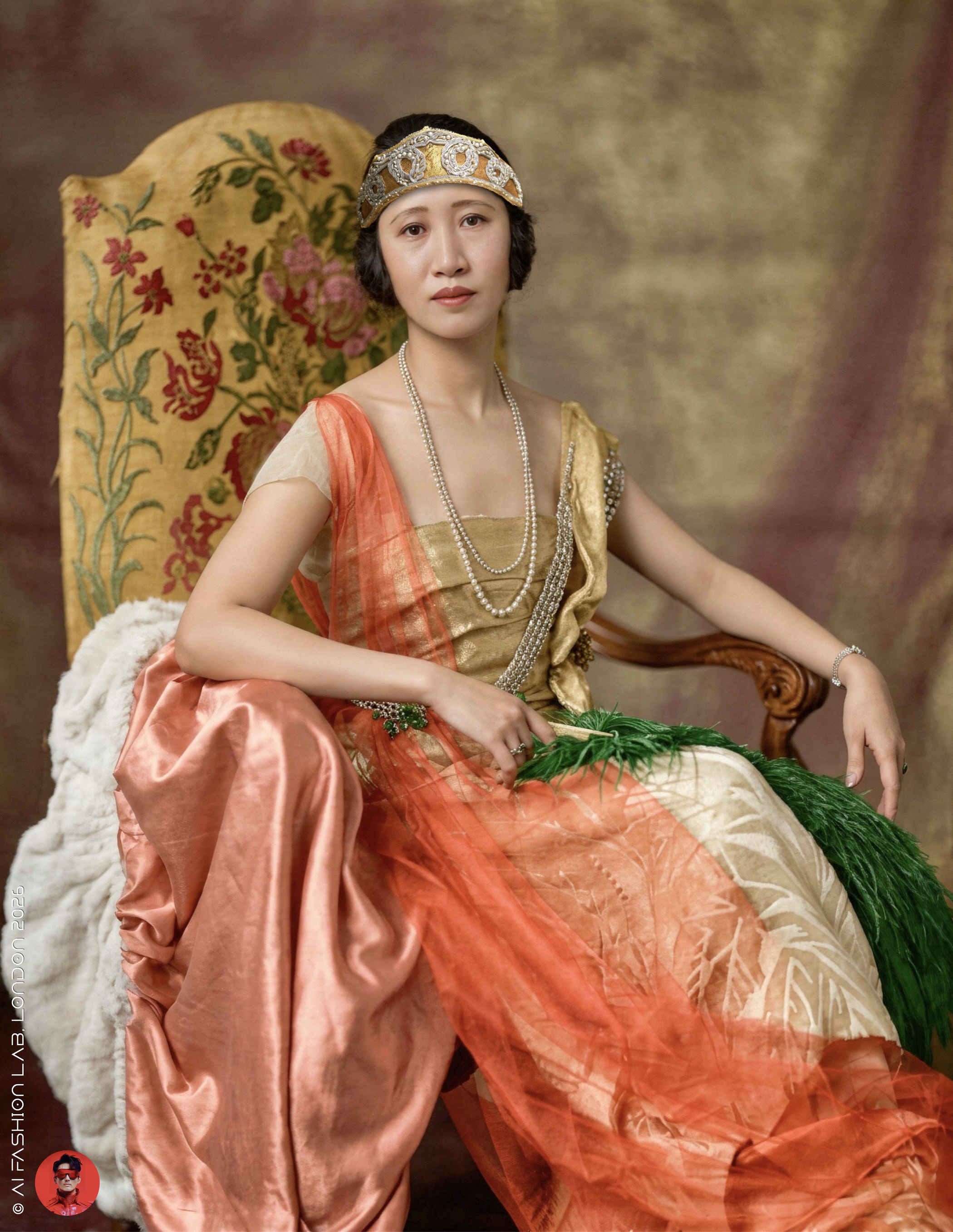
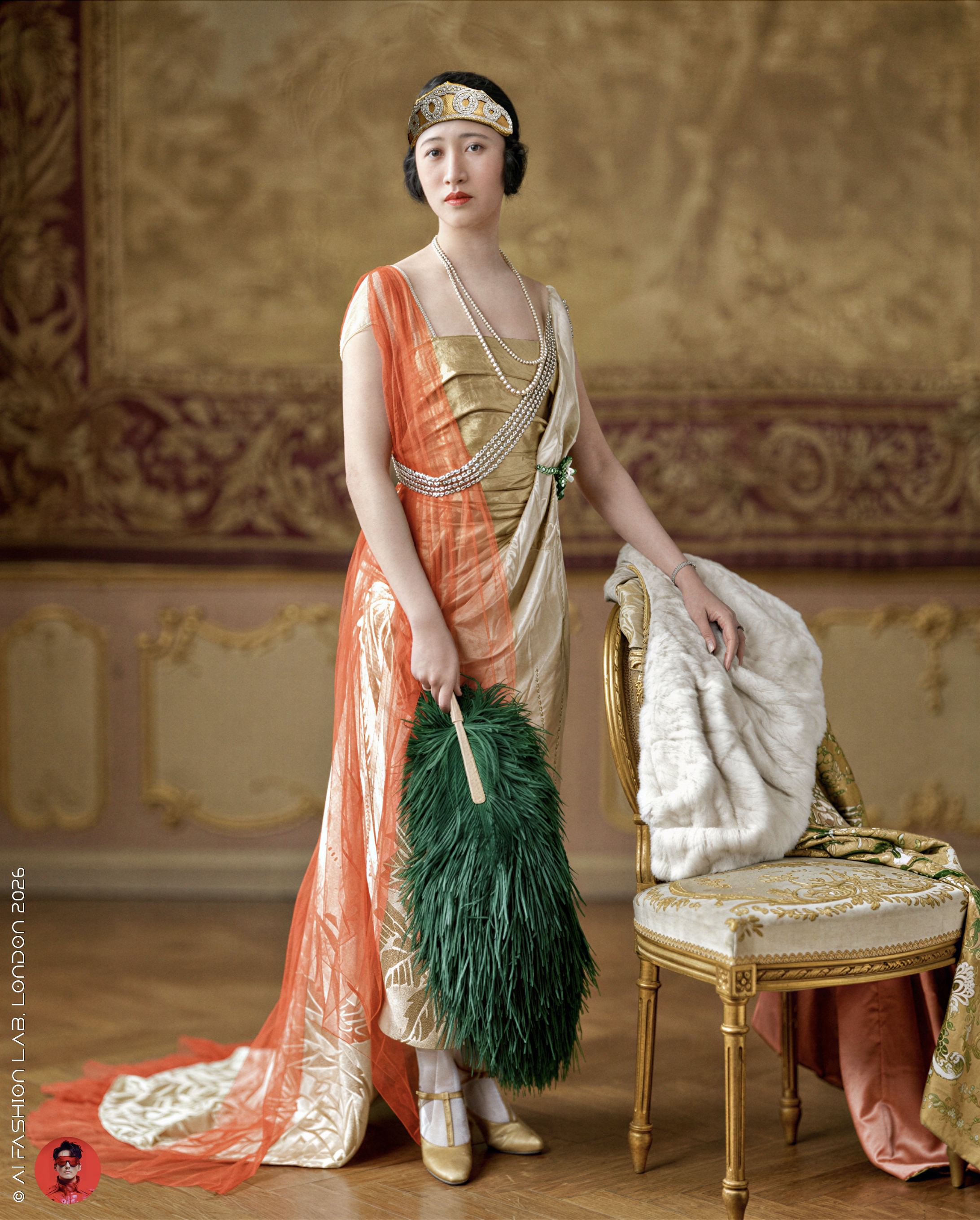
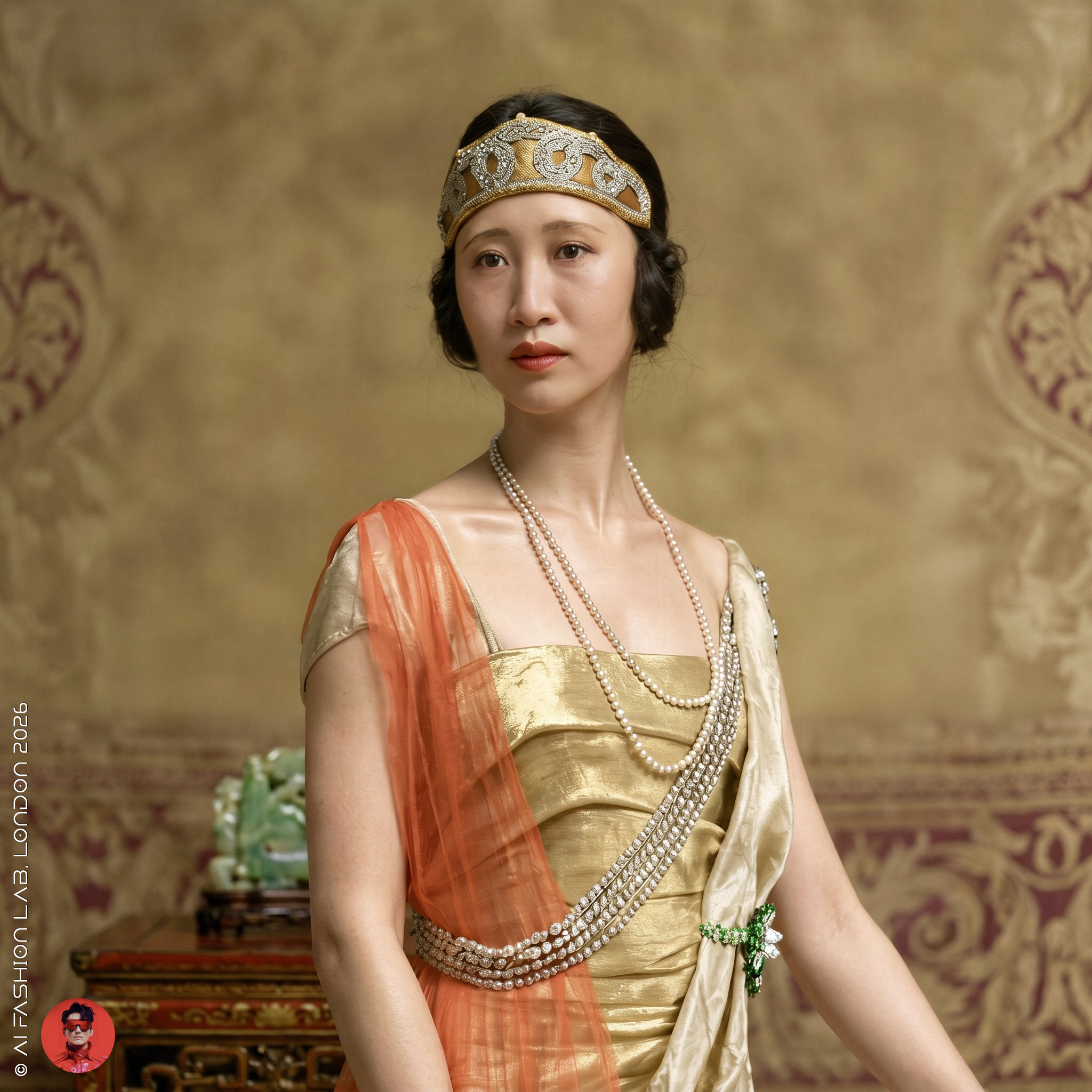
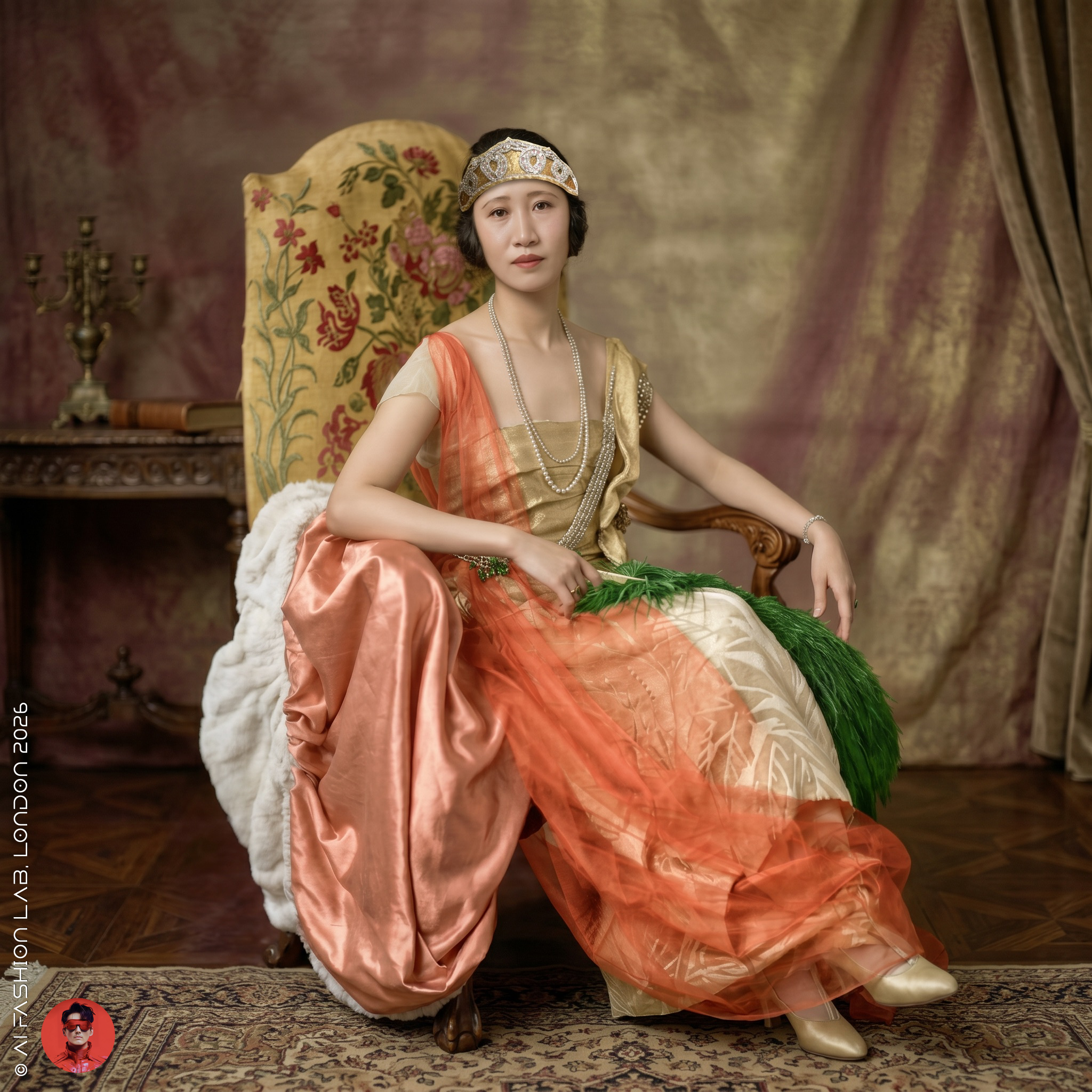
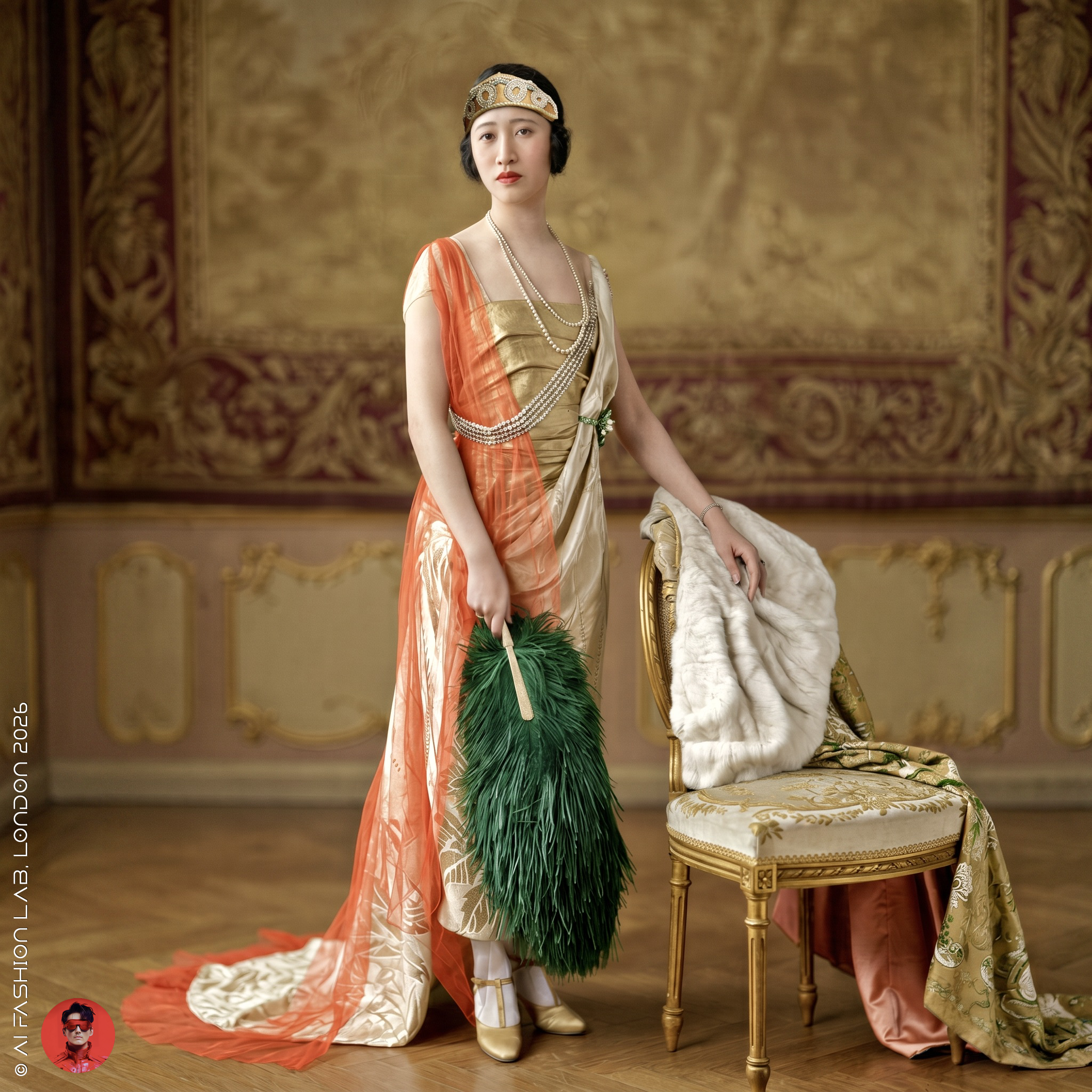
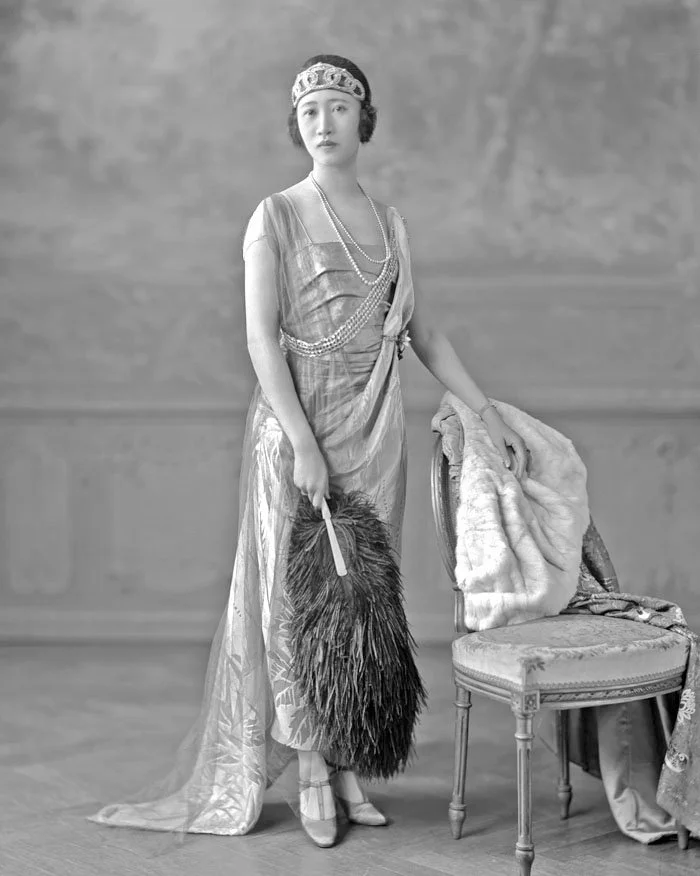
รัดเกล้าปักดิ้นเงินบนผ้ายก: ศิราภรณ์แบบ Bandeau ของมาดามเวลลิงตัน คู: ลอนดอน, ค.ศ. 1921
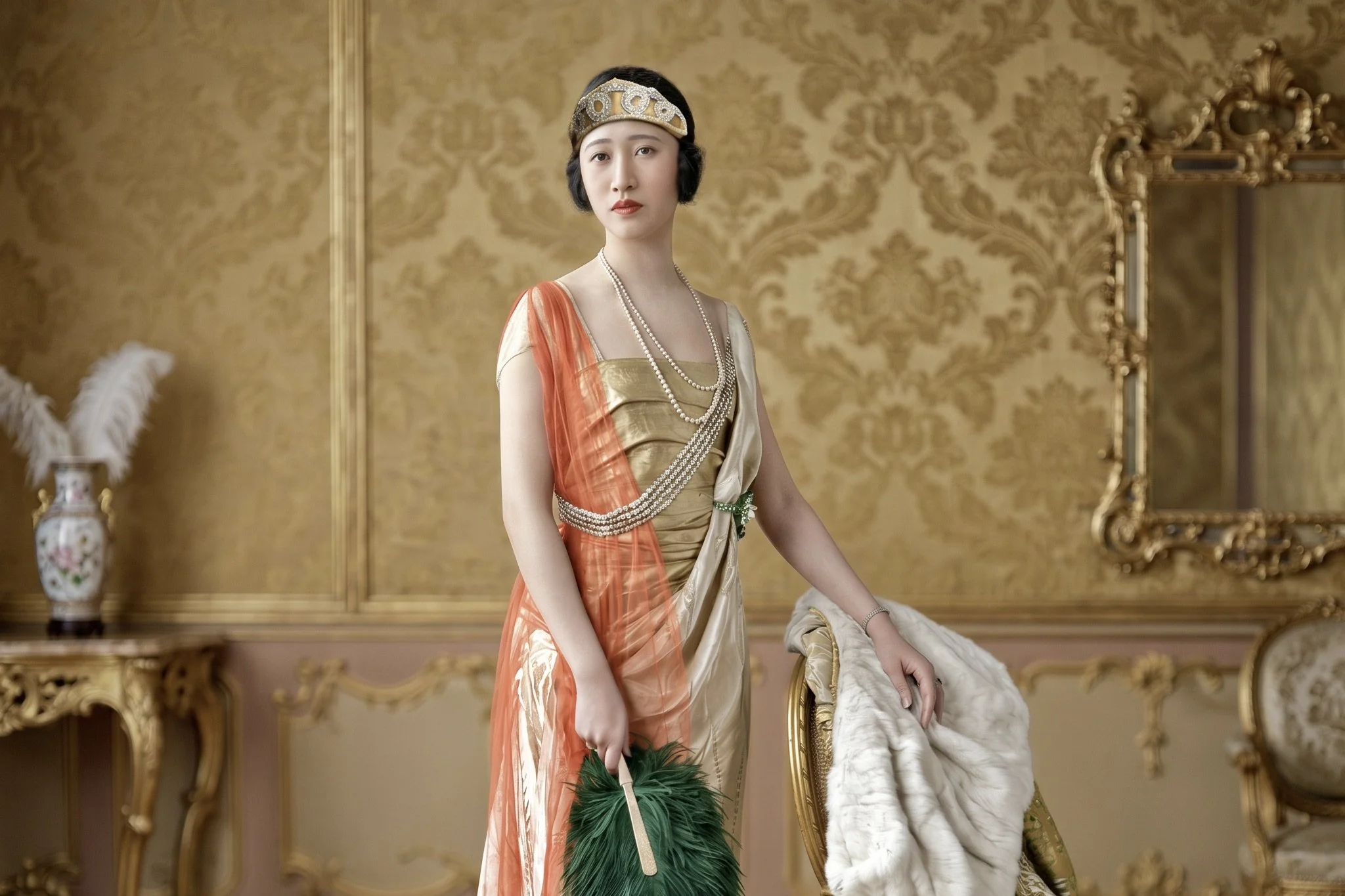
รัดเกล้าปักดิ้นเงินบนผ้ายก: ศิราภรณ์แบบ Bandeau ของมาดามเวลลิงตัน คู
ลอนดอน, ค.ศ. 1921 🇬🇧🏛️📸
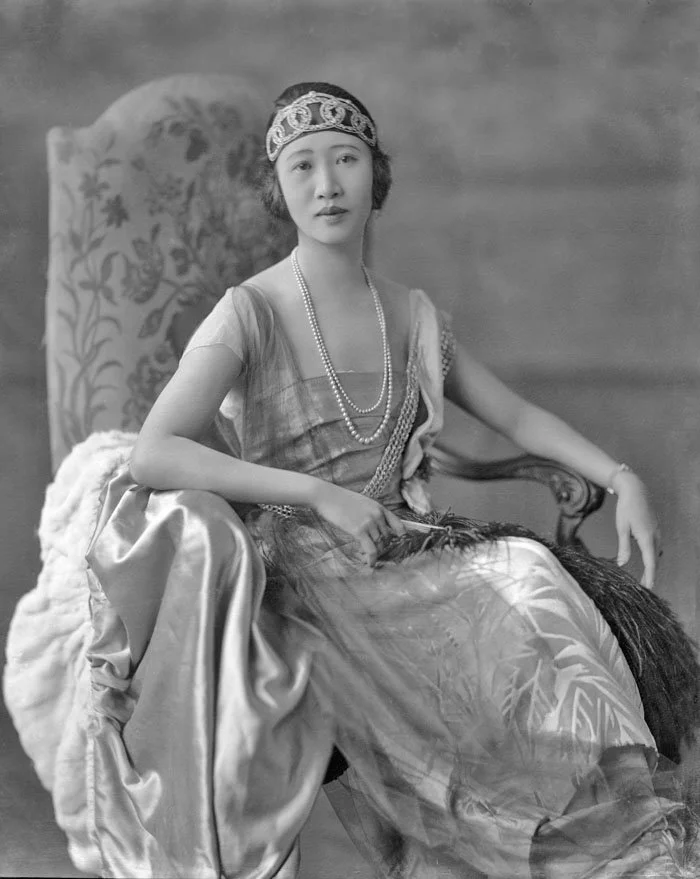
ภาพถ่ายแผ่นกระจกของสตูดิโอลาฟาแย็ต (Studio Lafayette) ลงวันที่ 22 เมษายน ค.ศ. 1921 บันทึกรายละเอียดสำคัญบางอย่างไว้ให้เรามองเห็นอีกครั้ง หลังผ่านสายตาผู้ชมมากว่าหนึ่งศตวรรษ รายละเอียดเหล่านี้อาจเคยถูกมองข้าม เพราะแผ่นกระจกออร์โธโครมาติก (orthochromatic glass plate) ในยุคนั้นไม่สามารถบันทึก “สี” ของวัสดุได้อย่างที่ตาเห็น
การบูรณะและตีความภาพขาวดำให้เป็นภาพสีด้วยเทคโนโลยี AI ในวันนี้ จึงไม่ได้หมายความว่าเรากำลังเห็น “สีจริง” อย่างสมบูรณ์ของปี ค.ศ. 1921 แต่เป็นการเปิดโอกาสให้เรากลับไปอ่านโครงสร้าง วัสดุ แสงเงา และความสัมพันธ์ระหว่างเครื่องแต่งกายกับศิราภรณ์ในภาพอย่างละเอียดขึ้น
การตีความสีของภาพนี้ไม่ได้อาศัยการคาดเดาจากภาพขาวดำเพียงอย่างเดียว หากได้รับการกำกับโดยคำบรรยายร่วมสมัยในหนังสือพิมพ์ The Times วันที่ 8 กรกฎาคม ค.ศ. 1921 ซึ่งบันทึกชุด Court Dress ของมาดามคูไว้อย่างละเอียดว่าเป็น “กำมะหยี่ผ้ายกลายสีครีม มีชายลากยาวแคบ ขลิบด้วยระบายผ้าโปร่งสีเปลวไฟ เสื้อท่อนบนเข้ารูปจับเดรปด้วยผ้ายกทอง ประดับดิอาม็องเต และมีกลุ่มเครื่องประดับสีเขียวกับคริสตัลติดอยู่ที่เอว” หลักฐานนี้ทำให้การ colourisation ด้วย AI ในครั้งนี้ไม่ใช่การแต่งสีตามจินตนาการ หากเป็นการตีความเชิงประวัติศาสตร์ที่ตั้งอยู่บนคำบรรยายเครื่องแต่งกายในสื่อร่วมสมัย
และสิ่งที่ปรากฏในภาพนี้ น่าสนใจกว่าที่เคยคาดไว้
_________
👗👑 ไม่ใช่รัดเกล้าเพชร แต่คือ Bandeau ปักดิ้นเงินบนผ้ายก
สิ่งที่ในแผ่นกระจกขาวดำอาจเคยถูกอ่านว่าเป็น diamond tiara หรือรัดเกล้าเพชรของ Cartier เมื่อพิจารณาผ่านการตีความสีและรายละเอียดของพื้นผิว กลับดูเหมือนวัตถุอีกประเภทหนึ่งโดยสิ้นเชิง นั่นคือ bandeau บนพื้นผ้ายกทอง ปักด้วยดิ้นเงินและแล่งเงิน — silver bullion embroidery on gold lamé ground
โครงสร้างของ bandeau เป็นผ้ายกทอง หรือ gold lamé / gold tissue ตัดเป็นรูปทรงโค้งสามยอดตามแนวศีรษะ ขอบบนมีเส้นโค้งคล้ายมงกุฎโคโคชนิก (Kokoshnik) ของรัสเซีย ซึ่งเป็นรูปทรงที่ร้านเครื่องประดับและห้องเสื้อปารีสนำมาปรับใช้กันอย่างแพร่หลายในช่วงทศวรรษ 1910 หลังจาก Ballets Russes ของ Diaghilev เปิดตัวที่ปารีสในปี ค.ศ. 1909
ลวดลายหลักคือพวงหรีดลอเรลสานเชื่อมต่อกันสามวง — interlaced laurel wreaths — วงใหญ่ตรงกลางขนาบด้วยวงเล็กกว่าทั้งสองข้าง เทคนิคการปักใช้ลวดเงินบิดเป็นเกลียวคล้ายเชือก เย็บตรึงลงบนพื้นผ้ายกทองด้วยวิธี couching สลับกับลาย filigree ประดับด้วยไข่มุกเม็ดเล็กกระจายทั่วทั้งชิ้น และมีคริสตัลขนาดเล็กตามขอบบางจุด
กล่าวอีกนัยหนึ่ง นี่ไม่ใช่ศิราภรณ์ที่สร้างจากโลหะและเพชร หากเป็นงานเย็บปักที่สร้างภาพลวงตาของเครื่องประดับโลหะขึ้นจากผ้า ดิ้นเงิน ไข่มุก และคริสตัล นี่จึงไม่น่าจะเป็นผลงานของร้านเครื่องประดับ แต่เป็นผลงานของห้องเสื้อ
_________
Worth, Callot และ embroidered court bandeaux ค.ศ. 1920–1922
ในช่วงต้นทศวรรษ 1920 รัดเกล้าหรือ tiara / bandeau สำหรับการเข้าราชสำนักในยุโรปมีที่มาสำคัญสองแนวทาง
💎👑 แนวทางแรกคือ joaillier route — เส้นทางของร้านเครื่องเพชรพลอย เช่น Cartier, Chaumet และ Boucheron ซึ่งผลิต tiara หรือ bandeau จากแพลทินัมและเพชรในฐานะเครื่องประดับล้ำค่าและมรดกประจำตระกูล เมื่อสวมเสร็จแล้วก็กลับไปเก็บรักษาในตู้นิรภัย
👗👑 แนวทางที่สองคือ atelier route — เส้นทางของห้องเสื้อ รัดเกล้าหรือ bandeau แบบนี้เป็นงานเย็บปักที่ออกแบบขึ้นให้เป็นส่วนหนึ่งของชุดเข้าราชสำนัก ผลิตโดยห้องเสื้อเองหรือผ่านช่างปักเฉพาะทาง วิธีนี้เป็นแนวทางที่ Worth, Callot Sœurs และ Lanvin ใช้ในการสร้าง ensemble ที่เครื่องแต่งกายและศิราภรณ์สัมพันธ์กันตั้งแต่แนวคิดแรกของการออกแบบ
Callot Sœurs เป็นห้องเสื้อปารีสที่มีชื่อเสียงด้านงานปักอันละเอียดประณีตที่สุดแห่งหนึ่งของยุคนั้น Vogue เคยเรียกพี่น้อง Callot ว่า “the Three Fates” หรือ “สามเทพีแห่งโชคชะตา” และในปี ค.ศ. 1922 Ladies’ Home Journal รายงานว่า Callot อาจมีลูกค้าเศรษฐีมากกว่าห้องเสื้อใด ๆ ในโลก ตั้งแต่อเมริกาใต้ แอฟริกาใต้ ไปไกลถึงญี่ปุ่น
หนึ่งในตัวอย่างที่ยังคงหลงเหลือคือชุดราตรีของ Callot Sœurs ปี ค.ศ. 1921 ซึ่งเป็น transitional piece หรือชิ้นงานในช่วงเปลี่ยนผ่านที่ยังคง silhouette เน้นสะโพกของทศวรรษ 1910 ขณะเดียวกันก็เริ่มก้าวเข้าสู่เส้นสายแบบทศวรรษ 1920 ลักษณะนี้ใกล้เคียงกับเส้นรูปทรงของชุดมาดามคูในภาพ
มาดามคูเองมีความเชื่อมโยงโดยตรงกับ Callot Sœurs เพราะชุดแต่งงานสีงาช้างที่เธอสวมในพิธีสมรส ณ สถานราชทูตจีนในกรุงบรัสเซลส์ เมื่อวันที่ 9 พฤศจิกายน ค.ศ. 1920 เป็นผลงานของห้องเสื้อนี้
ขณะเดียวกัน House of Worth ในปี ค.ศ. 1921 อยู่ภายใต้การกำกับของฌอง-ชาร์ลส์ เวิร์ธ (Jean-Charles Worth) หลานชายของชาร์ลส์ เฟรเดอริก เวิร์ธ ผู้ก่อตั้งห้องเสื้อ ฌอง-ชาร์ลส์ปรับภาพลักษณ์ของ Worth จากความหรูหราอันซับซ้อนของปลายคริสต์ศตวรรษที่ 19 ไปสู่เส้นสายและ silhouette ที่เรียบขึ้น สอดคล้องกับรสนิยมสมัยใหม่ในช่วงต้นทศวรรษ 1920
Worth ยังคงเป็นห้องเสื้อสำคัญที่จัดทำชุดให้กับราชสำนักยุโรปหลายแห่งที่ยังคงรักษาพิธีการเข้าเฝ้า รวมถึงราชสำนักเซนต์เจมส์ในกรุงลอนดอน
ช่างปักที่ Worth ใช้ในยุคนั้นคือ Maison Michonet ซึ่งดำเนินกิจการมาตั้งแต่ปี ค.ศ. 1858 ต่อมาในปี ค.ศ. 1924 กิจการนี้ถูกซื้อโดย Albert Lesage และกลายเป็น Maison Lesage — ห้องปักชั้นสูงที่ภายหลังจะมีบทบาทสำคัญในงาน haute couture ของฝรั่งเศส รวมถึงงานปักฉลองพระองค์ของสมเด็จพระนางเจ้าสิริกิติ์ พระบรมราชินีนาถ ในช่วงทศวรรษ 1960 และในเวลาต่อมายังกลายเป็นหนึ่งในห้องปักสำคัญของ Chanel
ดังนั้น หาก bandeau ในภาพนี้เป็นผลงานของ Worth จริง ในเชิงเทคนิคแล้ว มันอาจเกี่ยวข้องกับสายงานช่างฝีมือที่ในอีกเพียงสามปีต่อมาจะกลายเป็นต้นทางของ Maison Lesage และ Lesage Archives
_________
📜 ทำไมจึงเป็นเรื่องสำคัญ
หากรัดเกล้าในภาพนี้คือ atelier piece ของ Worth จริง — ไม่ใช่ bandeau เพชรของ Cartier ที่ยืมมาจากตระกูลหรือร้านเครื่องประดับ — สิ่งนี้จะอธิบายได้ว่าเหตุใดสีและพื้นผิวของ bandeau จึงประสานกับ gold tissue corsage ของชุดอย่างพอดี
พื้นทอง ดิ้นเงิน ไข่มุก และประกายคริสตัลไม่ได้ถูกเลือกมา “ให้เข้ากัน” ภายหลัง แต่เป็นไปได้สูงว่าได้รับการออกแบบและผลิตขึ้นพร้อมกับชุด ในฐานะ ensemble เดียวกัน
นี่สอดคล้องกับรูปแบบการแต่งกายของมาดามคูตลอดชีวิต ซึ่งไม่ได้ใช้เครื่องประดับเพียงเพื่อประกอบชุด แต่เลือกใช้เครื่องประดับ ศิราภรณ์ และเสื้อผ้าให้สัมพันธ์กันในเชิงภาพรวมอย่างประณีต ในกรณีนี้ ทั้งชุดและ bandeau อาจเป็นผลงานของ Worth ในปี ค.ศ. 1921 ผ่านเครือข่ายช่างปักของ Maison Michonet — เป็นชิ้นงานที่ถูกคิด ตัด เย็บ และปักไปพร้อมกัน
_________
🌺 โอเอ ฮุย-หลาน — มาดามเวลลิงตัน คู
โอเอ ฮุย-หลาน (黃蕙蘭, “กล้วยไม้แห่งความเมตตา”) เกิดที่เมืองเซอมารัง ชวากลาง อินโดนีเซีย เมื่อวันที่ 21 ธันวาคม ค.ศ. 1889 บิดาคือ มาโยร์-ทิตูแลร์ โอเอ เถียง ฮัม (Majoor-titulair Oei Tiong Ham) ผู้นำบริษัท Kian Gwan ซึ่งในต้นคริสต์ศตวรรษที่ 20 เติบโตเป็นหนึ่งในเครือธุรกิจจีนที่ใหญ่ที่สุดในเอเชียตะวันออกเฉียงใต้ มารดาของเธอมาจากชนชั้น Cabang Atas หรือชนชั้นสูงเปอรานากันจีนในชวายุคอาณานิคม
โอเอ ฮุย-หลาน เติบโตขึ้นในโลกข้ามวัฒนธรรม เธอพูดได้หลายภาษา ได้แก่ มลายู ฮกเกี้ยน จีนกลาง ดัตช์ อังกฤษ และฝรั่งเศส ความสามารถทางภาษาและพื้นฐานทางสังคมเช่นนี้ทำให้เธอเคลื่อนไหวได้อย่างคล่องแคล่วระหว่างโลกอาณานิคมเอเชีย ราชสำนักยุโรป สังคมทูต และวงการแฟชั่นชั้นสูง
เธอมาถึงลอนดอนครั้งแรกในปี ค.ศ. 1910 พร้อมกับสามีคนแรก โบแชม คอลฟิลด์-สโตเกอร์ (Beauchamp Caulfeild-Stoker) ชาวแองโกล-ไอริช ทั้งคู่อาศัยที่บ้านเกรย์แลนด์สในวิมเบิลดัน ก่อนที่ชีวิตสมรสอันไม่มีความสุขจะสิ้นสุดลงด้วยการหย่าในปี ค.ศ. 1920
ในเดือนสิงหาคม ค.ศ. 1920 เธอได้พบกับเวลลิงตัน คู (Wellington Koo) ในงานเลี้ยงที่กรุงปารีส เขาเป็นนักการทูตจีนผู้สำเร็จการศึกษาจากมหาวิทยาลัยโคลัมเบีย และเป็นหนึ่งในผู้แทนจีนในการประชุมสันติภาพปารีส ค.ศ. 1919 ทั้งคู่แต่งงานกันที่สถานราชทูตจีนในกรุงบรัสเซลส์ เมื่อวันที่ 9 พฤศจิกายน ค.ศ. 1920 โดยมาดามคูสวมชุดแต่งงานของ Callot Sœurs
ต้นปี ค.ศ. 1921 เวลลิงตัน คูได้รับการแต่งตั้งเป็นทูตจีนประจำราชสำนักเซนต์เจมส์ ทั้งคู่จึงกลับมาลอนดอนในฐานะผู้แทนของสาธารณรัฐจีน ณ ใจกลางจักรวรรดิอังกฤษ
วันที่ 22 เมษายน ค.ศ. 1921 เพียงสามเดือนหลังการรับตำแหน่ง มาดามคูเดินทางผ่านย่านเมย์แฟร์ จากถนนนิวบอนด์ (New Bond Street) ไปยังถนนโดเวอร์ (Dover Street) และนั่งถ่ายภาพที่สตูดิโอราชสำนักชั้นนำสองแห่งของลอนดอนในเช้าวันเดียวกัน โดยสวม bandeau ผ้ายกทองปักดิ้นเงินชิ้นนี้
ภาพถ่ายนี้จึงไม่ใช่เพียงภาพเหมือนของสตรีผู้มีรสนิยม หากเป็นหลักฐานของช่วงเวลาที่แฟชั่น การทูต ราชสำนัก และอัตลักษณ์ข้ามวัฒนธรรมมาบรรจบกันบนร่างกายของผู้หญิงคนหนึ่ง
_________
⏳ ภายหลัง
ในทศวรรษต่อมา มาดามเวลลิงตัน คูจะกลายเป็นหนึ่งในสตรีที่แต่งกายดีที่สุดของ Vogue ในช่วงทศวรรษ 1920, 1930 และ 1940 เธอมีบทบาทสำคัญในการทำให้ cheongsam หรือ qipao กลายเป็นเครื่องแต่งกายสมัยใหม่ของสตรีจีน โดยเฉพาะรูปแบบที่ผ่าข้างสูงถึงเข่า และการใช้ผ้าไหมกับผ้ายกจีนท้องถิ่น ซึ่งเธอยืนยันว่ามีคุณภาพและความงามเหนือกว่าผ้าฝรั่งเศสที่นำเข้าไปยังเซี่ยงไฮ้
ในปี ค.ศ. 2015 พิพิธภัณฑ์ศิลปะเมโทรโพลิแทนจัดให้มาดามเวลลิงตัน คูเป็นหนึ่งใน “Women of Style” ในนิทรรศการ China: Through the Looking Glass
แต่จุดเริ่มต้นของตำนานสไตล์นี้อาจอ่านได้จากภาพถ่ายแผ่นกระจกของ Studio Lafayette บนถนนนิวบอนด์ ในเช้าวันที่ 22 เมษายน ค.ศ. 1921 — ภาพที่บันทึกมาดามคูในชุดเข้าราชสำนัก พร้อม bandeau ปักดิ้นเงินบนผ้ายก ซึ่งกล้องในยุคนั้นบันทึกไว้ได้เพียงเป็นขาวดำ
หนึ่งศตวรรษต่อมา เราเพิ่งเริ่มมองเห็นรายละเอียดของมันอีกครั้ง — ไม่ใช่ในฐานะ “สีจริง” ที่ย้อนคืนมาอย่างสมบูรณ์ แต่ในฐานะการอ่านใหม่ผ่านแสง สี วัสดุ และเทคโนโลยี ที่ทำให้ศิราภรณ์ชิ้นเล็ก ๆ นี้กลับมามีเสียงในประวัติศาสตร์แฟชั่นอีกครั้ง
_________
Silver-Bullion Embroidery on Gold Lamé: Madame Wellington Koo’s Bandeau
London, 1921🇬🇧🏛️📸
The glass-plate photograph taken at Studio Lafayette on 22 April 1921 preserves a set of details that have passed before the eyes of viewers for more than a century, yet may have remained largely unnoticed. The reason is partly technical. The orthochromatic glass plates of the period could not record the colour of fabrics and materials as the human eye perceived them.
Today, AI-assisted restoration and colour interpretation do not allow us to recover the “true” colours of 1921 with absolute certainty. What they can do, however, is invite us to read the image again: to examine structure, surface, light, textile, embroidery, and the relationship between dress and head ornament with renewed attention.
The colour interpretation in this restoration was therefore not an act of pure imagination. It was guided by a contemporary description in The Times of 8 July 1921, which described Madame Koo’s Court Dress as “cream brocaded velvet, with a narrow train edged with trails of flame-coloured tulle. Her closely fitting draped corsage of gold tissue was ornamented with diamanté trimming, and a cluster of green and crystal was fastened at the waist.” This written record provides the historical anchor for the AI-assisted colourisation, allowing the image to be read through the documented palette of cream velvet, gold tissue, diamanté, flame-coloured tulle, and green crystal.
And what this image seems to reveal is far more interesting than expected.
👗👑 Not a Diamond Tiara, but an Embroidered Bandeau
What may once have been read in the black-and-white glass plate as a Cartier diamond tiara appears, under close material interpretation, to be something quite different: a bandeau made on a gold lamé or gold tissue ground, embroidered with silver bullion and silver thread.
The structure of the bandeau is textile-based. It is cut into a three-peaked curved form following the line of the head. Its upper edge recalls the Russian Kokoshnik, a shape that Parisian jewellers and couture houses adopted enthusiastically during the 1910s, especially after Diaghilev’s Ballets Russes made its sensational Paris debut in 1909.
The principal motif is a set of interlaced laurel wreaths: a larger central wreath flanked by two smaller ones. The embroidery appears to use twisted silver cord, couched onto the gold ground, combined with filigree-like stitching. Small pearls are scattered across the surface, with tiny crystals accenting parts of the edge.
In other words, this is not a head ornament made from metal and diamonds. It is an embroidered object that creates the illusion of metalwork through textile, silver thread, pearls, and crystal. It seems less likely to be the work of a jeweller than of a couture atelier.
_________
Worth, Callot, and Embroidered Court Bandeaux, 1920–1922
In the early 1920s, tiaras and bandeaux worn for European court presentation could come from two quite different routes.
💎👑 The first was the joaillier route: Cartier, Chaumet, Boucheron and other great jewellery houses produced tiaras and bandeaux in platinum and diamonds as precious jewels and family heirlooms. They were worn for the occasion, then returned to the safe.
👗👑 The second was the atelier route: embroidered bandeaux made as part of a complete court ensemble. These were produced either by the couture house itself or by specialist embroiderers working for the house. This was the route used by houses such as Worth, Callot Sœurs and Lanvin when creating a fully coordinated ensemble in which gown, train, corsage and head ornament were conceived together.
Callot Sœurs was one of the Paris couture houses most celebrated for exquisite embroidery. Vogue famously referred to the Callot sisters as “the Three Fates”, while in 1922 Ladies’ Home Journal reported that Callot may have had more wealthy clients than any other house in the world, from South America and South Africa to Japan.
A surviving Callot Sœurs evening dress from 1921 shows this transitional moment very clearly. It still retains aspects of the hip-emphasising silhouette of the 1910s, while moving towards the straighter lines of the 1920s. This is very close to the silhouette seen in Madame Koo’s dress.
Madame Koo herself had a direct connection with Callot Sœurs. The ivory wedding gown she wore at the Chinese Legation in Brussels on 9 November 1920 was made by the house.
The House of Worth in 1921 was under the direction of Jean-Charles Worth, grandson of its founder, Charles Frederick Worth. Jean-Charles shifted the house away from the heavily elaborate luxury associated with the late nineteenth century and towards simpler lines and silhouettes more suited to the modern taste of the early 1920s.
Worth remained one of the great couture houses supplying European courts where formal presentation rituals still mattered, including the Court of St James’s in London.
The embroidery atelier used by Worth during this period was Maison Michonet, established in 1858. In 1924, it was bought by Albert Lesage and became Maison Lesage, the great embroidery house that would later play a major role in French haute couture, including the embroidered royal dresses of Her Majesty Queen Sirikit The Queen Mother in the 1960s, and which would eventually become one of the key embroidery ateliers associated with Chanel.
If the bandeau in this photograph is indeed a Worth atelier piece, then technically it may belong to the line of craftsmanship that, only three years later, would become part of the origin story of Maison Lesage and the Lesage Archives.
_________
📜 Why This Matters
If the head ornament in this photograph is a Worth atelier piece — rather than a Cartier diamond bandeau borrowed from a family collection or jewellery house — this would explain why its colour and surface relate so perfectly to the gold tissue corsage of the dress.
The gold ground, silver bullion, pearls and crystals were not merely chosen to “match” the gown afterwards. It is far more likely that they were designed and produced together, as part of a single ensemble.
This corresponds closely with Madame Koo’s lifelong approach to dress. She did not simply add jewellery to complete an outfit; she understood clothing, head ornaments and jewels as part of a total visual composition. In this case, both the gown and the bandeau may have been made by Worth in 1921, through the specialist embroidery network of Maison Michonet — conceived, cut, sewn and embroidered as one unified court ensemble.
_________
🌺 Oei Hui-lan — Madame Wellington Koo
Oei Hui-lan (黃蕙蘭, “Compassionate Orchid”) was born in Semarang, Central Java, Indonesia, on 21 December 1889. Her father was Majoor-titulair Oei Tiong Ham, head of the Kian Gwan conglomerate, which by the early twentieth century had become one of the largest Chinese business empires in Southeast Asia. Her mother came from the Cabang Atas, the elite Peranakan Chinese class of colonial Java.
Oei Hui-lan grew up in a deeply cosmopolitan world. She spoke several languages, including Malay, Hokkien, Mandarin, Dutch, English and French. This linguistic and social background allowed her to move with unusual fluency between colonial Asia, European court society, diplomatic circles and high fashion.
She first arrived in London in 1910 with her first husband, the Anglo-Irish Beauchamp Caulfeild-Stoker. They lived at Graylands in Wimbledon, but the unhappy marriage ended in divorce in 1920.
In August 1920, she met Wellington Koo at a party in Paris. Koo was a Columbia-educated Chinese diplomat and one of China’s representatives at the Paris Peace Conference in 1919. They married at the Chinese Legation in Brussels on 9 November 1920, with Madame Koo wearing a wedding gown by Callot Sœurs.
In early 1921, Wellington Koo was appointed Chinese Minister to the Court of St James’s. The couple returned to London as representatives of the Republic of China at the heart of the British Empire.
On 22 April 1921, only three months after his appointment, Madame Koo moved through Mayfair from New Bond Street to Dover Street, sitting for portraits at two of London’s leading court photographers on the same morning. In these portraits, she wore this gold textile bandeau embroidered with silver bullion.
The photograph is therefore more than a portrait of a stylish woman. It is evidence of a moment when fashion, diplomacy, court culture and cross-cultural identity converged on the body of one remarkable woman.
_________
⏳ Afterlife
In the decades that followed, Madame Wellington Koo became one of Vogue’s best-dressed women of the 1920s, 1930s and 1940s. She played an important role in defining the modern cheongsam, or qipao, especially the version with a slit rising to the knee, made from Chinese silks and brocades that she insisted were superior to the French fabrics imported into Shanghai.
In 2015, the Metropolitan Museum of Art included Madame Wellington Koo as one of its “Women of Style” in the exhibition China: Through the Looking Glass.
Yet the beginning of that style legend may be read here: in a glass-plate photograph taken at Studio Lafayette on New Bond Street on the morning of 22 April 1921. It shows Madame Koo in court dress, wearing a silver-bullion embroidered bandeau on gold lamé — an object the camera of the period could record only in black and white.
A century later, we are only beginning to see it again: not as a perfectly recovered “true colour” image, but as a renewed reading through light, colour, material and technology — one that allows this small but extraordinary head ornament to speak again within the history of fashion.
_________
เรียนเชิญกด Subscribe ได้ที่ลิงก์นี้ครับ เพื่อร่วมติดตามงานสร้างสรรค์ต้นฉบับ งานวิจัยประวัติศาสตร์แฟชั่น และผลงานอนุรักษ์มรดกวัฒนธรรมด้วยเทคโนโลยี AI ของ AI Fashion Lab, London ซึ่งมุ่งตีความอดีตผ่านมิติใหม่ของการบูรณะภาพ การสร้างสรรค์ภาพ และการเล่าเรื่องด้วยศิลปะเชิงดิจิทัล https://www.facebook.com/aifashionlab/subscribe/
http://lafayette.org.uk/koo8712.html
http://lafayette.org.uk/koo8711.html
#aifashionlab #AI #aiartist #aiart #aifashion #aifashiondesign #aifashionstyling #aifashiondesigner #fashion #fashionhistory #historyoffashion #fashionstyling #fashionphotography #digitalfashiondesign #digitalcostumedesign #digitaldesign #digitalaiart #ThaiFashionHistory #ThaiFashionAI #thailand #MadameWellingtonKoo #LafayetteStudio #1920sCouture #ChromaticReconstruction #AIFashionLab #ChineseDiaspora #PeranakanHistory #CryptoColonial