History of Fashion

Fashion and the Culture of Orders and Decorations During the Reign of King Rama VI
Fashion and the Culture of Orders and Decorations During the Reign of King Rama VI
This collection is the result of AI-generated images created by training three different LoRA models on Flux: LoRA of women's fashion during the reign of King Rama VI, LoRA of men's fashion featuring military uniforms with the sash and the Most Exalted Order of the White Elephant, and LoRA of couple portraits by merging individuals into a base image to refine the model. The process was time-consuming as the original photographs were black and white, requiring colourisation before AI enhancement to achieve 3D-like quality and clarity, making them suitable for LoRA training. However, the royal decorations generated in the AI images do not precisely replicate the real medals, as LoRA could not fully capture their exact structure. Nevertheless, the images successfully convey the essence of the fashion and the significance of honourary decorations from that historical period.
During the reign of King Vajiravudh (Rama VI) from 1910 to 1925, Thailand underwent significant cultural transformations, particularly in the realm of fashion and the adoption of Western-style military uniforms. This period marked an integration of traditional Thai aesthetics with European influences, reflecting the country's broader modernisation efforts. Alongside these sartorial changes, the system of royal decorations and orders played an integral role in defining status, honour, and national identity.

Thai Fashion in the Late Reign of King Rama V (1900–1910): The Transition to Western Styles and the Tradition of Auspicious Colours
Thai Fashion in the Late Reign of King Rama V (1900–1910): The Transition to Western Styles and the Tradition of Auspicious Colours
During the late reign of King Rama V, from 1900 to 1910, Thai fashion underwent a significant transformation, especially within the Inner Court. Traditional attire, which had long been defined by phaa nung (wrapped skirt), jong kraben (pleated trousers), and sabai (shoulder cloth), gradually incorporated Western-style blouses influenced by Edwardian fashion from Britain. This shift reflected Thailand’s growing exposure to Western culture and modernization under King Rama V’s reign.
The Tradition of Auspicious Colours in Thai Court Fashion
The tradition of wearing colours based on the days of the week in Thailand dates back to the Ayutthaya period. It is rooted in astrology and Hindu beliefs, which associate each day with a specific planetary deity. This tradition continued through the early Rattanakosin period and became highly popular during the reign of King Rama V, particularly among noblewomen in the royal court, who preferred to wear contrasting colours in their pra-sapai and jong kraben based on daily auspicious colours.
Despite embracing Western-style clothing, traditional elements such as the pra-sapai (decorative sash) and jong krabenremained an essential part of courtly attire. These garments maintained a sense of Thai identity, ensuring that cultural traditions were not completely overshadowed by European influences.
On Monday, a deep red pra-sapai was paired with pigeon grey jong kraben. Tuesday featured a soft lavender pra-sapaiwith chartreuse green jong kraben. Wednesday’s golden yellow pra-sapai was matched with earthy green jong kraben. Thursday’s muted green-yellow pra-sapai complemented an orange jong kraben. Friday’s pale yellow pra-sapai was worn with blue-grey jong kraben. Saturday combined an olive green pra-sapai with deep purple jong kraben, while Sunday’s terracotta red pra-sapai was paired with dark teal green jong kraben.
Although Western-style lace blouses became more popular, they were typically made of light fabrics such as white, cream, or ivory, featuring delicate embroidery and decorative bows. This blend of Western elegance with Thai traditions created a sophisticated look, symbolising Thailand’s transition into modernity while preserving its cultural heritage.
The practice of wearing auspicious colours in the royal court continued until King Rama VII’s reign. However, after the Siamese Revolution of 1932, which led to the abolition of the Inner Court, this tradition gradually faded. As the distinction between the Inner and Outer Court disappeared, noblewomen who had upheld these customs were no longer central to Thai society. Western fashion became fully integrated into everyday attire, and pra-sapai eventually disappeared, marking the end of an era in royal court fashion.
Although the custom of wearing auspicious colours in the royal court has faded, the belief in auspicious colours remains influential in Thai culture today. Many people still choose clothing colours based on these beliefs, especially for ceremonial events, religious functions, and royal celebrations. The continued significance of colour in Thai fashion serves as a symbolic link between past and present, showing how cultural traditions still influence modern aesthetics.

The Influence of Victorian Fashion on Siam and Lanna Women during the Reign of King Rama V and the Ancient and Auspicious Order of the Nine Gems
The Influence of Victorian Fashion on Siam and Lanna Women during the Reign of King Rama V and the Ancient and Auspicious Order of the Nine Gems
During the reign of King Chulalongkorn (Rama V) (1868–1910), Western fashion, particularly Victorian fashion, had a significant influence on the attire of the Siamese elite. One of the most notable elements adopted was the leg-of-mutton sleeves, a symbol of modernity and elegance. This reimagined portrayal presents the attire of a noblewoman from Chiang Mai or Lanna, possibly the wife of a recipient of the Ancient and Auspicious Order of the Nine Gems(เครื่องราชอิสริยาภรณ์อันเป็นโบราณมงคลนพรัตนราชวราภรณ์). While the patterns and colours of the fabrics depicted here are designed for aesthetic representation, they reflect the exquisite quality of high-ranking textiles of that era.
Lanna Hairstyle and Accessories
The hairstyle worn by the noblewomen in these depictions was first introduced by Princess Consort Dara Rasmi, who drew inspiration from Japanese hairstyles. This high bun with a low chignon enhanced a refined and dignified appearance. This hairstyle was unique to Lanna women, distinguishing them from Siamese women of the central region, who typically wore their hair short in the dok kratumb style (ทรงดอกกระทุ่ม). The Lanna hairstyle reflected social status and was reserved for significant occasions. It was often adorned with golden tiaras or elaborate hairpins, symbolising the wearer's noble standing.
The Tubular Skirt (Pha-sin) and Lanna Textile Heritage
The lower garment consists of the pha-sin (ผ้าซิ่น), a key element of Lanna and Northern Thai attire, which differs from the jong-kraben (โจงกระเบน) commonly worn in the royal court of Siam. The pha-sin is traditionally handwoven with great intricacy, often made from fine silk or cotton, and features supplementary weft patterns (teen jok) at the hem. For noblewomen, the pha-sin often included gold or silver-threaded designs, making it a signature textile of the region. While the pha-sin depicted in these images is an imaginative representation, it reflects the elegance and social status of high-ranking women in the late 19th century.
Siamese Noblemen’s Military Uniform
The men in these images are dressed in Siamese military court uniforms, which were heavily influenced by European military dress of the 19th century. As part of King Rama V’s administrative and military reforms, Siamese officials and courtiers adopted Western-style attire to align with international diplomatic standards. The high-collared white military jacket, adorned with gold embroidery on the collar and cuffs, closely resembles the formal dress uniforms of the British and French courts. The gold, green, and yellow sash, draped diagonally across the chest, indicates a high-ranking position in the military or royal administration. The trousers, featuring gold side stripes, were worn with polished leather riding boots, reflecting European cavalry influence. A ceremonial sword, an essential part of formal court attire, signifies authority and noble rank within the kingdom.

Fashion and Portrait Photography in Early 20th-Century Lanna: The Edwardian Influence in Monton Payap
Fashion and Portrait Photography in Early 20th-Century Lanna: The Edwardian Influence in Monton Payap
During the early 20th century, the region historically known as Lanna underwent significant political and cultural transformation. Under the administrative reforms of King Chulalongkorn (Rama V), Lanna was formally incorporated into Siam as Monton Payap in 1894. This was part of the broader centralisation policy that aimed to consolidate royal authority and modernise governance. Local rulers, such as the rulers of Chiang Mai, Lampang, and Lamphun, retained a degree of influence but were ultimately subordinated to the Siamese government. The administrative system of Monton Payap was heavily influenced by British colonial models in Burma and the Malay Peninsula, which the Siamese government studied and partially adopted.
British Influence and Centralisation in Monton Payap
During the late 19th and early 20th centuries, the British Empire expanded its influence across Southeast Asia, particularly in Burma and the Malay Peninsula. The administrative structures in these colonies served as models for the governance of Monton Payap. The Siamese government recognised the necessity of adopting British colonial methods to strengthen control over the northern region and counteract British and French territorial ambitions.
A significant turning point occurred in 1896 when Britain and France signed the Anglo-French Declaration, which formally recognised Siam’s sovereignty over Monton Payap. However, despite this diplomatic agreement, British economic influence remained dominant in the region, particularly in sectors such as teak logging and trade. To assert stronger control, the Siamese government initiated comprehensive reforms in Monton Payap, including legal restructuring, taxation reforms, and rapid infrastructure development. Railways, roads, and telegraph systems were expanded to facilitate administration and integrate the region more closely with Bangkok.
The British government also provided technical assistance to Siam, helping to modernise governance in a colonial-style framework. The administrative practices of Monton Payap reflected a hybrid model—while remaining under Siamese sovereignty, it functioned with a bureaucratic structure influenced by British colonial rule.
Edwardian Fashion and Portrait Photography in Monton Payap
As Western influences permeated Siamese society, the fashion of the elite in Monton Payap reflected the growing European presence. Women of the northern aristocracy adopted Edwardian-inspired lace blouses with high necklines and long sleeves, paired with the traditional tubular skirt (pha sin). These delicate lace blouses, often in white or pastel shades, symbolised refinement and modernity, blending Western aesthetics with traditional Lanna attire.
Hairstyles also evolved during this period. Women in Monton Payap favoured the high chignon, where hair was tightly pulled back and styled into an elegant bun at the crown of the head. This hairstyle was often adorned with decorative gold or silver hairpins, sometimes featuring floral motifs. Footwear choices reflected further Western influence—white or black stockings were paired with leather Mary Jane shoes or T-bar shoes, replacing more traditional forms of footwear.
For men, European-style dress uniforms became the standard attire for government officials and military officers. The transition from chong kraben (a wrapped lower garment) to tailored trousers and tunics was a visual marker of modernisation. Civilian officials wore high-collared tunics with brass buttons, while military officers adopted full dress uniforms inspired by British and European styles. These changes aligned with the broader administrative reforms that sought to professionalise the Siamese bureaucracy and reinforce state authority in Monton Payap.

Restoring the Past: The Love Story of a Chiang Mai Princess and a Siamese Prince Through Fashion and Image Restoration
Restoring the Past: The Love Story of a Chiang Mai Princess and a Siamese Prince Through Fashion and Image Restoration
In the realm of historical image restoration, each photograph serves as a portal to the past, revealing not just the faces of those long gone but also their stories, culture, and emotions. One such image is a century-old portrait of Prince Boworadet (พระองค์เจ้าบวรเดช) and Princess Thipawan Na Chiang Mai (เจ้าหญิงทิพวัน ณ เชียงใหม่), a photograph that beautifully captures the fusion of tradition and modernity in early 20th-century Siam. More than just a visual artifact, it tells a love story—a tale of a Chiang Mai noblewoman and a Siamese prince, bound by duty and affection, set against the backdrop of political and social change. Through the lens of fashion and digital restoration, we explore their world, where textiles and technology intertwine to bring history to life.
This restored image is of Prince Boworadet (พลเอกพระวรวงศ์เธอพระองค์เจ้าบวรเดช), the Viceroy of Northern Siam (อุปราชมณฑลพายัพ) from 1915 to 1919, and his consort, Princess Thipawan Na Chiang Mai (เจ้าหญิงทิพวัน ณ เชียงใหม่). The Viceroy was responsible for overseeing irrigation systems and dam construction along the Ping River to support agriculture and the livelihoods of the region's inhabitants. (Source: National Archives of Thailand - สำนักหอจดหมายเหตุแห่งชาติ)
However, based on the fashion elements in this image—specifically the Edwardian-style high-collared blouse and the prominence of the shoulder sash, both popular in the late 19th and early 20th centuries—it is estimated that the photograph was taken around 1900, during the reign of King Rama V (1868-1910). This aligns with the birth dates of Prince Boworadet (1877) and Princess Thipawan, placing them in their early twenties at the time, a period when young aristocrats were often formally photographed in court attire. before Prince Boworadet assumed his role as Viceroy of Northern Siam.

The Chemise à la Reine: Fashion, Politics, and the Global Impact of a Simple Cotton Gown
The Chemise à la Reine: Fashion, Politics, and the Global Impact of a Simple Cotton Gown
The late 18th century witnessed a significant transformation in fashion, largely influenced by Queen Marie Antoinette of France. Amidst the grandeur of Versailles, the queen sought refuge at the Petit Trianon, a secluded estate where she could escape the rigid expectations of court life. During these retreats, she and her closest circle adopted a simpler style of dress, favouring light muslin and cotton garments over the elaborate silk gowns traditionally worn by the aristocracy. This shift in fashion was not merely a personal preference but a bold departure from courtly convention, ultimately sparking a revolution in European dress.
In 1783, the renowned artist Élisabeth Louise Vigée Le Brun painted a portrait of Marie Antoinette wearing a modest white cotton gown, known as the robe de gaulle. This dress, cinched at the waist with a sheer sash and featuring minimal embellishment, starkly contrasted with the opulent styles of the period. When the portrait was exhibited at the Salon of the Académie Royale, it provoked an outcry. Many critics denounced the queen’s attire as scandalous, arguing that it resembled a mere undergarment and was unbefitting of a monarch. Moreover, the use of cotton—closely associated with England due to its colonial ties to India—was viewed as unpatriotic and a direct threat to the French silk industry. Despite this initial backlash, the chemise à la reine, as it came to be known, quickly gained popularity among fashionable circles, including Britain's Duchess of Devonshire. Its adoption signalled a move towards a more relaxed and natural style, challenging established norms of aristocratic dress.
The rise of the chemise à la reine had far-reaching economic consequences. As demand for cotton garments surged, European markets struggled to secure a steady supply. This led to increased reliance on cotton production in the American South, where plantation owners sought to meet the growing need for raw materials. The invention of the cotton gin by Eli Whitney in 1794 revolutionised cotton processing, making large-scale production possible. However, this technological advancement also entrenched the reliance on enslaved labour, as plantation economies expanded to capitalise on the booming cotton trade. Thus, what began as a simple shift in fashion inadvertently contributed to the expansion of slavery, highlighting the unexpected global impact of clothing trends.

Step-by-Step Guide: Creating Double Portraits in Traditional Thai Court Dress from the Reign of King Rama VI Using AI
Step-by-Step Guide: Creating Double Portraits in Traditional Thai Court Dress from the Reign of King Rama VI Using AI
Many people ask how to create a double portrait featuring a couple in historically accurate Thai court dress from the reign of King Rama VI. This process involves training multiple LoRA models and leveraging AI-powered editing tools to fine-tune the details. Below is a step-by-step breakdown of the workflow.

Estimating the Date of a Historical Photograph Through Fashion and Context
Estimating the Date of a Historical Photograph Through Fashion and Context
Photographs offer invaluable glimpses into the past, preserving the likenesses of historical figures along with their fashion, hairstyles, and cultural settings. By analysing attire and contextual clues, we can estimate the date of an image, particularly when exact records are unavailable. To enhance clarity, I use AI to restore and colourise original black-and-white photographs, making details more visible while preserving historical authenticity.
The photograph in question features Prince Uttarakarn Kosol (Sukkasem Na Chiang Mai) and Princess Buachum Na Chiang Mai, members of the Chiang Mai nobility. Princess Buachum’s attire consists of a finely woven silk pha sin (traditional Thai skirt) paired with a lace-trimmed blouse. This blend of European lace and Thai silk reflects late 19th to early 20th-century aristocratic fashion. Her upswept hairstyle follows the traditional Chiang Mai nobility style, distinct from Siamese women, who commonly wore short-cropped hair during this period. This suggests a timeframe of circa 1905-1910.
Prince Uttarakarn Kosol is dressed in a Western-style white military uniform, a style widely adopted in Siam after King Rama V’s European visits. The presence of epaulettes, a sword, and a structured belt indicates a high-ranking officer or noble status. This military attire aligns with the early 1900s when Siamese officials followed European-inspired dress codes.
Additional contextual clues further narrow the date. Historical records confirm that Prince Uttarakarn Kosol passed away in 1913 at the age of 33, meaning he was born around 1880. If the portrait was taken when he was in his twenties or early thirties, it further supports a date of around 1905-1910. The studio setting, featuring a painted backdrop of grand architecture and elaborate furniture, is characteristic of turn-of-the-century photography in Siam.
Considering the combination of fashion, historical context, and photographic style, it is highly likely this portrait dates to between 1905 and 1910, during the reign of King Rama V or the early reign of King Rama VI. Through AI-enhanced restoration, we can better appreciate the details of such historical photographs while preserving their authenticity for future generations.

From Black-and-White to AI-Enhanced: My Process for Training LoRA on Thai History
From Black-and-White to AI-Enhanced: My Process for Training LoRA on Thai History
Many people have asked how I train my LoRA model on 1940s Thailand, particularly in relation to the นโยบายมาลานำไทย (Hats Lead the Nation Policy). My process begins with colourising and enhancing original black-and-white photographs, which serves as the foundation for my dataset. This step takes time and effort because the quality of the dataset is the most crucial aspect of training a successful LoRA model—it must be as close to perfection as possible.
However, when colourising these historical photographs, I don’t aim for absolute accuracy or excessive detail. The purpose of this step is not to create a historically precise colour representation but rather to teach the AI that these images are ‘colour images.’ This allows the model to learn the concept of colour and integrate it into its training. Once the LoRA is fully trained, we gain much greater flexibility. Using Flux Dev, we can adjust colours, backgrounds, and other stylistic elements through prompts, refining the final output according to our vision.
LoRA is particularly useful for generating historically accurate fashion styles because it allows for fine-tuned control over specific details, such as fabric textures, silhouettes, and accessories. By training the model on carefully prepared datasets, we can ensure that the AI understands the unique characteristics of a specific era’s fashion. In my case, training LoRA on 1940s Thai fashion enables me to recreate and explore how clothing styles from that period might have looked in colour, helping to bring history to life in a way that traditional black-and-white photographs cannot.
Here are some examples of the original images alongside their AI-enhanced and colourised versions. This method can also be applied to restoring old photographs, making it a valuable tool for those looking to preserve and revitalise historical imagery. I hope this explanation is helpful for anyone interested in training LoRA models for historical fashion with Flux Dev.

The Aesthetics of Court Ladies’ Attire in the Late Reign of King Chulalongkorn, Rama V of Siam
The Aesthetics of Court Ladies’ Attire in the Late Reign of King Chulalongkorn, Rama V of Siam
Interpreting Fashion Through Silhouettes and Details
The fashion of the court ladies of the Siamese royal court in the late reign of King Chulalongkorn, Rama V of Siam (circa 1900-1910) reflects an exquisite blend of traditional royal customs and Western influences, particularly from the Edwardian era, which was the height of European court fashion at the time.
The attire of court ladies retained its distinctive Siamese elegance, with chong kraben (wrapped trousers), sashes, and delicate lace blouses remaining key elements. However, Western fashion trends influenced tailoring techniques, fabric choices, and embellishments, creating a style unique to this golden era of Siamese fashion.
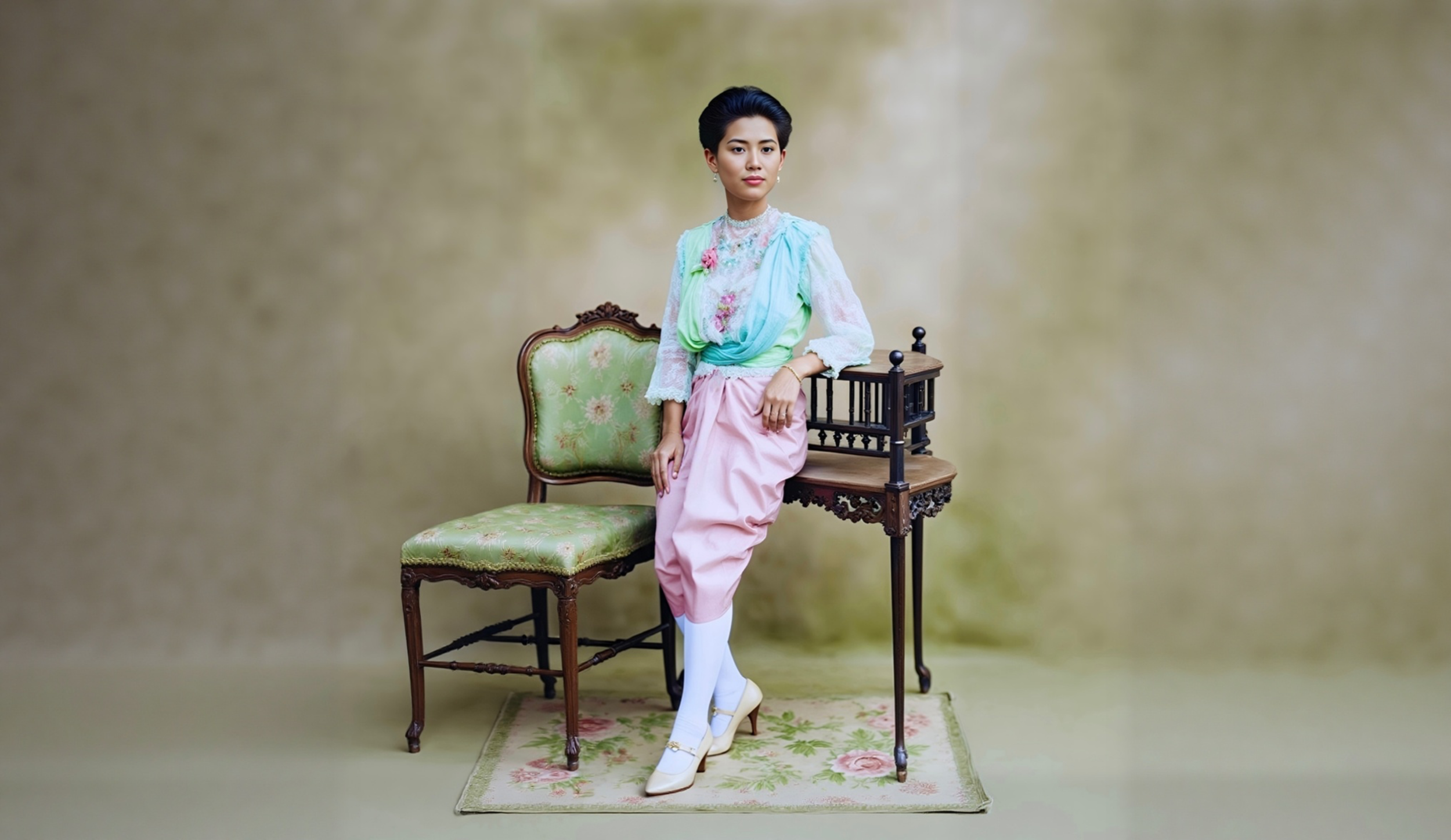
Thai Women's Fashion in the Early Reign of King Rama VI: Reimagining the Past with AI and Historical Precision Through Flux LoRA
Thai Women's Fashion in the Early Reign of King Rama VI: Reimagining the Past with AI and Historical Precision Through Flux LoRA
The fashion of Thai women during the early reign of King Rama VI (1910-1915) reflects a blend of traditional court attire and Edwardian influences, presented here in an artistic pastel reinterpretation. The once tightly fitted, high-collared blouses of the previous era evolved into looser lace or embroidered blouses, inspired by the Edwardian shirtwaist style. These feature three-quarter sleeves, slightly open necklines, and delicate embellishments, creating a softer, more fluid silhouette. The pigeon-breasted effect, a hallmark of Edwardian fashion, is subtly echoed in the blouse’s fullness.
Women continued to wear silk โจงกระเบน (chong kraben) as their primary lower garment, maintaining Thai elegance while incorporating pastel hues in this artistic adaptation. A distinctive feature is the แพรสะพาย (phrae sapai), a sash draped diagonally across the torso, which has evolved into a light silk or chiffon cloth that now flows more gracefully, with its ends neatly hanging at the waist. This development reflects Western influences while preserving its symbolic and decorative function in Thai dress.
The ทรงดอกกระทุ่ม (Dok Krathum hairstyle), popular since King Rama V’s reign, remains fashionable but has become fuller and longer, mirroring the Edwardian Gibson Girl updo. Accessories play a key role in completing the look, with pearls, wristwatches, brooches, and layered necklaces reflecting European trends. Some noblewomen also adopted bandeaux or tiaras, mirroring the jewellery styles of Western aristocracy.
The AI Process Behind These Images
Creating these images required extensive work using Flux and training a LoRA (Low-Rank Adaptation) model tailored to Thai fashion of this era. Many existing AI platforms, particularly text-to-image and image-to-image models,struggle to accurately interpret Thai fashion, as they were primarily trained on datasets curated by Western developers. As a result, the representation of Eastern or specifically Thai historical fashion is often highly inaccurate. To address this limitation, I trained my own LoRA model to ensure historical accuracy in fashion silhouettes, fabrics, and hairstyles.
To make the silhouettes correct, I used original black-and-white photographs from the late 19th and early 20th centuries. Preparing the dataset involved colourising these images first, then enhancing them with AI for improved clarity and a 3D-like quality. Once the dataset was perfected, I trained a LoRA model to specifically generate Thai fashion of this period. My process spans multiple decades, as I have trained models for different eras from the 1830s onward, using both daguerreotype photographs and glass plate negatives. While time-consuming, this method guarantees accuracy in fashion styles, silhouettes, and hairstyles.
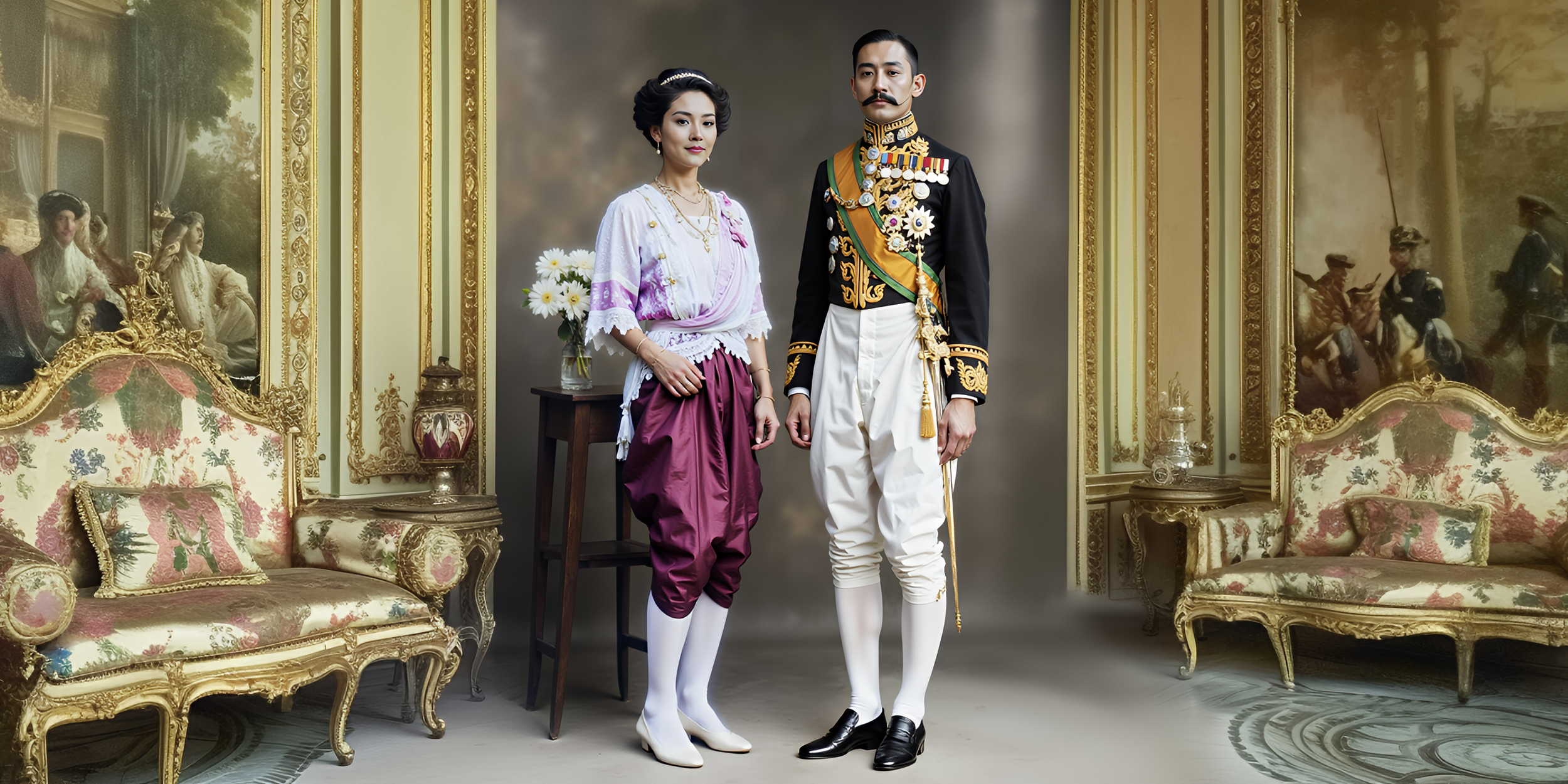
Edwardian Fashion’s Influence on Siamese Court Dress During King Rama VI’s Reign
Edwardian Fashion’s Influence on Siamese Court Dress During King Rama VI’s Reign
During the reign of King Rama VI (1910–1925), Siamese court dress underwent a significant transformation, blending traditional Thai elements with Western influences, particularly from Edwardian Britain. This shift was largely driven by the king himself, who was educated in Britain at Eton College and Oxford University, where he was exposed to British aristocratic culture, military traditions, and court formalities. Upon ascending the throne, he sought to modernise Siam’s elite dress and ceremonial customs, reinforcing Western-style etiquette and court dress codes among the aristocracy and royal family. His vision was to present Siam as a progressive nation, aligning its court culture with those of European monarchies while maintaining distinct Thai identity.
Men’s Court Attire: A Formal European Influence
Men’s court attire during this period reflected British and European diplomatic and military uniforms. High-ranking officials and courtiers wore black tailcoats or military-style embroidered jackets with elaborate gold detailing, a clear nod to European aristocratic traditions. White knee-length breeches, silk stockings, and polished black court shoesbecame standard, aligning with formal attire in European courts. Medals, sashes, and royal orders were prominently displayed, similar to British and continental European court dress, with ceremonial swords signifying rank and service to the monarchy. King Rama VI further codified the khrui, a traditional Siamese ceremonial robe, in 1912, assigning specific styles to royal and government officials. These changes reinforced formality and structure in court attire, mirroring Western sartorial standards.
Women’s Court Dress: A Blend of Thai Elegance and Edwardian Sophistication
Women’s court dress during King Rama VI’s reign retained traditional Thai silhouettes but was increasingly influenced by Edwardian British fashion. The rigid, high-collared blouses of previous decades evolved into looser lace blouses with three-quarter sleeves, often adorned with fine embroidery, reflecting Edwardian trends. Necklines were slightly lower, a subtle Western influence, while the chong kraben (pleated silk trousers) remained the standard lower garment. Paired with sabai (draped silk shawls), this ensemble balanced Thai tradition with European sophistication. Women wore their hair in long, elegant updos, often adorned with tiaras or bandeaux, similar to British aristocratic styles. This fusion of styles presented Siamese noblewomen as both culturally refined and modern.
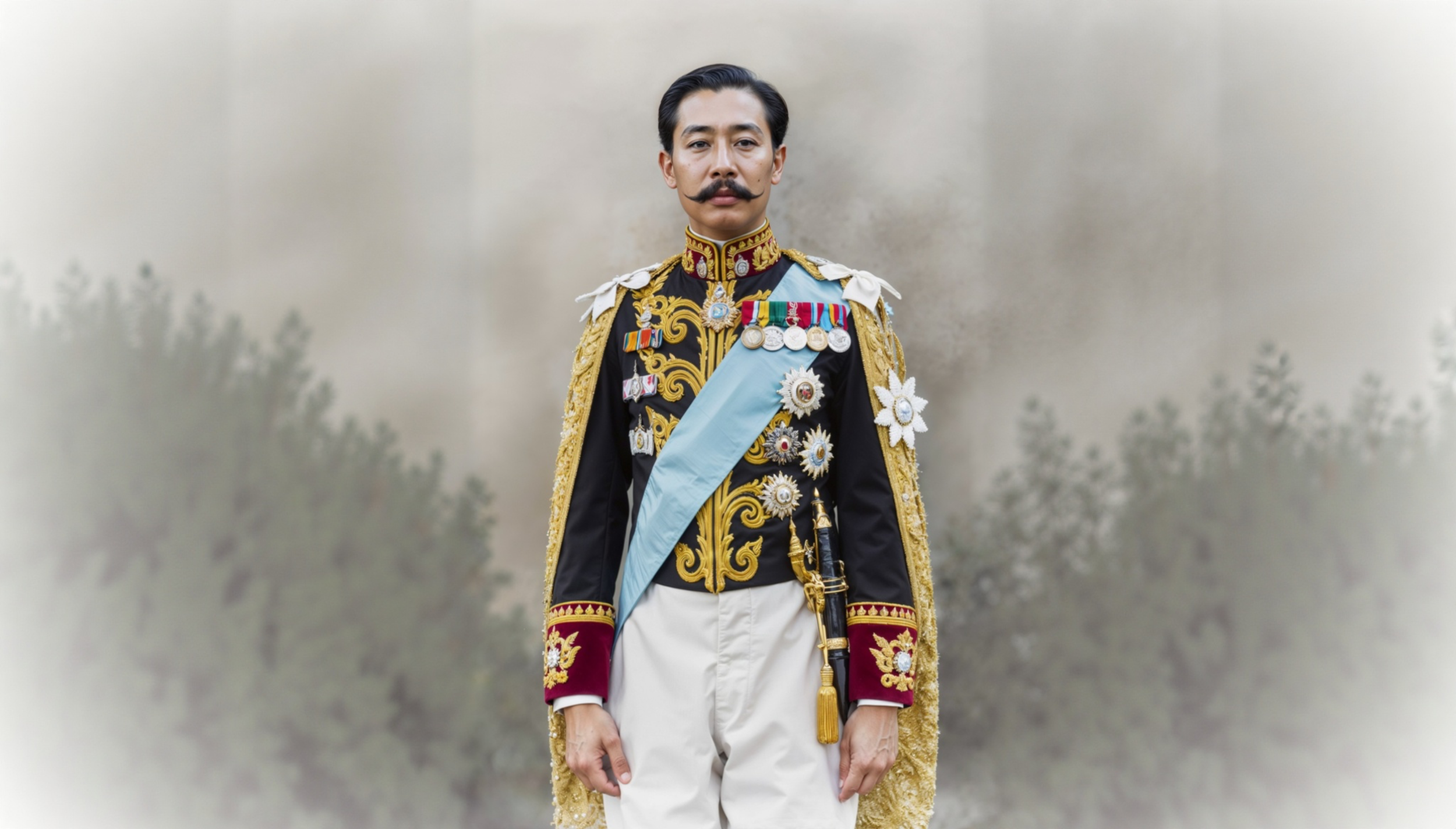
Court Dress Uniform in the Reign of King Vajiravudh (Rama VI)
Court Dress Uniform in the Reign of King Vajiravudh (Rama VI)
During the reign of King Vajiravudh (1910–1925), the Siamese court underwent significant Westernisation, particularly in terms of court dress, military uniforms, and ceremonial attire. This transformation was largely influenced by his education in England.
He was educated in England from a young age, attending Eton College (1893–1895) before undergoing military training at the Royal Military Academy Sandhurst (1895–1899) and later studying at Christ Church, Oxford University (1899–1901). However, he did not complete his studies, as he had to return to Siam in 1901 due to the serious illness of his father, King Chulalongkorn (Rama V).
In 1901, King Chulalongkorn suffered from chronic fatigue, a condition likely caused by his heavy royal duties, accumulated stress, and possibly diabetes or kidney disease. Although his health improved at times, he continued to decline until he passed away in 1910, leading to the ascension of Crown Prince Vajiravudh as King Rama VI.
King Vajiravudh’s experience in England, particularly his British military training and governance studies, profoundly influenced his vision of modernising Siam. This was clearly reflected in the transformation of court dress, which was heavily influenced by the dress codes of the British and European royal courts.
British and European Influence
The adoption of Western-style court uniforms in Siam began in the late 19th century, particularly under King Chulalongkorn (Rama V), but it became fully institutionalised during the reign of King Vajiravudh.
The British court dress system, particularly full-dress military uniforms and civil service attire, served as the primary inspiration.
European-style orders, decorations, and sashes became symbols of rank and royal favour.
The Role of Court Dress in Early 20th-Century Siam
In the early 20th-century Siamese court, court dress had a deeper meaning beyond ceremonial attire—it was a symbol of status, hierarchy, and allegiance to the monarchy.
It was worn by royals, ministers, high-ranking officials, and military officers during state occasions, royal audiences, and official court functions.
Court uniforms reflected the Westernisation of the Siamese elite, reinforcing Siam’s position as a modern and civilised nation in the eyes of Western powers.
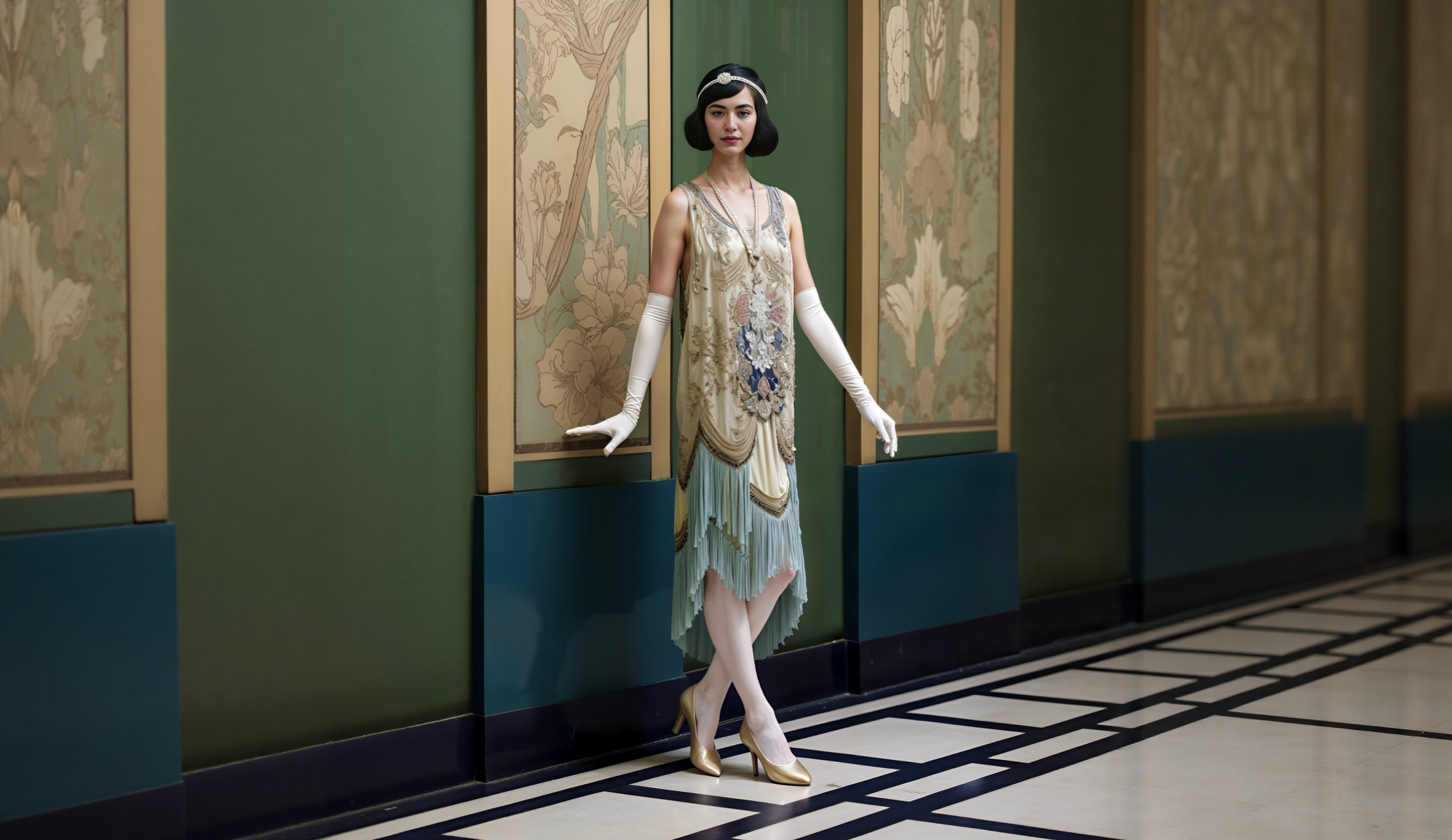
Imagining Art Deco Bangkok: Western Fashion in a Thai World
Imagining Art Deco Bangkok: Western Fashion in a Thai World
Imagine Bangkok in the early reign of King Rama VII, in a parallel world where Thai society fully embraced Western fashion. This collection showcases 1920s Art Deco beauty through dresses adorned with intricate embroidery, soft pastel tones, and jewel-like details, inspired by renowned designers like Paul Poiret and Jeanne Lanvin. This style reflects the luxury and elegance of the era within a Western context, fitting seamlessly with Bangkok’s atmosphere, especially the Western-inspired architecture of Hua Lamphong Station. In this imagined scene, Thai society adopts Western fashion fully, creating a refined and modern alternative in Thailand’s fashion history.
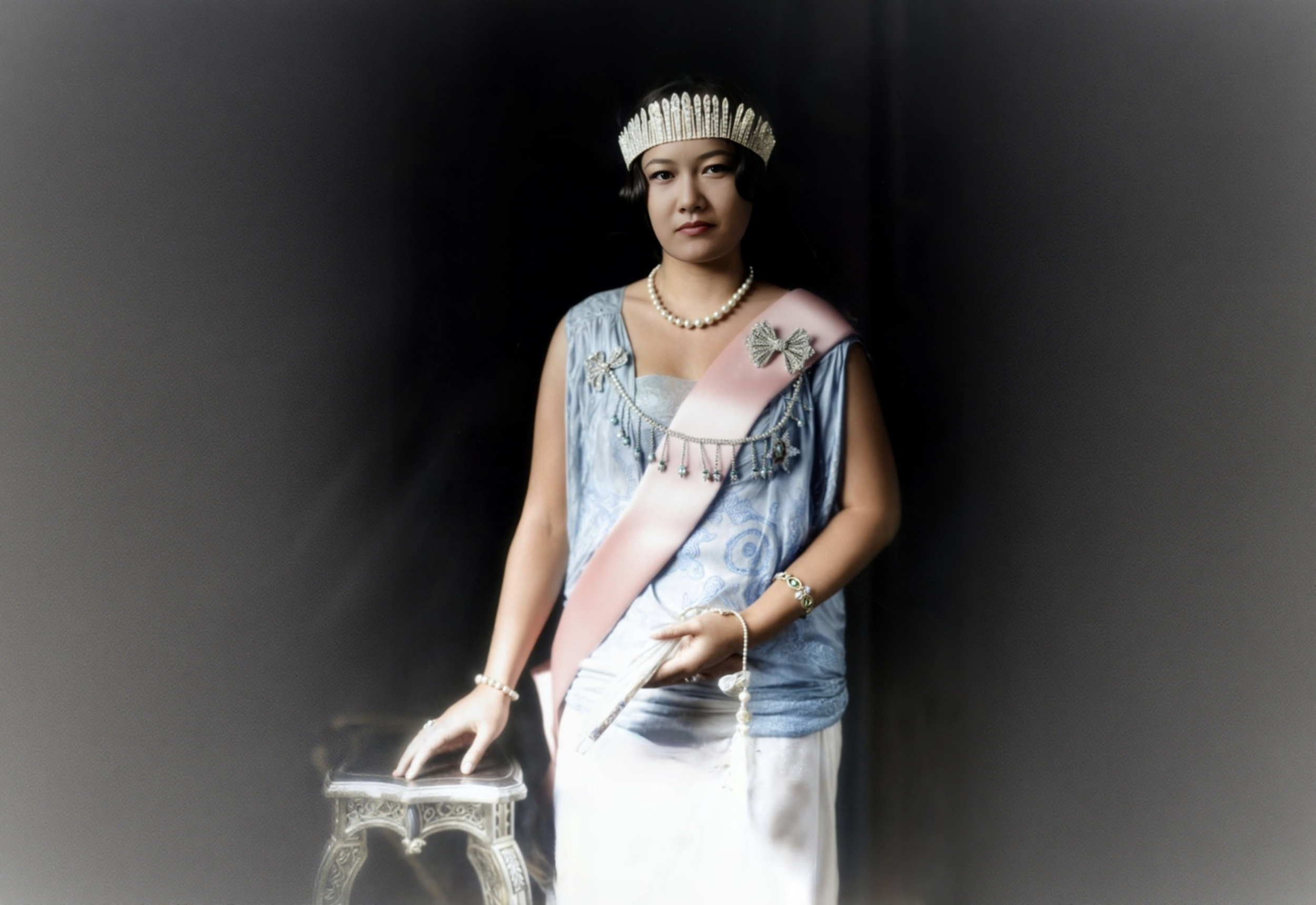
1920s Siamese Fashion: The Foundation of Modern Thai Dress
1920s Siamese Fashion: The Foundation of Modern Thai Dress
The 1920s marked a period of significant fashion transformation in Siam, bridging the reigns of King Rama VI (1910–1925) and King Rama VII (1925–1935). This era saw a fusion of traditional Siamese attire and Western influences, particularly in urban areas where foreign visitors and trade played a role in shaping styles. Men adapted to Western fashion more quickly, transitioning from jong kraben to trousers, collared shirts, and suits, while women gradually moved towards the simple blouse and pha-sin look, which became the defining silhouette of the era.
By the late 1920s, the stable pha-sin look had fully taken root, replacing jong kraben as everyday wear for most women. The knee-length or slightly longer tubular silhouette echoed global flapper fashion while maintaining Thai textile traditions. Meanwhile, men in government and business had almost entirely adopted Western suits. However, a mixture of styles remained, as traditional Siamese outfits, Thai-adapted flapper fashion, and full Western ensembles coexisted in the capital.
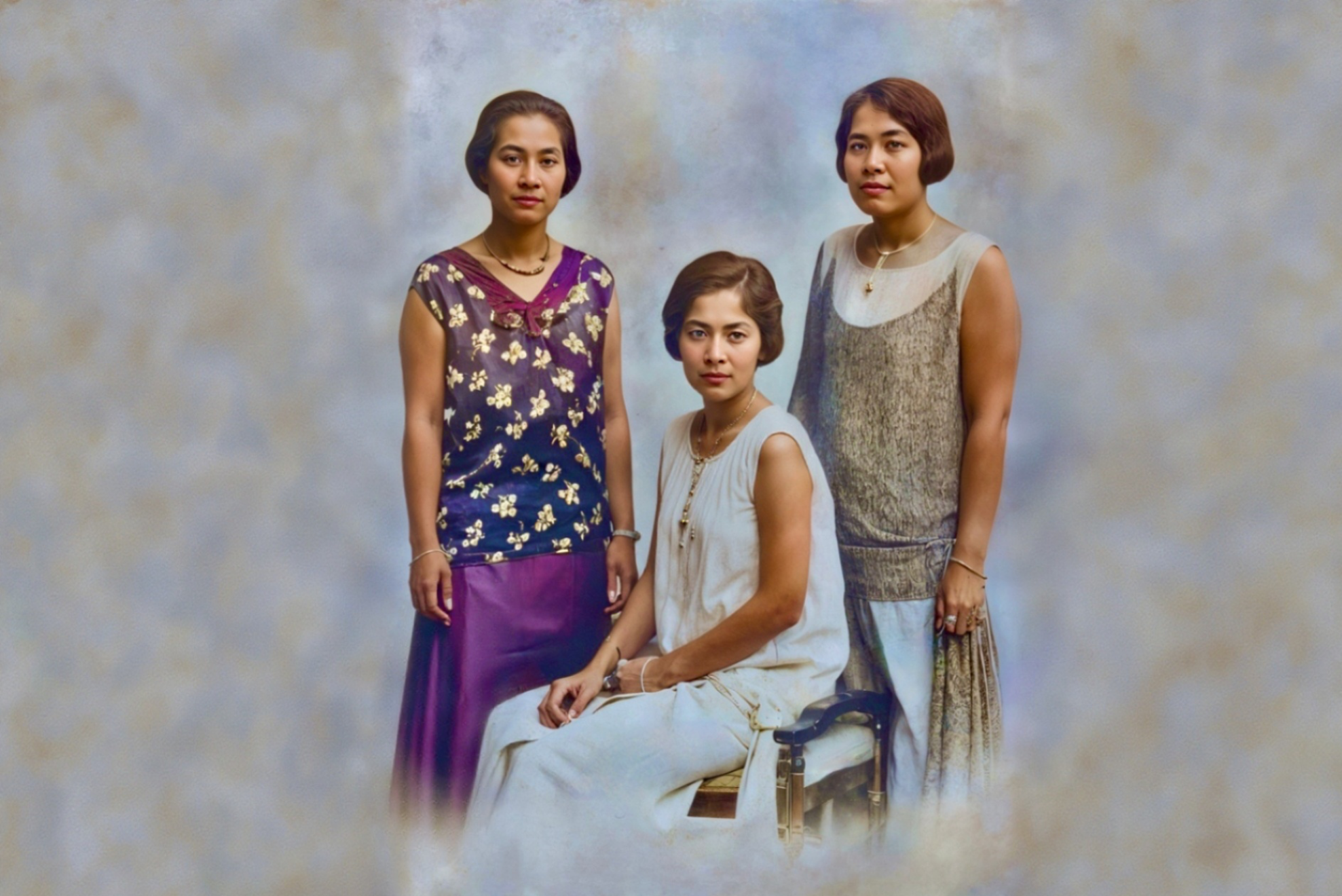
1920s Fashion Data set: Colourised photographs used to train an AI model on Thai fashion from the 1920s–1930s.
These are some samples of 50 photographs used to train an AI model on Thai fashion from the 1920s–1930s.
This dataset was used to train an AI fashion model based on the styles of this period during the reign of King Rama VII. The images were colourised from original black-and-white photographs and enhanced with AI to improve clarity and achieve a three-dimensional quality before training the model.
By applying AI, we can now colourise photographs much faster than manually rendering them in Photoshop. While the results may not always be perfect and manual adjustments to clothing colours are sometimes necessary, for AI training, the key requirement is that the images are in colour and have sufficient clarity. Once the model is trained, we can refine the results using prompts to adjust clothing colours and details as needed.
Using original period photographs ensures greater accuracy in capturing the silhouette and authentic styles of clothing worn at that time. Another crucial aspect is the consistency of hairstyles, which must accurately reflect the era. This helps the AI-generated fashion results remain historically accurate and visually realistic.
นี่คือตัวอย่างภาพถ่าย 50 ภาพที่ใช้ในการฝึกโมเดล AI เกี่ยวกับแฟชั่นไทยในช่วงทศวรรษ 1920–1930
ชุดข้อมูลนี้ถูกใช้ในการฝึกโมเดล AI ด้านแฟชั่นของช่วงเวลาดังกล่าวในรัชสมัยพระบาทสมเด็จพระปกเกล้าเจ้าอยู่หัว โดยภาพเหล่านี้ได้รับการเติมสีจากภาพถ่ายขาวดำต้นฉบับและผ่านการปรับปรุงด้วย AI เพื่อให้มีคุณภาพที่คมชัดและมีมิติคล้ายสามมิติก่อนนำไปฝึกโมเดล
ด้วยการประยุกต์ใช้ AI เราสามารถใช้โมเดลเหล่านี้ในการเติมสีให้กับภาพถ่ายได้รวดเร็วขึ้นกว่าการลงสีด้วยมือใน Photoshop แม้ว่าผลลัพธ์อาจไม่สมบูรณ์แบบเสมอไปและจำเป็นต้องปรับแต่งสีของเสื้อผ้าแบบแมนนวล แต่สำหรับการฝึก AI แล้ว สิ่งสำคัญคือภาพต้องเป็นภาพสีและมีความคมชัดเพียงพอ เมื่อโมเดลได้รับการฝึกแล้ว เราสามารถใช้คำสั่ง (prompts) เพื่อปรับแต่งสีและรายละเอียดของเสื้อผ้าได้ตามต้องการ
การใช้ภาพถ่ายต้นฉบับจากยุคสมัยนั้นช่วยให้ได้ผลลัพธ์ที่แม่นยำในเรื่องของรูปทรง (silhouette) และสไตล์ของเสื้อผ้าที่แท้จริงในช่วงเวลานั้น อีกสิ่งที่สำคัญไม่แพ้กันคือทรงผม ซึ่งต้องมีความถูกต้องและสอดคล้องกับยุคสมัย เพื่อให้แฟชั่นที่ได้จากโมเดล AI มีความสมจริงและใกล้เคียงกับประวัติศาสตร์มากที่สุด
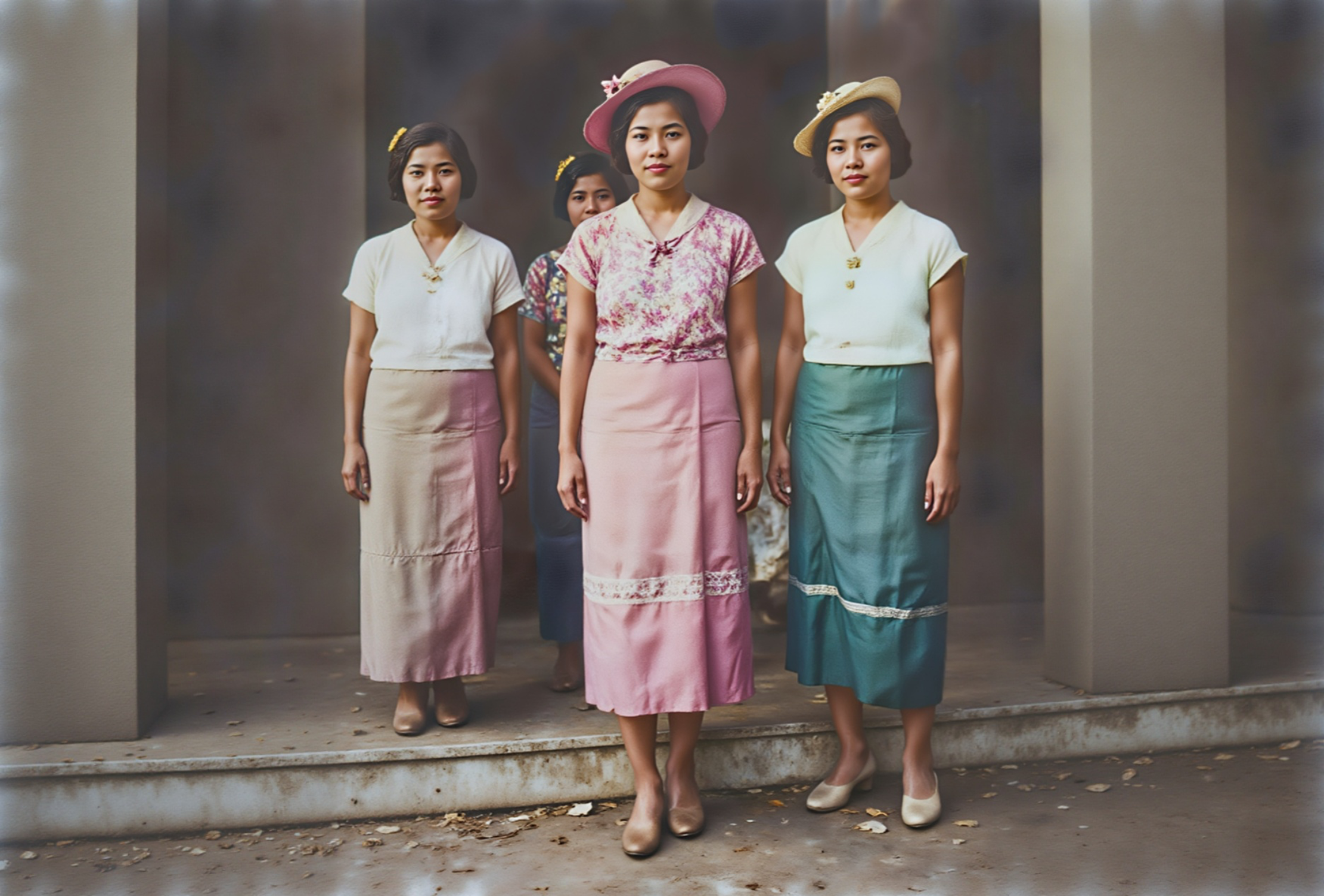
Thai Women's Fashion in the 1940s: A Hybrid of Tradition and Western Influence
Thai Women's Fashion in the 1940s: A Hybrid of Tradition and Western Influence
During the Second World War, Thailand experienced significant austerity, making Western clothing a luxury. Ready-to-wear garments were not widely available, and most Western-style clothing had to be custom-made by dressmakers, which was expensive and time-consuming. As a result, many women incorporated Western elements into their attire while retaining practical aspects of traditional Thai dress.
Thai Women's Fashion in the 1940s: The Blend of Western and Traditional Styles Under Plaek Phibunsongkhram’s Modernisation Policy
During World War II, Thailand was under the "Cultural Mandates" of Field Marshal Plaek Phibunsongkhram, which encouraged the adoption of Western-style clothing, especially in major cities. However, this transformation did not occur uniformly across the country. Thai women's fashion in the 1940s can be categorised into three distinct styles, reflecting social, cultural, and economic differences.
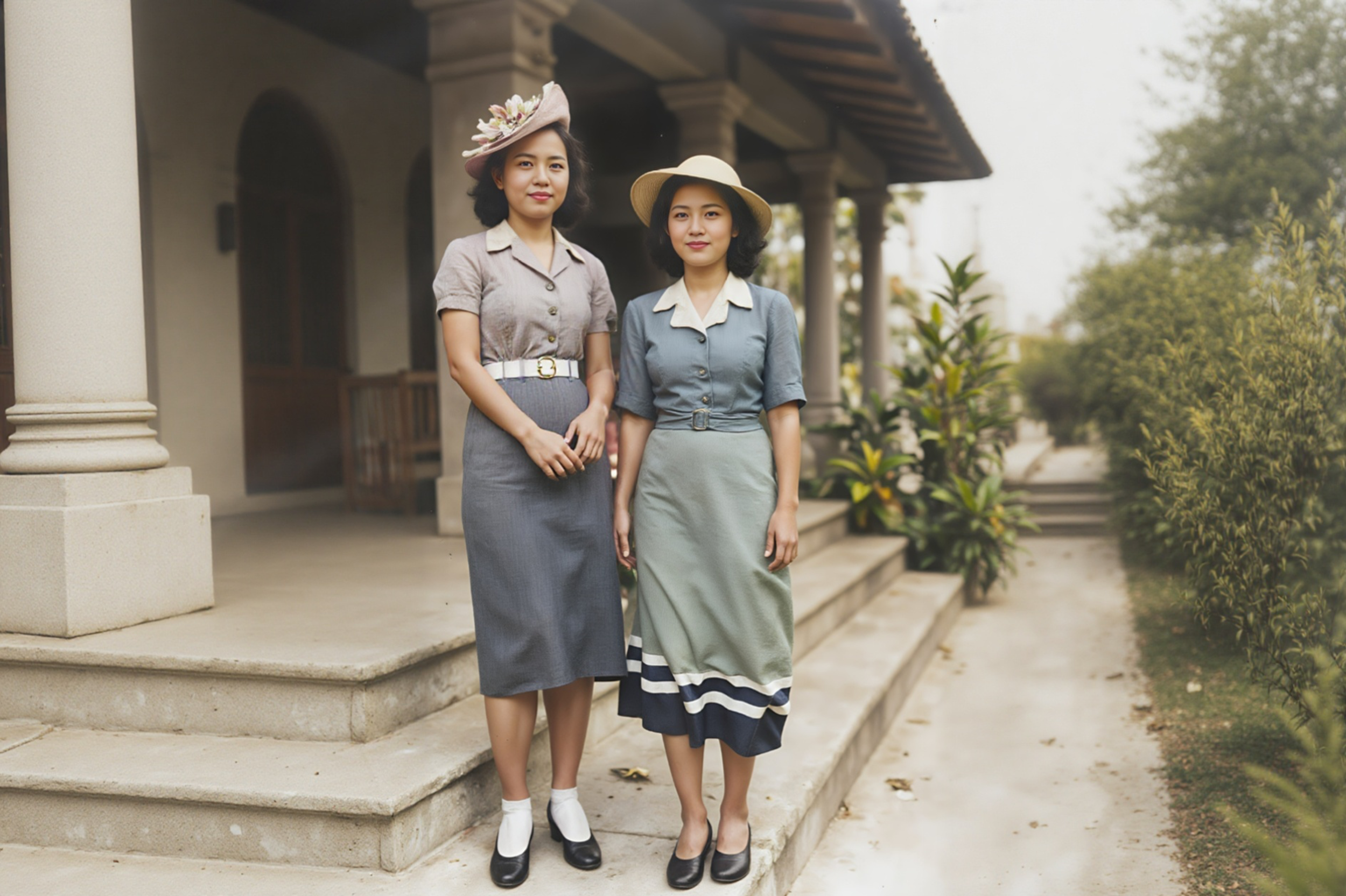
Fashioning the Nation: Thailand’s 1940s Style Transformation under Phibunsongkhram and the "Hat Leads the Nation" Campaign
Fashioning the Nation: Thailand’s 1940s Style Transformation under Phibunsongkhram and the "Hat Leads the Nation" Campaign
The reign of King Ananda Mahidol (Rama VIII) (r. 1935-1946) marked a turning point for the Thai monarchy, following the 1932 revolution that transitioned the country from an absolute monarchy to a constitutional one. This political shift was cemented by the abdication of King Rama VII in 1935, leading to the ascension of King Ananda Mahidol. His reign, spanning from 1935 until his untimely passing in 1946, was largely symbolic, as executive authority had shifted to the elected government. This transformation was accompanied by sweeping cultural changes, including state-led modernisation efforts.
Under the leadership of Field Marshal Plaek Phibunsongkhram, Westernisation became a key element of national identity, influencing multiple aspects of Thai society, particularly fashion. While the monarchy no longer held absolute power, it remained a unifying symbol of the nation. King Ananda’s return from his studies in Europe reflected this new era of modernisation and the monarchy’s adaptation to the evolving political landscape. Though his role in governance was limited, his reign represented the monarchy’s transition under the constitutional system and mirrored the broader social changes occurring in Thailand, including the state-enforced fashion reforms that sought to cultivate a modern, Westernised national image.
Nationalism and Fashion Reform
When Phibunsongkhram became Prime Minister in 1941, he introduced a series of policies aimed at modernising Thailand. At the heart of these reforms was the desire to cultivate a strong, unified national identity, distinct from colonial influences. A central aspect of this vision was the promotion of new dress codes. As part of the broader push for modernisation, the government launched a campaign encouraging Thai citizens, particularly women, to abandon traditional garments like the sarong in favour of more Western-style clothing, such as skirts and dresses, which were deemed more ‘civilised’ and aligned with international norms.
This period also saw the government actively promote the wearing of hats by women as part of their daily attire. The "Hat Leads the Nation" campaign encouraged Thai women to wear hats as symbols of national pride, civility, and progress. The hat became a symbol of Thai modernity, and its adoption was promoted across social classes as a way to demonstrate the nation’s emerging global status.
The Enduring Flapper Silhouette in Early 1930s Siam: A Reflection of Change
The Enduring Flapper Silhouette in Early 1930s Siam: A Reflection of Change
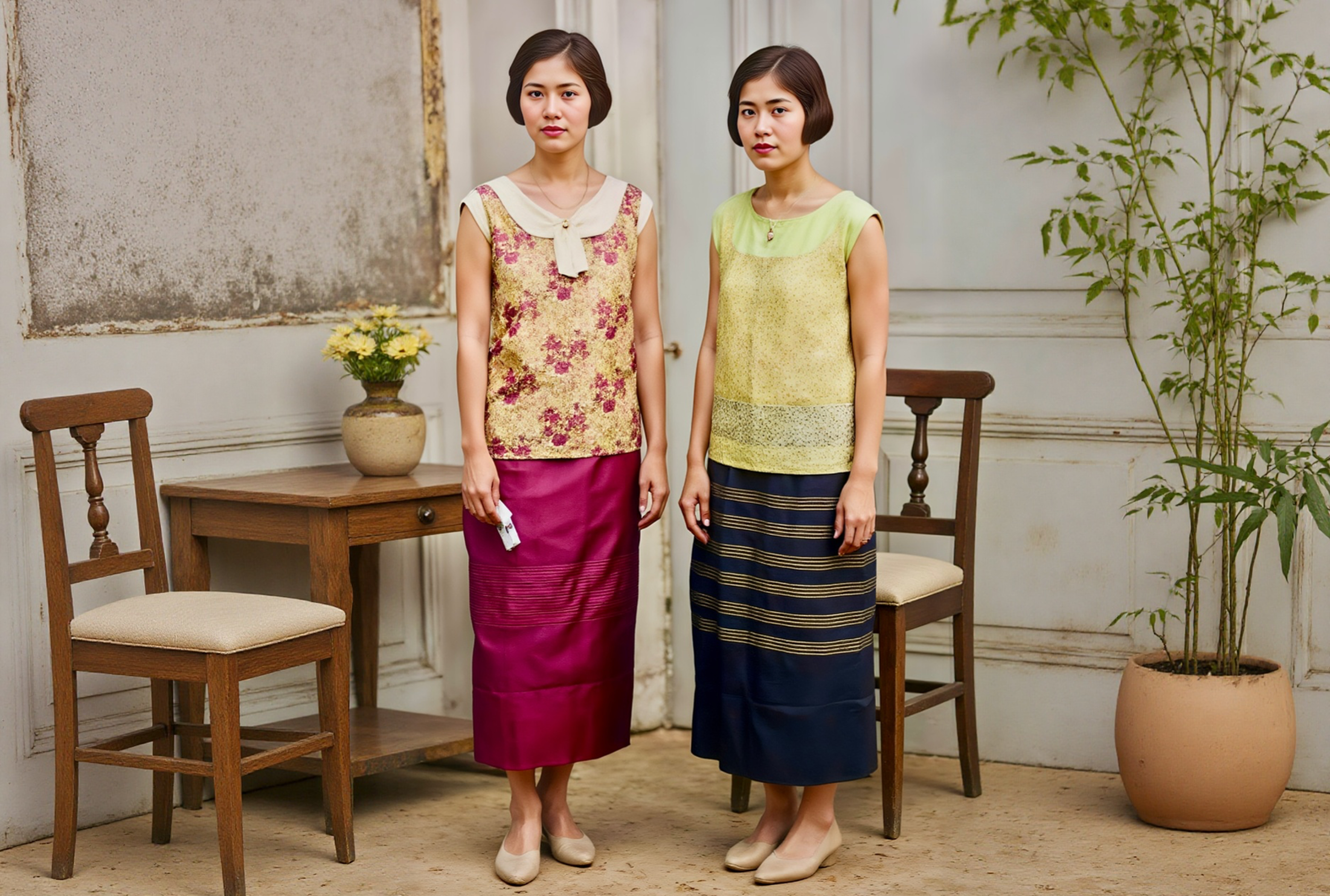
In the early 1930s, Siamese women’s fashion was deeply influenced by the lingering elegance of the 1920s flapper silhouette, adapted to local traditions through the pairing of the pha-sin (ผ้าซิ่น) with long, loose-fitting blouses. This hybrid style became the defining look of modern urban women, particularly among the emerging middle class and elite. The reign of King Prajadhipok (Rama VII) from 1925 to 1935 saw the peak of this style, coinciding with a period of political and societal transformation that would reshape Siamese identity.
Fashion as a Marker of Cultural Shift
The transition into the 1930s saw Siamese women embracing the softened, modest interpretation of Western trends while preserving traditional elements. The straight-cut, drop-waisted look of the 1920s flapper era persisted, but instead of short skirts, Siamese women continued to wear their ankle-length pha-sin, now often woven in fine silk or cotton with delicate floral and geometric motifs. These skirts were paired with boxy or slightly tailored blouses, sometimes adorned with sailor collars, lace trims, or subtle embroidery. The choice of light fabrics reflected both the tropical climate and the evolving role of women in society—practical yet refined, modern yet grounded in tradition.
During this time, Western-style shoes—low-heeled pumps, Mary Janes, or simple black flats—had become the standard for urban women, especially in Bangkok and major towns. In everyday life, open-toe sandals and flip-flops were also commonly worn, reflecting the practical adaptation to the tropical climate.
Late Edwardian Fashion in Siam: A Comparison of Western and Thai Attire During the Early Reign of King Rama VI (1910-1915) (2 of 2)
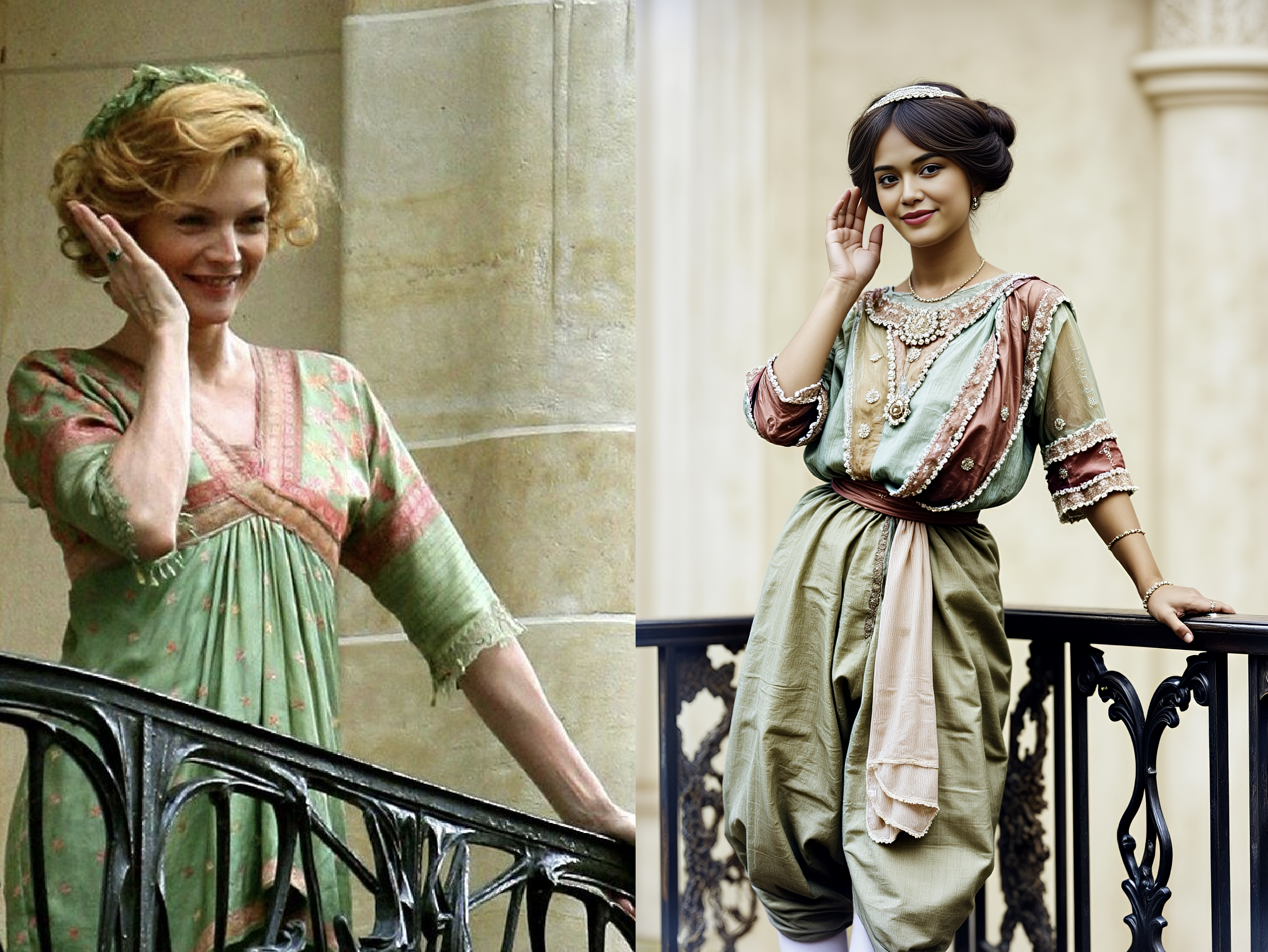
The early reign of King Vajiravudh (Rama VI) marked a period of transformation in women’s fashion in Siam, influenced by Western trends, particularly Late Edwardian fashion, which gradually evolved into the Teens era (1911-1919, aligning with the years ending in -11 to -19, much like the term teenager in English). Upper-class women and the royal court in Siam began to integrate European styles with Thai aesthetics in a refined manner. AI-generated images, based on historical Siamese photographs and Edwardian fashion sources, beautifully illustrate this evolution. While the garments retained Western silhouettes and detailing, they incorporated Thai elements such as diagonal sashes, chongkraben, and royal court accessories, resulting in a uniquely hybridised style.
While Western Edwardian fashion in the late 1910s featured lightweight fabrics, sheer overlays, and softly draped gowns, transitioning away from rigid structures, Siamese fashion of the same period retained chongkraben as a key component, often paired with delicate lace blouses or silk tops influenced by European styles. AI-generated representations may not always depict chongkraben in full detail, but the upper half of the attire still reflects the aesthetics of the Late Edwardian and early Teens era. In the early years of King Rama VI’s reign, high lace collarsremained popular for formal court occasions, mirroring European fashion trends. However, as Western styles evolved, modern Siamese women, particularly those educated abroad or involved in European-style social events, embraced lower necklines and fluid draped fabrics, which became hallmarks of the Teens era.