History of Fashion

The Swinging Sixties: Bangkok Fashion and Its Global Influences
The Swinging Sixties: Bangkok Fashion and Its Global Influences
The inspiration for this AI-generated collection comes from a deep admiration for the golden era of Thai cinema in the 1960s (พุทธศักราช 2503-2512). This period was a defining moment for Thai fashion, where Western influences merged seamlessly with local aesthetics, creating a unique and glamorous style. Thai movie stars of the time, such as Petchara Chaowarat (เพชรา เชาวราษฎร์) and Aranya Namwong (อรัญญา นามวงศ์), were not just celebrated actresses but also fashion icons who epitomised the beauty ideals of their generation. Their meticulously styled hair, elegant dresses, and bold makeup set the standard for Thai fashion, influencing the way women dressed both on and off the screen.
To bring this nostalgic vision to life, I meticulously trained three LoRA models using archival photographs from old magazines, carefully adjusting different weight parameters to achieve an authentic recreation of the era. Each element—hairstyling, makeup, fabric textures, and silhouettes—has been designed with historical accuracy to evoke the feeling of vintage fashion photography from that time. The goal of this collection is to transport viewers back to the vibrant world of 1960s Bangkok, capturing the elegance and charm of an era when Thai fashion was at the crossroads of tradition and modernity.
This AI collection is not merely an artistic experiment but a homage to the cinematic and fashion legacy of Thailand’s most glamorous decade. The meticulously curated visuals reflect how the 1960s fashion in Thailand was shaped by both international influences and local sensibilities, honouring the icons who defined an era of beauty and sophistication.
The 1960s was a transformative decade for fashion across the world, and Bangkok was no exception. The rapid modernisation of Thailand, influenced by political, social, and cultural shifts, led to an embrace of Western styles, particularly in urban centres. Fashion became a marker of progress, youth, and cosmopolitanism, as Thailand continued its transition from a traditional society into a more globally integrated one. Yet, even as Bangkok absorbed the latest styles from London, Paris, and Hollywood, Thai identity remained deeply embedded in its fashion, resulting in a unique fusion of modernity and cultural heritage.
Western Fashion Trends and the Rise of Modernity
The early 1960s retained some elements of the structured, feminine silhouettes of the 1950s, but as the decade progressed, youth-driven fashion began to take centre stage. London became the epicentre of change, with the rise of the Mod movement, championed by designers such as Mary Quant, who revolutionised women’s wear with the miniskirt. Short hemlines, bold geometric patterns, and vibrant colours became synonymous with the youthful rebellion of the time. The influence of Parisian haute couture remained strong, particularly with the sleek and futuristic designs of André Courrèges and Pierre Cardin, who introduced space-age fashion with metallic fabrics, clean lines, and minimalistic silhouettes.
Simultaneously, Hollywood glamour continued to inspire trends, with actresses such as Audrey Hepburn, Elizabeth Taylor, and Brigitte Bardot setting the standard for elegance and sophistication. American fashion adopted a more relaxed approach with the rise of casual wear, embracing slim trousers, tailored blouses, and shift dresses. By the late 1960s, the influence of the counterculture movement introduced psychedelic prints, flowing bohemian dresses, and an overall rejection of formality, paving the way for the more relaxed styles of the 1970s.
Thailand’s Journey Towards Westernisation
Thailand had been steadily Westernising since the 1950s, a process largely driven by its close ties with the United States during the Cold War. The government’s efforts to modernise Bangkok saw an influx of Western media, consumer goods, and pop culture. Hollywood films, international fashion magazines, and American music became widely accessible, influencing the way young Thai women dressed. While the formal Thai dress tradition—rooted in silk-wrapped skirts (pha nung) and Thai-style blouses—remained essential for official and traditional events, everyday attire in Bangkok’s cosmopolitan society increasingly mirrored global trends.
In the early 1960s, the Thai elite and middle class adopted the classic fitted dresses and tailored suits reminiscent of European styles. Silk remained a staple material, but its designs shifted towards more Western cuts. By the mid-1960s, the influence of the London Mod scene was undeniable, with young Thai women in urban areas wearing miniskirts, A-line dresses, and fitted blouses inspired by Twiggy and Jean Shrimpton. Colourful patterns, bold stripes, and geometric shapes became increasingly popular, reflecting the optimism and modernity of the era.
One of the biggest shifts in Thai fashion was the growing acceptance of shorter hemlines. While traditionally, Thai women’s dresses were modest and draped, the 1960s saw a rapid change as skirts gradually rose above the knee. This shift was particularly visible among film stars and socialites, who embraced the new silhouettes. Petchara Chaowarat and Aranya Namwong, two of Thailand’s most celebrated actresses of the era, became style icons, their wardrobe choices influencing thousands of Thai women. Their on-screen costumes frequently featured sleek, figure-hugging dresses, pastel tones, and intricate lace embellishments, blending Western fashion trends with Thai textile craftsmanship.

1950s Fashion in Bangkok: Christian Dior’s New Look
1950s Fashion in Bangkok: Christian Dior’s New Look
During the 1950s (1950–1960), women in Bangkok began widely adopting Christian Dior’s New Look, marking a significant transformation that reflected global fashion trends. Introduced in 1947, the New Look was defined by cinched waists and voluminous skirts, emphasising a graceful and elegant silhouette. Women in Bangkok eagerly embraced these styles, aligning themselves with international fashion trends and symbolising Thailand’s modernisation in the post-war era.
Inspiration from a Vintage Photograph and AI Creation
The inspiration for this collection came from an original black-and-white photograph of Bangkok from the 1950s, depicting commuters walking along a narrow alley. Most women were dressed in traditional Thai attire—blouses paired with pha-sin skirts—but one woman stood out, wearing a full skirt in the style of Dior’s New Look. This rare image provided tangible evidence that the global fashion trend had also reached Bangkok.
Intrigued by this visual contrast, I colourised the original photograph to enhance the details of the clothing, allowing for a clearer representation of how these styles coexisted. From this inspiration, I developed an AI-generated collection, reimagining 1950s fashion in Bangkok influenced by Dior’s New Look, while preserving the historical context of the period.
The Influence of Hollywood and High Fashion Designers
Hollywood cinema played a crucial role in influencing the acceptance of the New Look in Thailand. Iconic actresses such as Grace Kelly, Elizabeth Taylor, and Audrey Hepburn became style inspirations for Thai women, who admired their glamorous appearances and refined femininity. Whether it was full skirts, fitted bodices, V-neck blouses, or elegant accessories, these Hollywood stars set the standard for sophisticated dressing.
Her Majesty Queen Sirikit (as she was known at the time) also played a pivotal role in popularising the New Look in Thailand. Her collaboration with Pierre Balmain, the renowned French designer, in the late 1950s resulted in exquisite royal ensembles that blended the feminine elegance of Dior’s silhouette with delicate Thai aesthetics. The outfits she wore on state visits garnered global admiration and became an inspiration for women in Thailand’s elite society.
Over time, the influence of Hollywood and haute couture designers made fashion in Bangkok increasingly cosmopolitan. Thai women embraced New Look-style full skirts not only for formal gatherings and diplomatic events but also in everyday fashion, reflecting both modern beauty ideals and newfound confidence.

The Development of Thai Fashion in the 1950s: A Fusion of Tradition and Modernity
The Development of Thai Fashion in the 1950s: A Fusion of Tradition and Modernity
During the 1950s (2493–2503 BE), Thai fashion was shaped by both local traditions and increasing Western influences, particularly from France. This period marked a transition from the more practical, post-war simplicity of the 1940s to a more refined and structured style, especially among the urban elite and younger generation. However, many Thai women continued to wear simple and practical clothing, echoing the styles of the 1940s, which blended Thai and Western elements for everyday wear.
One of the most significant Western fashion influences to reach Thailand in this era was Christian Dior’s “New Look”, introduced in 1947 (2490 BE). Defined by fitted bodices, cinched waists, and full skirts, the New Look became an international symbol of femininity and elegance. While this style was widely adopted in Europe and America, its reception in Thailand was more gradual and selective. Fashion-forward women in Bangkok incorporated elements of the New Look, such as A-line skirts and tailored blouses, but adapted them for practicality. Skirts were often less voluminous than their Western counterparts, reflecting the local climate and cultural preferences. Many women also continued wearing tube skirts (ผ้าซิ่น) or slim-cut skirts, which had been popular since the 1920s.

The Adoption of Western Dress Uniform in the Thai Court: A Fashion History
The Adoption of Western Dress Uniform in the Thai Court: A Fashion History
The transition from traditional Siamese court attire to Western-style dress uniforms was a gradual yet significant transformation that reflected Siam’s modernisation efforts during the late 19th and early 20th centuries. This shift was closely tied to King Chulalongkorn’s (Rama V) policies of state reform and diplomacy, which sought to align Siam with global standards while preserving its sovereignty amidst colonial pressures.
The introduction of Western military-style uniforms in the Thai court can be traced back to King Mongkut (Rama IV), who first adopted elements of European dress for diplomatic occasions. However, it was during the reign of King Chulalongkorn (1868–1910) that such uniforms became a formalised aspect of royal and government dress. Inspired by European courts, the King and high-ranking officials began wearing tailored military jackets adorned with medals, epaulettes, and aiguillettes, often paired with traditional phanung chongkraben (a draped lower garment) in the early phases of adoption.
By the time of King Vajiravudh (Rama VI, 1910–1925), the Western-style full dress uniform had become the official court attire for military and civil officials, replacing older hybrid styles. The long-standing tradition of wearing chongkraben with a European jacket gradually gave way to Western trousers, particularly for formal state functions and military ceremonies. These uniforms, influenced by British and French military attire, symbolised discipline, hierarchy, and modern governance in Siam.
Even today, the legacy of these dress uniforms remains visible in Thai official and military attire, particularly in royal ceremonies and state functions. The incorporation of European-style uniforms into the Thai court represents not just a shift in fashion but a deeper cultural and political evolution, balancing modernisation with national identity.
A Birthday Celebration with a Historical Twist! 🎉👑
Since today is my birthday, I thought it would be fun to add AI-generated portraits of myself wearing the early 20th-century Siamese dress uniform from the reign of King Rama VI! I wanted to capture the elegance of that era, with the beautifully embroidered military tunic, high collar, and ceremonial sash that defined the formal court attire of the time.
Do these AI portraits look like real historical photographs? 😆 Let me know what you think! Are they regal enough? Or should I add a few more medals for good measure? 😂
Cheers to another year and to celebrating Thailand’s rich sartorial heritage! 🎂🎖️

King Chulalongkorn and the Royal Hungarian Order of Saint Stephen: A Diplomatic Exchange in the Austro-Hungarian Expedition in 1869
King Chulalongkorn and the Royal Hungarian Order of Saint Stephen: A Diplomatic Exchange in the Austro-Hungarian Expedition in 1869
The AI-generated recreation presented here brings to life a pivotal moment in Thai-European diplomatic history, depicting King Chulalongkorn (Rama V) in full regalia, adorned with the Royal Hungarian Order of Saint Stephen. This prestigious honour was bestowed upon the king by Emperor Franz Joseph I of Austria-Hungary in 1868, marking an important step in Siam’s growing engagement with European diplomacy. The original black-and-white photograph, taken during the Austro-Hungarian expedition to Siam in 1869, has been carefully reimagined in colour, providing a detailed reconstruction of how the king might have appeared at the time.
This ceremonial exchange of decorations was not merely an honorary gesture but part of a broader system of diplomatic gift-giving, deeply rooted in both European chivalric traditions and Siamese courtly culture. In his seminal work The Gift (1925), the French sociologist Marcel Mauss theorised that the act of giving, receiving, and reciprocating gifts is fundamental to social and political relationships. Applying this framework, the bestowal of the Order of Saint Stephen was not a unilateral act of generosity but an invitation to a reciprocal relationship—one that placed Siam within the network of European states and reinforced its sovereignty on the international stage.
The Austro-Hungarian Expedition to Siam (1869): A Historic Diplomatic Encounter
The 1869 Austro-Hungarian expedition to Siam was part of a larger diplomatic initiative aimed at expanding commercial and political ties in Asia. This mission took place during the early years of King Chulalongkorn’s reign, a period in which the young monarch sought to modernise Siam while preserving its independence amidst European colonial expansion. The delegation, led by Wilhelm Burger, a Viennese photographer and painter, was tasked with documenting Siamese society, architecture, and its ruling elite.
One of the most significant moments of this diplomatic exchange was the presentation of the Royal Hungarian Order of Saint Stephen to King Chulalongkorn by Emperor Franz Joseph I. The Order of Saint Stephen, originally established in 1764 by Empress Maria Theresa, was among the most distinguished honours of the Austro-Hungarian Empire. Traditionally reserved for European aristocrats and heads of state, its bestowal upon King Chulalongkorn signified Siam’s increasing status as a recognised and respected sovereign entity in the global diplomatic arena.
The event was meticulously recorded in photographs taken during the expedition, which later became an enduring visual representation of Siam’s engagement with European powers. These images, once attributed solely to Wilhelm Burger, have now been re-evaluated to include the contributions of Francis Chit (Khun Sunthornsathitsalak), the first Thai court photographer. Diaries from Burger’s assistant, Michael Moser, confirm Chit’s involvement, revealing that both Western and Thai photographers collaborated in producing these historic images. As Moser noted in his journal on May 16, 1869:
“We were three photographers: namely a native Siamese who does beautiful things and is also on the river. His name is Francis Chit. My master bought very nice matrices from him.”
This rediscovery challenges the Eurocentric narrative that had long credited Burger alone for these visual records, instead highlighting Siam’s active role in shaping its own diplomatic and visual representation.
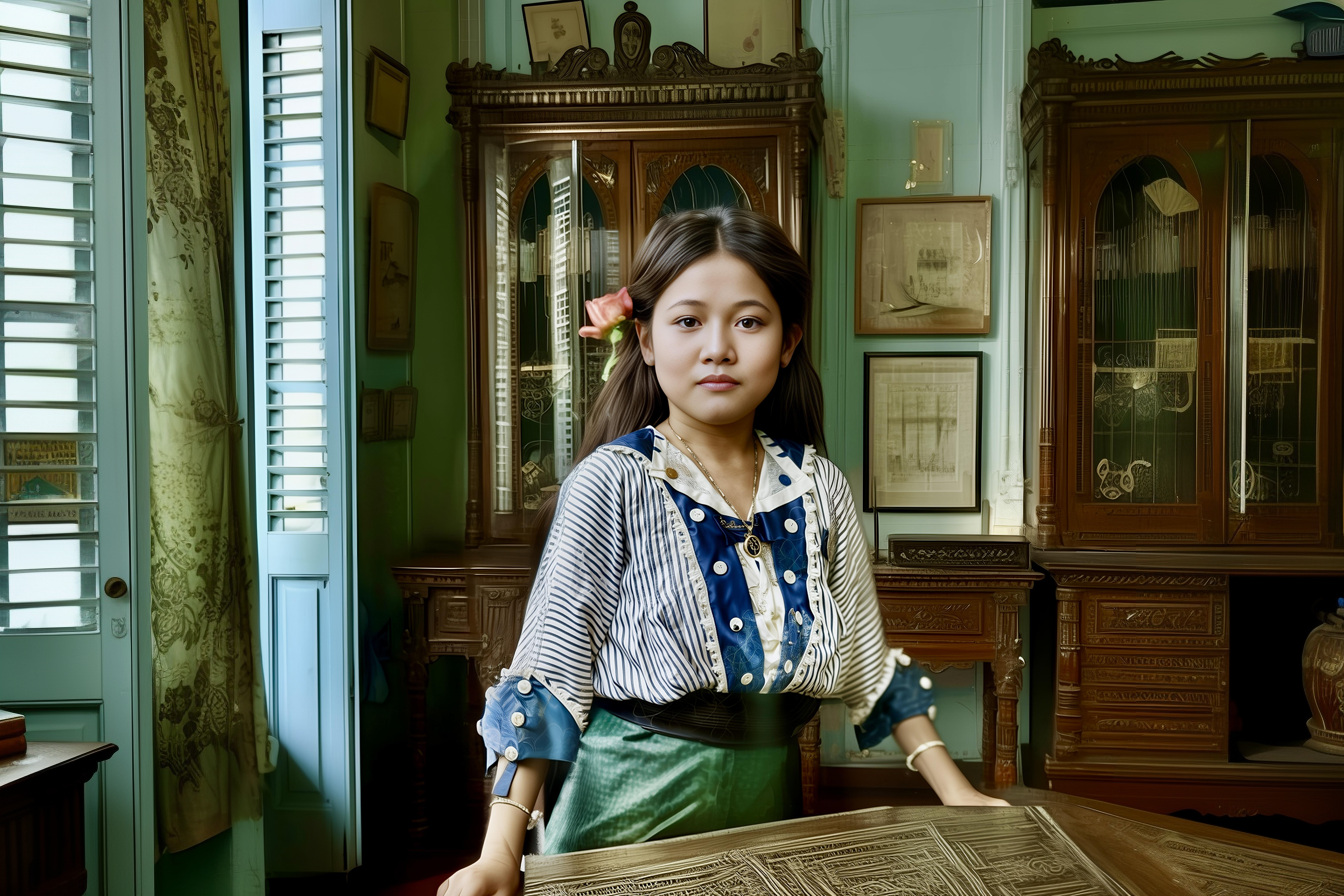
Women’s Fashion in Late Edwardian Siam: A Study of Pre-War Fashion and Western Influences
Women’s Fashion in Late Edwardian Siam: A Study of Pre-War Fashion and Western Influences
Pre-War Fashion and the Influence of the Edwardian Era
Pre-war fashion was a significant period of transition in women's fashion. The early 20th century, particularly the late reign of King Edward VII (Edwardian Era, reigned 1901–1910), marked the final phase of elaborate and structured clothing before garments gradually shifted towards simpler and more practical designs.
During this time, fashion silhouettes were evolving from the rigid, corseted styles of the 19th century into more fluid, movement-friendly designs. This change became especially noticeable in the Teens Fashion period (1911–1919), which introduced a looser silhouette, narrower waistlines, and softer draping.
Pre-War and Post-War Fashion in the Teens Era
The Teens Fashion period (1911–1919) is often divided into two phases:
Early Teens Fashion (1911–1914) → Pre-War Fashion, which retained much of the elegance of the Edwardian era but with a gradual softening of structure.
Late Teens Fashion (1919–1919) → Post-War Fashion, which saw significant changes due to World War I (1914–1918), leading to simpler, practical designs that transitioned into the 1920s styles.
However, in Siam, under the reigns of King Chulalongkorn (Rama V, reigned 1868–1910) and King Vajiravudh (Rama VI, reigned 1910–1925), aristocratic women adopted Western-style blouses while retaining jong kraben, maintaining a distinct fusion of modernity and tradition.
The Importance of Reigning Monarchs in Fashion History
Fashion history is often categorised according to the reigning monarchs of a given period, as their courts influence dress trends. The transition between Rama V and Rama VI in Siam aligns with the Edwardian era and the Teens Fashion period in Britain and Europe, making it essential to consider both in historical fashion studies.
By referencing both Siamese and British monarchs, we can better contextualise the impact of global fashion trends on Siamese court attire, particularly as Western influences grew during the early 20th century.
Estimating Queen Rambai Barni’s Age and Fashion Context
Queen Rambai Barni was born on 20 December 1904 (B.E. 2447). If we examine her black-and-white photographs from childhood, we can estimate that she was between 8 to 12 years old, dating the image to approximately 1912–1916 (B.E. 2455–2459)—a critical period before World War I.
At this time, Western fashion was increasingly influencing Siamese aristocratic attire, especially in the royal court. Western-style blouses with lace embellishments and sailor collars became common, while jong kraben remained the standard lower garment among court women. The continued use of jong kraben in combination with European blouses reflected not only cultural traditions but also complex socio-political and economic factors.

The Evolution of Long Hairstyles in Siam: From ทรงดอกกระทุ่ม (Dok Krathum) to Western-Inspired Styles
The Evolution of Long Hairstyles in Siam: From ทรงดอกกระทุ่ม (Dok Krathum) to Western-Inspired Styles
Hairstyles in Siam have long served as markers of cultural identity, social status, and external influence. One of the most significant transformations occurred between the late 19th and early 20th centuries, when traditional short hairstyles gradually gave way to longer, Western-influenced styles.
While older generations, particularly those who came of age during the reign of King Chulalongkorn (Rama V),continued to favour closely cropped hairstyles, the Edwardian era (circa 1901–1910) marked the gradual rise of longer hairstyles among younger women. This shift reflected not only fashion trends but also broader cultural negotiations between tradition and modernity.

Long Hairstyles in Siam: A Symbol of Identity, Western Influence, and Crypto-Colonialism
The Evolution of Long Hairstyles in Siam: A Symbol of Identity, Western Influence, and Crypto-Colonialism
AI technology has enabled rapid colourisation and enhancement of historical black-and-white photographs, providing a valuable tool for reconstructing the aesthetics of the past. While accuracy may not always be perfect, this process significantly contributes to training AI models to authentically simulate historical beauty standards. The following AI-enhanced photographs showcase the evolution of hairstyles and Western-influenced fashion among Siamese noblewomen in the late 19th century, during the reign of King Chulalongkorn (Rama V). This research is part of my AI model training on long hairstyles in the Siamese royal court.
Hairstyles as Cultural and Political Symbols
Hairstyles serve as important cultural symbols, reflecting identity and social status. Whether in the East or the West, hair is not merely an aesthetic choice but a marker of race, gender, and civilisation. As Sarah Cheang states, ‘Hair is a visible and embodied space where ideas about race, gender, and civilisation are both reinforced and challenged.’ This suggests that changes in hairstyles often reflect broader ideological and political transformations.
Hairstyles and Social Identity in the West
In Western cultures, particularly during the Victorian era, hair was viewed as a reflection of morality, femininity, and social class. Women with long, well-maintained hair were associated with purity, dignity, and elegance, whereas women with short or neglected hair were often seen as challenging social norms. Haircare and grooming rituals reinforced ideas of discipline and propriety, making hairstyles an essential element in the construction of gender and social identity.
Moreover, the significance of long hair extended to ideas of nationalism and colonial encounters. Western powers often regarded the hair customs of indigenous peoples as a sign of ‘backwardness’ and sought to impose their own grooming standards as part of their civilising mission. As Geraldine Biddle-Perry and Sarah Cheang argue in Hair: Styling, Culture and Fashion, ‘Hair plays a significant and dynamic role in fashion, self-presentation, and the construction of social identity.’ Thus, hair was not only a personal feature but also a tool for social control and cultural dominance.

AI-Enhanced Recreation: Imagining the Fashion of Noblewomen in Ubon Ratchathani During the Reign of King Rama V
AI-Enhanced Recreation: Imagining the Fashion of Noblewomen in Ubon Ratchathani During the Reign of King Rama V
This AI-generated project envisions how the noblewomen of Ubon Ratchathani might have dressed during the reign of King Chulalongkorn (Rama V), a time when Thai women's fashion was influenced by Victorian and Edwardian styles. I used key elements such as high-collared lace-embellished blouses paired with traditional pha sin (ผ้าซิ่น) from Ubon Ratchathani as the foundation for generating these images with AI, ensuring that details of sin lai long (ซิ่นลายล่อง, vertically striped pha sin) and lai kruai cherng (ลายกรวยเชิง, stylised border motifs) were as accurate as possible.
The basis of this AI training began with three black-and-white photographs of Mom Chiang Kham (หม่อมเจียงคำ), which are available online. These images were then combined with a dataset consisting of pha sin textiles from Ubon Ratchathani and Edwardian-style blouses. One limitation of training LoRA (Low-Rank Adaptation) for this project was that once the first LoRA was trained and generated a few variations in fashion styles, those images were then used as a new dataset to train the second model.
I trained three AI models based on the images produced by the first two models to create more diverse fashion styles. Through this process, I found that although standard LoRA training typically recommends using similar types of images—such as training portrait models exclusively with images of faces or individuals—my approach of including clothing items like different blouse styles and textiles significantly improved the training process. This allowed the AI to incorporate those elements into the dataset for greater clothing variety, better textures, and more refined details.

A Glimpse into the Past: Victorian-Era Western Fashion in 19th-Century Chiang Mai
A Glimpse into the Past: Victorian-Era Western Fashion in 19th-Century Chiang Mai
This rare glass plate photograph from 19th-century Chiang Mai captures a striking moment in history—four well-dressed Asian men posing in impeccably tailored Victorian-era formalwear. Their frock coats, morning suits, and cravats, combined with carefully placed flowers on their lapels, suggest a significant occasion, possibly a wedding or a formal church ceremony. However, beyond the immediate intrigue of the event, this image serves as a fascinating window into the evolving landscape of men’s fashion in the late Victorian and early Edwardian eras, particularly in regions influenced by Western trends.
The Boutonnière: A Symbol of Ceremony and Status
One of the most striking details in this photograph is the boutonnières—the small flowers pinned to each man’s lapel. This single accessory provides a powerful clue to the nature of the event, as the boutonnière was not merely decorative but a marker of formality and significance in the 19th century.
The boutonnière, derived from the French word for “buttonhole,” was a hallmark of elegance and social standing among gentlemen during the Victorian and Edwardian eras. It was traditionally worn at weddings, religious ceremonies, and formal gatherings, as well as by men of high status at public events.

The Legacy of Mom Chiang Kham Chumphon na Ayutthaya’s Pha Sin (ผ้าซิ่น): The Noblewomen’s Pha Sin of Ubon Ratchathani
Inspiration for This AI-Generated Collection
This AI-generated collection is inspired by three historical photographs of Mom Chiang Kham Chumphon na Ayutthaya, a noblewoman of Ubon Ratchathani. By employing AI technology to recreate these images, I aimed to create her likeness as accurately as possible, particularly her clothing, which reflects the authentic style of the era. The pha sin (ผ้าซิ่น), a tubular skirt traditionally worn by women in Laos, Lanna, and Burma in the 19th and early 20th centuries, appears in these images with vertically striped patterns, known as sin lai long (ซิ่นลายล่อง), meaning "striped pha sin." This style is characteristic of indigenous textiles from Isan and Laos, differing from the horizontally patterned pha sin of Lanna.
In contrast to the widespread use of pha sin (ผ้าซิ่น) in these regions, most Siamese women at the time wore jong kraben(โจงกระเบน), a wraparound lower garment resembling the Indian dhoti, worn in a trouser-like style. The use of pha sin among noblewomen in Ubon Ratchathani thus reflects the region’s cultural connections to the broader Lao-influenced traditions of the Mekong region.
Mom Chiang Kham Chumphon na Ayutthaya was a prominent noblewoman of Ubon Ratchathani during the reign of King Rama V. She played a crucial role in preserving and advancing local textile arts. Passionate about wearing pha sin, she was instrumental in maintaining the exquisite weaving techniques unique to the noblewomen of Ubon Ratchathani. This article explores the historical and artistic significance of these noblewomen’s pha sin, along with Mom Chiang Kham’s contribution to preserving this heritage.

Reimagining a Modern Phu Thai Girl from 1906 Through AI
Reimagining a Modern Phu Thai Girl from 1906 Through AI
When I first encountered a 1906 photograph of a young Phu Thai girl taken during Somdet Krom Phraya Damrong Rajanubhab’s royal inspection of northeastern Siam, I was struck by her distinctive appearance. Unlike the traditional Phu Thai attire of the time, she wore a floral-patterned breast cloth, which hinted at the influence of imported textiles from Europe or China. This detail suggested a fascinating cultural hybridisation, where Western fabrics were being integrated into local dress traditions.
Curious to see how she might have looked with modern clarity, I used AI technology to enhance and reconstruct her likeness. This process brought out intricate details that weren’t immediately apparent in the original photograph, such as the smooth draping of her fabric and the elegance of her traditional high bun (มวยผมสูง). The AI-generated images helped me visualise her as a young woman at the crossroads of tradition and modernity, reflecting the shifting cultural landscape of early 20th-century Siam.
One striking feature in both the original photograph and the AI renderings was her bright, white teeth—an unusual detail considering that betel nut chewing was a common practice among Phu Thai and other ethnic groups in the region. This suggested that she was either too young to have started chewing betel nut or had consciously chosen not to adopt the custom, possibly due to changing beauty standards or exposure to modern influences. By the early 1900s, urban women in Siam had begun to abandon betel nut chewing, and this trend may have reached some rural communities as well.
Her appearance, fashion choices, and unstained teeth indicate that she was not just an ordinary Phu Thai girl but someone who embodied the subtle cultural transformations of her time. She may have belonged to a family with trade connections, had exposure to urban fashion trends, or simply preferred a more "modern" look while maintaining her ethnic identity. These details make her an extraordinary subject for historical and cultural exploration, demonstrating how young women in rural Siam were adapting to new influences while still preserving traditional elements of their heritage.
Through AI-generated images, I was able to reimagine her with greater clarity, allowing us to see the nuances of cultural fusion, fashion, and evolving social customs in early 20th-century Phu Thai society. This project highlights the power of AI in bringing historical figures to life, deepening our understanding of the past, and sparking discussions about how people navigated tradition and modernity over a century ago.

The Fashion History of Phu-Tai Women: Inspired by Photographs of Prince Damrong Rajanubhab During His Official Inspection Tour of the Northeastern Provinces in 1906 (BE 2449). (Article 1 of 2)
The Fashion History of Phu-Tai Women: Inspired by Photographs Taken by the Entourage of Prince Damrong Rajanubhab During His Official Inspection Tour of the Northeastern Provinces in 1906 (BE 2449).
The Phu-Tai Ethnic Group in Laos and Isan, Thailand
The Phu-Tai (or Pu Thai) ethnic group belongs to the Tai-Kadai language family and originally inhabited northern Laos and Vietnam, particularly around the Black and Red Rivers. Over time, waves of migration led to their settlement in central Laos and eventually Thailand, especially in Sakon Nakhon, Nakhon Phanom, Mukdahan, and Kalasin provinces.
During the late reign of King Chulalongkorn (Rama V), Isan was still administratively divided into different "Monthon" (provinces). In 1906 (BE 2449), Prince Damrong Rajanubhab, then Minister of the Interior, conducted an official inspection tour of these regions. Accompanied by photographers, he documented Phu-Tai women’s attire, providing invaluable insights into their clothing traditions of the time.
Phu-Tai Women’s Attire in the Late 19th to Early 20th Century
Phu-Tai women traditionally wore garments woven from locally produced cotton and silk, dyed with natural colours. The characteristic hues of Phu-Tai clothing included deep navy blue from indigo dye and shades of red derived from krang(lac resin). Their attire reflected simplicity and practicality while also conveying aesthetic preferences and cultural identity rooted in an agricultural lifestyle.
Social Characteristics and Textile Culture of Phu-Tai People
Phu-Tai people are known for their diligence, frugality, and strong textile traditions. As a result, various fabrics, including cotton and silk textiles, are commonly found among the Phu-Tai. In particular, Pha Phrae Wa (Phrae Wa fabric) stands out as a highly significant textile in Phu-Tai culture.
Phu-Tai Beliefs and Traditional Textiles
In Mukdahan Province, Phu-Tai communities commonly wear indigo-dyed sin mee cotton skirts in everyday life. For ceremonial occasions, silk sin mee skirts are often dyed in a purplish tone known as Si Pado. Additionally, some textiles share patterns linked to the Tai-Lao heritage of Ubon Ratchathani, such as Sin Thiu, a striped fabric with alternating red and black horizontal lines. Sin Thiu is traditionally reserved for the Yao ancestral spirit ceremony. Women belonging to the Mae Mueang Mo Yao lineage are believed to be required to wear Sin Thiu as dictated by ancestral spirits. While the weaving tradition of Sin Thiu still exists in Mukdahan, Phu-Tai weavers primarily produce Sin Thiu in red-black tones, making it a distinct and significant aspect of Phu-Tai textile identity.

The Aristocratic Women of Monthon Udon: Reconstructing Fashion Historiography of Northeastern Thailand during Prince Damrong’s 1906 Inspection Tour
The Aristocratic Women of Monthon Udon: Reconstructing Fashion Historiography of Northeastern Thailand during Prince Damrong’s 1906 Inspection Tour
I was inspired by the historical photograph of aristocratic women in Isan, specifically from the ruling family of Nakhon Phanom, taken in Udon Monthon approximately 115 years ago. This image, captured in Nakhon Phanom, features Madame Chankasee, the wife of Phra Surakorn Phanomkit (Phum), the provincial registrar of Nakhon Phanom, a key figure in the local administration at the time.
During this period, Prince Damrong Rajanubhab (กรมพระยาดำรงราชานุภาพ), then Minister of the Interior, conducted an official inspection tour of Udon Monthon, Isan Monthon, and Korat Monthon in 1906 (B.E. 2449). His mission aimed to strengthen provincial administration, improve local governance, and reinforce Siamese sovereignty in the Northeast. Accompanied by a photographer, this journey provided some of the earliest photographic evidence of life in the Isan region, allowing us to study the clothing styles, roles of aristocratic women, and the socio-cultural landscape of the time.
What Was a Monton?
In a European context, a Monton (มณฑลเทศาภิบาล) can be understood as an administrative division akin to a "province-general" or "regional governorship", comparable to a French département, a German Regierungsbezirk, or a British colonial residency. The Monton system was part of Siam’s centralisation reformsunder King Rama V, replacing the traditional city-state system (mueang) with a hierarchical structure controlled by the Ministry of Interior.
During this period, Siam was divided into 18 Montons, including Monton Udon, Monton Korat, and Monton Isan in the Northeast. These reforms were intended to modernise provincial administration, improve efficiency, and counter colonial threats from France and Britain.

Reimagining the Portrait of Princess Dara Rasmi through AI: Studying Historical Attire, Burmese Luntaya Acheik, Lanna Teen Jok Hem Borders, and the Political Dynamics of Siam, Lanna, and Burma (2/2)
Reimagining the Portrait of Princess Dara Rasmi through AI: Studying Historical Attire, Burmese Luntaya Acheik, Lanna Teen Jok Hem Borders, and the Political Dynamics of Siam, Lanna, and Burma
For the purpose of studying fashion history, particularly 19th-century court dress and textiles of Thailand, this project explores the hybridisation of Burmese Luntaya Acheik and Lanna Teen Jok Hem Borders in the context of Princess Consort Dara Rasmi. Given the limited availability of historical records and photographs, this initiative aims to create a new historiography by employing AI technology to reconstruct and visualise historical garments.
As part of London based AI Fashion Lab’s efforts to advance research in historical costumes and textiles, this project involves training AI models, including LoRA, to generate historically accurate representations of court dress and woven fabrics. By using AI-enhanced coloured photographs, I have created a digital portrait of Princess Dara Rasmi, reimagining the intricate details of her attire in colour. This work serves to honour her legacy and to bring the textile heritage of Lanna and Burma into a more vivid and accessible visual format.

Restoring a Royal Portrait: Bringing History Back to Life with AI
Restoring a Royal Portrait: Bringing History Back to Life with AI
This royal portrait is a valuable historical image that was originally published by Rambhai Barni Rajabhat Institute in the book Phra Mingkhwan Rambhai Barni, printed by Amarin Printing and Publishing, Bangkok, 2000 (BE 2543). The original portrait was a black-and-white photograph, but through artificial intelligence (AI) technology, I have restored and colourised it to bring it back to life while also enhancing its clarity and enlarging the image to make the details more visible.
Fashion Analysis: Determining the Time Period of the Photograph
Based on the clothing styles and footwear seen in this royal portrait, I can estimate that the photograph was taken in the early 1950s (circa 1950-1952, BE 2493-2495).
His Majesty King Bhumibol Adulyadej (Rama IX)
Dressed in a white suit with a matching tie, a fashion style influenced by Western trends of the era.
Wearing sunglasses, a distinctive feature of His Majesty’s style in his youth.
Her Majesty Queen Rambhai Barni, Queen Consort of King Rama VII
Wearing a three-quarter sleeve dress with simple accessories, reflecting the post-World War II fashion style.
Her hair is styled in an elegant style, a popular hairstyle in the late 1940s to early 1950s.
Her Majesty Queen Sirikit, The Queen Mother
Wearing a short-sleeved, collared dress with a fitted waist and belt, influenced by the “New Look” fashion introduced by Christian Dior, which was highly popular in the early 1950s.
Her hair is styled in soft waves, a hairstyle favoured by aristocratic women of that period.
AI Technology and Historical Image Preservation
The use of AI in restoring this royal portrait not only revives colours from the past but also serves as a method to preserve and share historical images with new generations in a clearer and more detailed format.
This royal portrait is an important historical record, reflecting the royal duties and dignified presence of Thailand’s royal family at that time. It also serves as a reminder of the elegance of Thai culture and fashion during the transition of the 20th century.
📌 Note: I would like to emphasise that this royal portrait has been restored using artificial intelligence (AI) and is not an actual colour photograph from the time period. The colours and details have been digitally reconstructed to provide a historical context.
✨ For those wishing to share this article, I recommend including the restored royal portrait alongside it, allowing interested individuals to study and compare it with the original version.
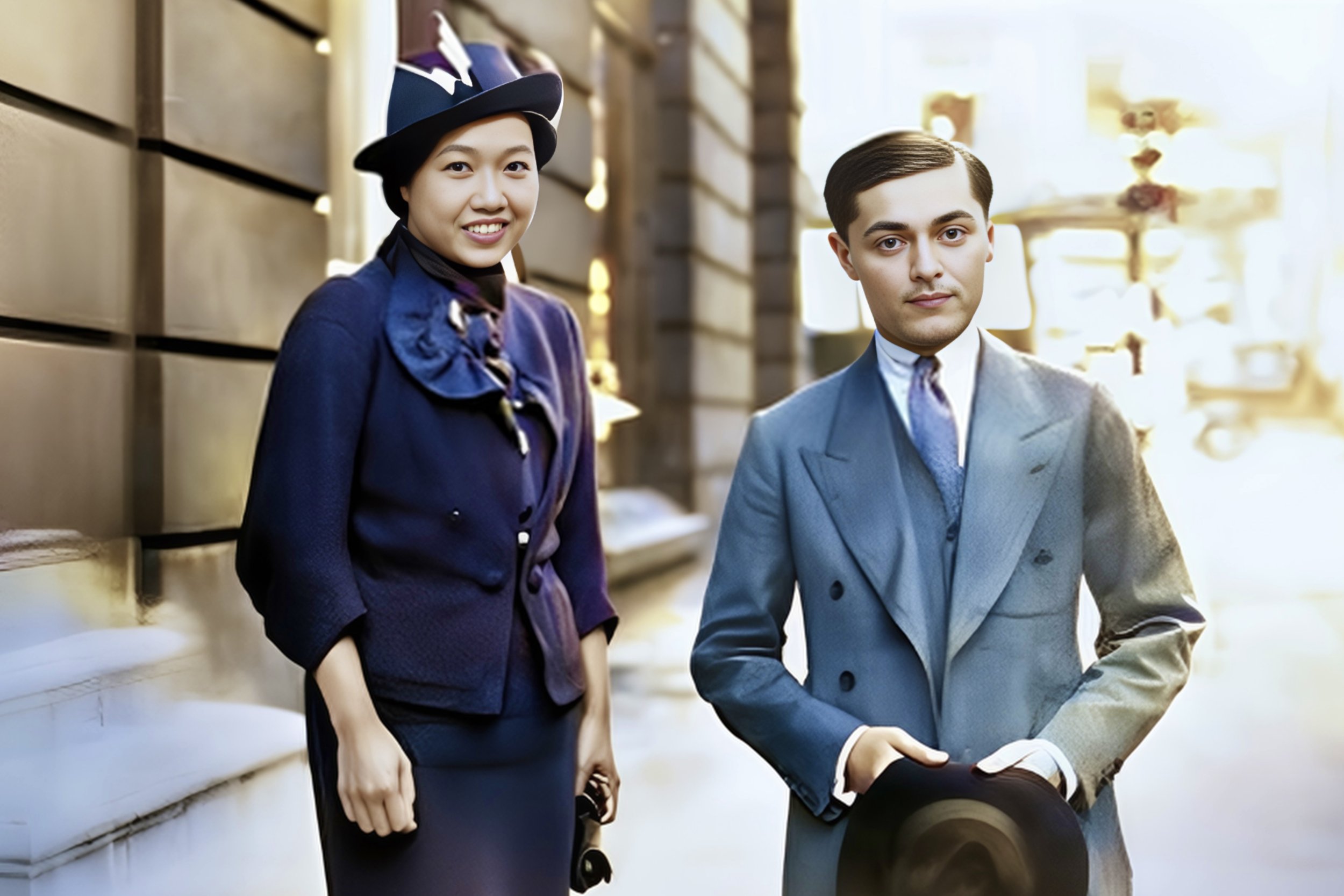
Restoring and Colourising a Historic Photograph of Queen Rambai Barni and Prince Chula Chakrabongse
Restoring and Colourising a Historic Photograph of Queen Rambai Barni and Prince Chula Chakrabongse
The process of restoring and colourising historical photographs offers a unique way to reimagine the past and breathe life into moments once captured in black and white. One such photograph, possibly taken in London during the exile of King Rama VII after the 1932 revolution, features Queen Rambai Barni and Prince Chula Chakrabongse in elegant 1930s attire. Through AI-assisted enhancement, this image has been meticulously restored, addressing several challenges in perspective, costume design, and historical accuracy.
The Original Photograph: A Glimpse into 1930s Fashion
The original image is a black-and-white medium shot portrait, capturing Queen Rambai Barni and Prince Chula Chakrabongse standing on a city street. The photograph showcases the Western fashion influences of the 1930s, a period that saw significant shifts in clothing styles.
Queen Rambai Barni, born as Mom Chao Rambai Barni Svasti, was affectionately referred to within the royal court as "Than Ying Na." This unique moniker, as recounted by Prince Chula Chakrabongse in his memoir Kerd Wang Parusakawan, has a charming origin. As a child, Queen Rambai Barni was playfully called a "turtle" due to her chubby appearance. When asked whether she would prefer to be a "golden turtle" or a "field turtle," she responded with a smile, "I want to be a field turtle!" From then on, she was lovingly known as "Than Ying Na."
Beyond their roles within the Thai royal family, Queen Rambai Barni and Prince Chula Chakrabongse shared a strong friendship that transcended their familial ties. As cousins growing up in the same grand yet tumultuous world of the Chakri dynasty, their bond was one of companionship and mutual respect. This closeness is evident in the photograph, where they appear relaxed and at ease in each other's company.
Fashion Details
Queen Rambai Barni is dressed in a tailored suit-skirt ensemble, complete with a matching hat. Given the fashion trends of the era, it is likely made from wool or another textured fabric, which was a popular choice for women's suits at the time. The hat follows the prevailing style of the 1930s—a departure from the close-fitting cloche hats of the 1920s to a small-brimmed design worn at a tilt. Her skirt falls at a midi length, a fashionable move away from the knee-length silhouettes of the previous decade.
Prince Chula Chakrabongse, on the other hand, wears a well-fitted double-breasted three-piece suit, reflecting the formal menswear trends of the period. His ensemble is complemented by a spearpoint-collar shirt, which was a defining feature of 1930s menswear, and he carries what appears to be a Homburg hat—widely popular across Europe during that time.

Reimagining the Portrait of Princess Dara Rasmi through AI: Studying Historical Attire, Burmese Luntaya Acheik, Lanna Teen Jok Hem Borders, and the Political Dynamics of Siam, Lanna, and Burma
Reimagining the Portrait of Princess Dara Rasmi through AI: Studying Historical Attire, Burmese Luntaya Acheik, Lanna Teen Jok Hem Borders, and the Political Dynamics of Siam, Lanna, and Burma
For the purpose of studying fashion history, particularly 19th-century court dress and textiles of Thailand, this project explores the hybridisation of Burmese Luntaya Acheik and Lanna Teen Jok Hem Borders in the context of Princess Consort Dara Rasmi. Given the limited availability of historical records and photographs, this initiative aims to create a new historiography by employing AI technology to reconstruct and visualise historical garments.
As part of London based AI Fashion Lab’s efforts to advance research in historical costumes and textiles, this project involves training AI models, including LoRA, to generate historically accurate representations of court dress and woven fabrics. By using AI-enhanced coloured photographs, I have created a digital portrait of Princess Dara Rasmi, reimagining the intricate details of her attire in colour. This work serves to honour her legacy and to bring the textile heritage of Lanna and Burma into a more vivid and accessible visual format.
1. AI-Assisted Research on Luntaya Textiles and Their Political Significance
This collection represents an attempt to train AI models to study historical fashion, focusing on the Pha-Sin Luntaya (Burmese Luntaya Acheik textile), a style introduced by Princess Consort Dara Rasmi through the integration of Burmese Luntaya Acheik textiles with Lanna Teen Jok Hem Borders. This hybrid fashion trend embodied political and cultural significance, reflecting the shifting power relations between Siam, Lanna, and Burma (then under British colonial rule).
While LoRA AI models have successfully simulated aspects of Burmese Luntaya weaving, the intricate Acheik wave patterns remain difficult to fully replicate due to their delicate, highly detailed craftsmanship. However, the latest AI-generated images represent the most accurate digital recreations thus far, successfully capturing other elements, including Edwardian fashion details such as upswept hairstyles and lace blouses.
2. Religious and Cosmological Symbolism of Luntaya Acheik Patterns
The Burmese Luntaya Acheik textile is not merely an artistic expression but also a symbol of Buddhist cosmology and religious beliefs. Thai historian Paothong Thongchua describes the spiritual meaning of Acheik wave patterns in Luntaya weaving:
“The wave pattern on this Luntaya Acheik textile carries profound meaning, representing the sacred Sattaboriphan mountains... The layered wave motifs symbolise the peaks of the Sattaboriphan mountains and the great oceans surrounding Mount Meru. The highest peak corresponds to the position of the bun on a Burmese woman’s head, signifying Mount Meru—the cosmic centre of the universe, where Lord Indra and celestial beings reside. Traditional Burmese women style their hair in an elegant bun and adorn it with flowers not merely for beauty but as an offering to the divine.” (Paothong Thongchua, Krungthep Turakij, 30 May 2022)
Following this belief, when Burmese women wore Luntaya Acheik textiles, they symbolically represented the cosmic structure on their own bodies. The seven-layered wave motifs were woven to mirror the seven concentric Sattaboriphan mountain ranges surrounding Mount Meru, the celestial home of Lord Indra in Hindu-Buddhist cosmology.

Studying Historical Attire through AI Modeling: Burmese Luntaya Acheik, Lanna Teen Jok Hem Border, and the Political Dynamics of Siam, Lanna, and Burma
Studying Historical Attire through AI Modeling: Burmese Luntaya Acheik, Lanna Teen Jok Hem Border, and the Political Dynamics of Siam, Lanna, and Burma
1. Introduction: AI Technology and the Study of Historical Fashion
This collection is an effort to train an AI model to study historical fashion, focusing on the Luntaya Acheik (Burmese Luntaya Acheik tubular skirt), a fashion trend initiated by Princess Consort Dara Rasmi. She integrated the Burmese Luntaya Acheik textile with the Lanna Teen Jok Hem Border (a traditional Lanna weaving technique featuring intricate handpicked supplementary weft patterns, typically used to decorate the hem of Pha-Sin skirts), creating a distinctive hybrid style that carried profound political and cultural significance during the transitional period in relations between Siam, Lanna, and Burma (then under British colonial rule).
Although several LoRA AI models have been trained to replicate the Luntaya Acheik wave patterns, the intricate details remain difficult to fully capture due to their high level of complexity and delicate weaving techniques. However, the latest results represent the most accurate visualisations achieved so far. Other elements, such as Edwardian fashion details—including upswept hairstyles and lace blouses—are rendered with high precision.
To enhance accuracy, this collection incorporates real photographs of Burmese Luntaya Acheik textiles alongside AI-generated Luntaya patterns trained using LoRA models and original photographs of Princess Consort Dara Rasmi in her Edwardian lace blouse and Pha-Sin Luntaya with Lanna Teen Jok Hem Border as reference materials.

Traditional Attire of Lao Women in Luang Prabang Under the Last King of Laos, King Mahinthrathibet (Chao Oun Kham) (1868–1895)
Traditional Attire of Lao Women in Luang Prabang Under the Last King of Laos, King Mahinthrathibet (Chao Oun Kham) (1868–1895)
(During the reign of พระเจ้ามหินทรเทพนิภาธร (ເຈົ້າອຸ່ນຄຳ, Chao Oun Kham, เจ้าอุ่นคำ), King of Luang Prabang, 1868–1895, amidst political upheaval and French colonial expansion into Laos)
During the late 19th century, under the reign of พระเจ้ามหินทรเทพนิภาธร (Chao Oun Kham, เจ้าอุ่นคำ), Lao women in Luang Prabang continued to wear traditional pha sin (ผ้าซิ่น) and pha biang (ผ้าเบี่ยง) for both daily life and special occasions such as Buddhist ceremonies, merit-making, and local festivals.
This period was marked by political upheaval, as Luang Prabang faced attacks from the Chinese Black Flag Army, leading to Chao Oun Kham’s temporary exile in Bangkok under the protection of Siam. Between his two ruling periods, he lived in Bangkok, where he provided assistance to Auguste Pavie, a French colonial diplomat who played a crucial role in establishing French control over Laos.
By 1893, after diplomatic efforts led by Auguste Pavie, France formally took control of Laos, incorporating it into French Indochina. This ended Siamese influence in the region, and by 1895, Chao Oun Kham’s reign came to an end, making him the last Lao king under Siamese suzerainty. Despite these political changes, Lao textile traditions remained a strong symbol of cultural identity, especially among women.