History of Fashion

เทรนด์การแต่งหน้าและทรงผมในยุค 1970: การปรับแต่งเสน่ห์แบบตะวันตกให้เข้ากับลุคของหญิงไทย
Recreating the Beauty of 1970s Thailand: An AI-Enhanced Exploration of Makeup, Hairstyle, and Fashion Trends Inspired by Thai Film Actresses
This AI-enhanced collection was created by training a LoRA AI model on authentic photographs from the 1970s, allowing me to faithfully recreate the beauty and fashion trends of the era. By carefully referencing original imagery and refining AI-generated outputs, I have reconstructed the distinct elegance of Thai women during this period, preserving a visual history of how Thai beauty evolved in this iconic decade.The 1970s was a pivotal era for Thai beauty and fashion, shaped by the golden age of Thai cinema, the rise of colour film, and increasing exposure to Western influences through magazines, television, and Hollywood films. This decade marked a shift from traditional Thai aesthetics to a fusion of local elegance with international glamour, as Thai women selectively adopted elements from Western beauty trends while maintaining features that suited Thai facial structures, skin tones, and hair textures.
Unlike previous decades, where classic Thai beauty ideals—full natural brows, soft rounded eyes, and sleek, neat hairstyles—were dominant, the 1970s embraced a more sculpted, dramatic look with ultra-thin brows, bold double eyeliners, dramatic false lashes, and voluminous hairstyles. While the West had its own beauty icons like Farrah Fawcett, Brigitte Bardot, and Cher, their specific styles were not entirely transferable to Thailand due to differences in hair texture, facial features, and climate. Instead, Thai women and local film stars adapted key elements of Western glamour to create a uniquely Thai version of 1970s beauty.
Actresses such as อรัญญา นามวงศ์ (Aranya Namwong), ทัศน์วรรณ เสนีย์วงศ์ ณ อยุธยา (Tasawan Seneewong na Ayutthaya), พิศมัย วิไลศักดิ์ (Pissamai Wilaisak), บุพผา สายชล (Buppha Saichon), เมตตา รุ่งรัตน์ (Metta Roongrat), นวรัตน์ ยุกตนันต์ (Nawarat Yuktanun), and ดวงใจ หทัยกาญจน์ (Duangjai Hathaikarn) became the leading beauty icons of the time. Their signature ultra-thin eyebrows, dramatic eye makeup, voluminous hair, and elegant fashion choices set the standard for women across Thailand. As cinema grew in influence, these actresses’ on-screen looks were imitated by everyday women, shaping trends in makeup, hair, and fashion, and even influencing social perceptions of femininity and elegance.

มรดกทางแฟชั่นจากภาพยนตร์ของสมบัติ เมทะนี และกรุง ศรีวิไล: ประวัติศาสตร์แฟชั่นไทยในทศวรรษ 2510
มรดกทางแฟชั่นจากภาพยนตร์ของสมบัติ เมทะนี และกรุง ศรีวิไล: ประวัติศาสตร์แฟชั่นไทยในทศวรรษ 2510
คอลเล็กชัน AI นี้ มีจุดมุ่งหมายเพื่อนำเสนอมรดกทางแฟชั่นจากภาพยนตร์ของสองดาราภาพยนตร์ไทยระดับตำนาน ได้แก่ สมบัติ เมทะนี และ กรุง ศรีวิไล ผมได้ฝึกโมเดล LoRA เพื่อสร้าง ภาพจำลองด้วย AI ของทั้งสองคน และภาพเหล่านี้สามารถถ่ายทอดเอกลักษณ์และเสน่ห์ที่ทำให้ทั้งสองคนเป็นดาวค้างฟ้าแห่งวงการภาพยนตร์ไทย ภาพจำลองเหล่านี้ เป็นจุดอ้างอิงสำคัญในการทำความเข้าใจแฟชั่นไทย โดยเฉพาะแฟชั่นบุรุษ ในทศวรรษ 2510 (1970s) ซึ่งเป็นยุคที่นักแสดงทั้งสองไม่เพียงแต่ครองจอเงิน แต่ยังมีอิทธิพลต่อกระแสแฟชั่นในประเทศไทย
ยุคทองของภาพยนตร์ไทยและบริบททางแฟชั่น
ทศวรรษ 2510 ถือเป็นช่วงเวลาสำคัญในประวัติศาสตร์อุตสาหกรรมภาพยนตร์ไทย ซึ่งเติบโตอย่างไม่เคยมีมาก่อน มีการสร้างภาพยนตร์ไทยมากกว่า 100 เรื่องต่อปี และ สมบัติ เมทะนี เองเคยร่วมแสดงภาพยนตร์พร้อมกันมากถึง 40 เรื่องในปีเดียว ในช่วงเวลานี้ แฟชั่นไทยเริ่มผสมผสานระหว่าง ความงดงามแบบไทยดั้งเดิม และ อิทธิพลจากโลกตะวันตก ก่อให้เกิดสไตล์ที่สะท้อนถึงความทันสมัยของสังคม ขณะเดียวกันก็ยังคงไว้ซึ่งรากเหง้าทางวัฒนธรรม การเปิดรับแฟชั่นตะวันตกหลังสงครามโลกครั้งที่ 2 ทำให้ประเทศไทยปรับตัวเข้าสู่กระแสสากล ซึ่งนำไปสู่การออกแบบเสื้อผ้าที่มีลักษณะเฉพาะตัว
ในทศวรรษ 2510 กระแสแฟชั่นนี้ได้รับการขับเคลื่อนโดย ดีไซเนอร์ไทย ที่เริ่มสร้างอัตลักษณ์ของตนเอง ด้วยการผสมผสาน องค์ประกอบแบบไทยกับแนวคิดสมัยใหม่ เสื้อผ้าแบบตะวันตกเข้ามามีบทบาทสำคัญในสังคมไทย แต่ในขณะเดียวกัน ผ้าไทยและลวดลายดั้งเดิม ก็ถูกนำไปปรับใช้กับแฟชั่นตะวันตก ทำให้เกิดสไตล์ที่เป็นเอกลักษณ์เฉพาะของไทย
ภาพจำลองด้วย AI ในคอลเล็กชันนี้สะท้อนปรากฏการณ์ดังกล่าวได้อย่างชัดเจน โดยเฉพาะผ่านแฟชั่นของ สมบัติ เมทะนี และ กรุง ศรีวิไล ซึ่งเป็นตัวแทนของการผสมผสานแฟชั่นสากลเข้ากับเอกลักษณ์ไทยได้อย่างลงตัว

1970s Fashion: Social Context, Silhouettes, and Its Representation in Bangkok
1970s Fashion: Social Context, Silhouettes, and Its Representation in Bangkok
The 1970s was a transformative decade in fashion, influenced by shifting cultural, political, and social dynamics. The aftermath of the 1960s counterculture movement, the rise of second-wave feminism, and economic shifts led to a diversification of fashion trends, ranging from relaxed bohemian styles to bold disco glamour. The influence of television, cinema, and international trade further accelerated the spread of global fashion, while local adaptations remained prominent. In Bangkok, the decade saw a unique fusion of these international trends with traditional Thai aesthetics, as seen in magazines and films featuring Thai movie and TV stars. These visual records provide invaluable insight into how fashion was adopted and adapted in Thailand, particularly in urban settings.
Social Context: Global Influence and Local Adaptation
The 1970s saw the rise of a more liberal and expressive fashion culture, driven by the feminist movement, the counterculture revolution, and the disco craze. The decade was also marked by increasing globalisation, which allowed Western fashion trends to permeate different cultures, including Thailand. As Thailand modernised, its film industry flourished, and magazines frequently featured popular actors and actresses dressed in the latest trends.
This period also witnessed a growing middle class in Thailand, leading to greater consumerism and access to imported clothing. Western-style ready-to-wear garments became more widely available, while traditional textiles and silhouettes were reinterpreted for modern fashion. Bangkok, as the cultural and economic hub, embraced these styles while integrating them with traditional elements.
Enhancing historical photos with AI has allowed for a more comprehensive visualisation of 1970s Thai fashion, providing an accurate representation of silhouettes and style choices that were previously confined to cropped magazine covers.
Silhouettes and Key Fashion Trends of the 1970s
The 1970s fashion evolution can be broadly categorised into three phases:
1. Early 1970s (1969–1973): Bohemian and Hippie Influence
Women’s Fashion: Flowing maxi dresses, high-waisted skirts, and peasant blouses were popular. Floral prints and lace detailing were prevalent, often seen in Thai actresses' wardrobes.
Men’s Fashion: Flared trousers, wide-collared shirts, and patterned fabrics dominated. The casual look often included open-necked shirts, influenced by Hollywood and European styles.
2. Mid-1970s (1974–1976): Refined Elegance and Feminine Glamour
Women’s Fashion: Silk and chiffon dresses with delicate embroidery gained popularity. This period saw an adaptation of global trends with traditional Thai elements, such as tailored silk blouses paired with long skirts.
Men’s Fashion: Three-piece suits, with wide lapels and bold patterns, were increasingly common, reflecting international influences. A distinctive feature of men’s fashion during this era was the big wide spearpoint collar shirts, often paired with flared trousers or suits for a dramatic and stylish look.
3. Late 1970s (1977–1979): The Rise of Disco and Power Dressing
Women’s Fashion: Glamorous evening gowns, metallic fabrics, and sequined dresses defined the era. High heels, statement jewellery, and sleek hairstyles became mainstream.
Men’s Fashion: Velvet suits, fitted blazers, and bow ties emerged as formalwear staples, with a shift towards tailored silhouettes.
Fashion in Bangkok: The Influence of Thai Cinema and Magazines
The enhanced AI images from vintage Thai magazines provide a rare glimpse into the full-length fashion choices of the time. Thai actresses and actors were seen embracing global trends while incorporating local aesthetics. Examples of Bangkok fashion trends from the era include:
Women wearing Thai silk blouses with Western-style skirts or trousers, blending modernity with tradition.
Men in sharp suits with flared trousers, reflecting both Western sophistication and regional adaptations.
Elegant evening gowns with intricate embroidery and pastel hues, as seen in high-society events and film premieres.
The Importance of AI-Enhanced Imagery in Fashion History
While magazines from the 1970s provide an authentic documentation of Thai fashion, most original images were focused on close-up portraits, often limiting the view of complete outfits. By enhancing these images using AI, it becomes possible to visualise the era’s fashion in its full-length form, offering a clearer understanding of silhouettes, fabric choices, and styling.
This technological approach not only preserves historical fashion but also initiates discussions on how style evolved in Bangkok, allowing modern audiences to appreciate the intricate details of 1970s Thai fashion.
These AI-enhanced images were inspired by original images from the Facebook page Thai Movie Posters. The contents of that page provide a valuable source for studying 1970s Thai fashion. I would like to extend my gratitude to Thai Movie Posters for their original content, which inspired me to enhance these images for the purpose of fashion study using AI.
Conclusion
The 1970s was a decade of dynamic fashion transformation, blending global influences with local traditions. In Bangkok, movie and television stars served as fashion icons, shaping trends that resonated with urban Thai society. With AI-enhanced imagery, a more complete picture of this fascinating era can be reconstructed, preserving the elegance and evolution of Thai fashion history for future generations.

Honoured to Teach AI for Fashion Design at Chulalongkorn University
I am truly honoured to be invited to teach AI for Fashion Design as part of the AI Fashion Lab at Chulalongkorn University. This opportunity allows me to collaborate with two distinguished experts in the field—Ajarn May and Ajarn Trin from Zenity X—who bring extensive knowledge of AI integration, digital fashion, and technological innovation.
We have been given six lecture sessions, each lasting three hours, covering an extensive range of topics that demonstrate how AI is reshaping the fashion industry. Our curriculum includes:
Centralised Generative AI Platforms – Tools like MidJourney, Krea
Open-Source AI Tools – Exploring ComfyUI, ControlNet, and open-source models
AI in Moving Images and Virtual Catwalks – Using AI-generated animation and 3D virtual showcases
The Challenge of Teaching via Zoom
One of the main challenges of this lecture series is that I am currently based in London, and all of my sessions are delivered remotely via Zoom. While virtual teaching enables broader accessibility, it also presents limitations in interaction, hands-on learning, and real-time guidance. AI for fashion is inherently experimental and visual, requiring immediate adjustments, critiques, and practical application.
In a traditional classroom setting, I would be able to observe students' workflows, guide them through real-time experimentation, and facilitate live discussions that flow naturally. AI-generated fashion design involves an iterative process where small adjustments in the prompt can result in dramatically different outputs. Teaching this remotely means relying on screen sharing, chat discussions, and asynchronous feedback, which can sometimes hinder the fluidity of the learning experience. In-person teaching would provide a far richer and more dynamic environment for learning AI-driven creativity.
Introduction to AI in Fashion
The first lecture began with an introduction to AI in fashion, discussing the role of generative AI in the creative process and its potential to revolutionise how designers conceptualise and visualise their work.
I led a discussion on:
The strengths of AI in fashion, such as its ability to generate endless variations, speed up the ideation process, and assist in trend forecasting.
The weaknesses of AI, including limitations in accuracy, fabric physics, and cultural nuances that require human intervention.
The biases embedded in AI models, particularly in fashion imagery where most AI-generated models default to white female figures in Western clothing. This led to an important discussion on how AI-generated diversity can be improved by designing intentional prompts that account for different ethnicities, body types, and fashion influences.
How AI Prompts Shape Fashion Imagery
AI-generated images are only as effective as the prompts used to create them. Unlike traditional photography or hand-drawn fashion sketches, where designers have direct control over every aspect of the image, AI-generated fashion is dictated by language—the words and structure used in prompts define the outcome.
For this reason, I introduced students to a structured approach to writing AI prompts for fashion imagery. The goal is to create clear, intentional, and detailed prompts that result in high-quality, stylistically accurate, and conceptually aligned AI-generated fashion images.

Are You Ready for Songkran? 💦🌸 A Celebration of Colour, Culture & 1960s Retro Style
Are You Ready for Songkran? 💦🌸 A Celebration of Colour, Culture & 1960s Retro Style
Songkran, Thailand’s most exciting and vibrant festival, is almost here! As the Thai New Year, it is a time of joy, renewal, and, of course, the famous water fights that take over the country. From the streets of Bangkok to small villages, locals and visitors splash water on each other, symbolising the washing away of the past year's misfortunes and welcoming fresh beginnings.
But Songkran is more than just water—it's about celebration, community, and embracing Thai cultural heritage. And what better way to do that than through fashion? This AI-enhanced collection is a bold, contemporary fusion of 1960s men’s fashion with Thai tradition, bringing the Flower Power movement and Mon Rak Luk Thung (มนต์รักลูกทุ่ง) vibes into the modern Songkran scene.
🌼 The Flower Power Movement: A Revolution of Peace & Style
The Flower Power movement emerged in the mid-1960s in Berkeley, California, as part of the growing anti-Vietnam War protests. Young activists, often called hippies, rejected war and materialism, instead promoting peace, love, and harmony. They adopted flowers as symbols of non-violence, wearing them in their hair, handing them to soldiers, and incorporating floral prints into their clothing as a message of peace.
🌻 How it Influenced Fashion:
Bold floral prints became a symbol of freedom and rebellion.
Loose, relaxed silhouettes reflected the movement’s carefree spirit.
Bright, vibrant colours represented optimism and a break from conservative styles of previous decades.
This spirit of peace, joy, and togetherness perfectly aligns with Songkran, which is also a time for people to forgive, reconnect, and celebrate life. The floral shirts and tropical hues in this collection echo the same ideals—bringing people together in a joyous, colourful way.
🎨 Psychedelic Fashion: The Art of the Mind-Bending
While Flower Power was rooted in activism, the psychedelic movement grew out of the 1960s counterculture’s fascination with art, music, and expanded consciousness. Influenced by the surreal, dreamlike effects of psychedelic experiences, fashion took on wild, swirling patterns, optical illusions, and clashing colours.
This trend was seen in:
Music Festivals like Woodstock, where young people wore psychedelic prints and eccentric styles.
Thai Luk Thung Singers who embraced bold floral shirts, wide collars, and eye-catching colours, much like Western musicians of the time.
This connection makes psychedelic fashion a perfect fit for Songkran, where fun, vibrancy, and expressive style are at the heart of the celebrations. The AI-enhanced designs in this collection bring those trippy patterns, neon hues, and groovy prints into a Thai context, merging nostalgia with contemporary style.
💦 Songkran Meets 1960s: A Fun, Retro-Thai Fusion
This collection reimagines 1960s men’s fashion with a Thai cultural twist, perfect for the vibrant energy of Songkran:
🎨 Neon Colour Palette – Inspired by psychedelic art and the bright hues of Thai festival fashion, these looks are bold and unforgettable.
🌸 Oversized Floral Prints – A nod to Flower Power, featuring loud, tropical blooms that blend vintage style with modern-day Songkran fun.
🧣 Thai Heritage Touches – Traditional pha-khao-ma (ผ้าขาวม้า) patterns are subtly woven into belt designs and accents, honouring local craftsmanship.
💈 1960s Hairstyles – The longer, sleek styles worn by men of the era (think Elvis, The Beatles, and Thai Luk Thung singers) add a nostalgic yet timeless charm.
🌞 Ready to Make a Splash? Celebrate Songkran in Full Colour!
Fashion is more than just clothing—it’s a way to celebrate culture, express yourself, and have fun! This Songkran, embrace the spirit of the 1960s and the vibrant heart of Thai tradition with a look that’s bold, stylish, and full of life.
Let’s bring the Flower Power energy to Songkran—one splash at a time! 💦🌼✨

The Fashion History of "Sin Kan Kho Khwai" (ซิ่นก่านคอควาย) or "Sin Lae" (ซิ่นแหล้): A Legacy of Northern Thai Textiles
The Fashion History of "Sin Kan Kho Khwai" (ซิ่นก่านคอควาย) or "Sin Lae" (ซิ่นแหล้): A Legacy of Northern Thai Textiles
This article explores the history, cultural significance, and traditional craftsmanship of Sin Kan Kho Khwai (ซิ่นก่านคอควาย), also known as Sin Lae (ซิ่นแหล้), a distinctive textile of the Thai Yuan people from Northern Thailand. With its striking black fabric and bold red bands, this traditional pha sin (ผ้าซิ่น) reflects the rich heritage of Lanna dress culture. The article also examines the integration of AI technology in visualising and preserving historical textiles, offering a glimpse into how these garments might have appeared in full colour decades ago.
A few days ago, I came across a post featuring Sin Kan (ก่าน) Kho Khwai (ซิ่นก่านคอควาย) or Sin Lae (ซิ่นแหล้) in original black-and-white photographs. These photos were taken in Phrae, possibly in a morning fresh market between the 1950s and 1960s (พ.ศ. 2493–2509). The images captured local women wearing this distinct pha sin (ผ้าซิ่น), a striking example of traditional Northern Thai textiles. Seeing these photographs, I felt it was a shame that they were not documented in colour.
Inspired by these archival photos, I embarked on a project to colourise them and use them as a foundation to train a LoRA model. This allowed me to generate historically accurate AI-enhanced images showcasing Sin Kan (ก่าน) Kho Khwai (ซิ่นก่านคอควาย) as it might have appeared in full colour over 70 years ago. I hope that this AI-generated collection will be valuable to collectors, students, and enthusiasts of Thai textiles, helping to preserve and document historical evidence in colour.
As someone passionate about the study of historical fashion and textile preservation, I see AI as a powerful tool for reconstructing and visualising garments that were once only available in faded or black-and-white records. AI-enhanced images provide a way to imagine and revive textile traditions, allowing us to study the structure, colours, and patterns of traditional dress with more depth. However, AI is only as accurate as the references used to train it. While my AI-generated Sin Kan (ก่าน) Kho Khwai (ซิ่นก่านคอควาย) images closely reflect the real garments, slight variations in pattern placement or stripe thickness can occur. Nonetheless, the results serve as an effective visual reconstruction, making these garments more accessible to modern viewers and researchers.

Fashion of Queen Rambhai Barni in Exile: A Reflection of 1920s and 1930s Elegance
Fashion of Queen Rambhai Barni in Exile: A Reflection of 1920s and 1930s Elegance
Queen Rambhai Barni, wife of King Rama VII, found herself in exile in England following the 1932 Siamese Revolution, which marked the end of absolute monarchy in Siam. During her years abroad, her wardrobe evolved in tandem with European fashion trends, particularly British styles of the 1920s and 1930s. Her clothing reflected both her royal heritage and the influence of Western styles, as she adapted to life in Britain while maintaining elements of her Siamese identity.
1920s: The Roaring Twenties and the Shift to Modernity
The 1920s marked a drastic departure from the Edwardian era’s structured silhouettes and corsetry. Women’s fashion embraced a more liberated style, reflecting post-war societal changes. Hemlines rose to the knee, and dresses featured straight, dropped waists, rejecting the curves that had previously dominated fashion. Queen Rambhai Barni’s attire from this period would have followed these trends, incorporating luxurious fabrics and embellishments suitable for a royal figure.
Key fashion elements of the 1920s seen in the Queen’s wardrobe:
Drop-waist dresses with a looser silhouette, as seen in her photographs.
Delicate lace and embroidery, maintaining a refined and elegant aesthetic.
Short, bobbed hairstyles which were common for modern women of the time.
1930s: Elegance in Exile
As Queen Rambhai Barni and King Rama VII settled in England, the 1930s brought a new wave of fashion. The Art Deco influences of the late 1920s transitioned into a more sophisticated and form-fitting silhouette. The Great Depression affected fashion trends, leading to the adoption of more practical yet refined styles.
Defining features of 1930s fashion in the Queen’s wardrobe:
Longer, more fitted gowns that embraced a natural waistline, moving away from the drop-waist styles of the 1920s.
Draped and bias-cut dresses, inspired by designers such as Madeleine Vionnet and Elsa Schiaparelli, offering a fluid, elegant silhouette.
Smart tailored suits, which were favoured by aristocratic and royal women in England.
Fur-trimmed coats and accessories, a staple of 1930s winter fashion, reflecting luxury and status.
Hats with intricate designs, often small and asymmetrical, in contrast to the large-brimmed Edwardian styles.
During her time in England, Queen Rambhai Barni’s attire would have also reflected the influence of British aristocratic dressing, particularly in outdoor settings and social gatherings. Tweed suits, tailored coats, and elegant day dresses became part of her wardrobe as she adjusted to life abroad.
Historical Context and Fashion in England
The 1930s in Britain saw a shift towards more structured and practical fashion due to the economic hardships of the Great Depression. However, for the upper class and royals, clothing remained a symbol of status. The period was defined by:
The increasing popularity of trousers for women, particularly among the fashionable elite.
Hollywood’s influence on glamour, with figures like Marlene Dietrich and Greta Garbo shaping elegant evening wear trends.
The rise of British designers, such as Norman Hartnell, who would later become the official dressmaker to Queen Elizabeth II.
Queen Rambhai Barni’s wardrobe choices would have been a balance between adapting to British styles and maintaining elements of traditional Siamese fashion. While she embraced Western silhouettes, her use of Thai silk and embroidered detailing remained a subtle nod to her heritage.
Bringing History to Life Through AI-Enhanced Images
The AI-enhanced images in this collection provide a glimpse into Queen Rambhai Barni’s elegant wardrobe evolution. Through colourisation and enhancement, these images help us visualise the richness of her attire and the broader context of 1920s and 1930s fashion. The imagined colours remain historically appropriate, reflecting the palettes and textiles of the era.
By preserving and studying these photographs, we honour the Queen’s legacy and her role in Thai and British fashion history, illustrating how royal figures adapted to changing times while maintaining their cultural identity.

Princess Bahurada Manimaya (สมเด็จพระเจ้าบรมวงศ์เธอ เจ้าฟ้าหญิงพาหุรัตมณีมัย กรมพระเทพนารีรัตน์)(19 December 1878 – 27 August 1887)
This AI photo collection was created upon request from a fan page that deeply respects and honours the legacy of Princess Bahurada Manimaya (Thai: พาหุรัตมณีมัย; RTGS: Phahuratmanimai) (19 December 1878 – 27 August 1887), a princess of Siam and a royal daughter of King Chulalongkorn (Rama V of Siam). I enhanced and refined the original black-and-white photograph to restore its details more clearly.
Princess Bahurada Manimaya was the eldest daughter of King Chulalongkorn and was born to Queen Saovabha Phongsri, the Queen Mother on 19 December 1878. At birth, she had not yet received a formal royal title, and therefore, the courtiers referred to her as "Princess Ying Yai" (ทูลกระหม่อมหญิงใหญ่) meaning "Elder Princess," as she was the first daughter of Queen Saovabha Phongsri.

Princess Wimon Nakanaphisi (พระเจ้าลูกเธอ พระองค์เจ้าวิมลนาคนพีสี)(2 October 1889 – 20 February 1892)
Yesterday, a reader and a page follower asked if I could help enhance a portrait of Princess Wimon Nakanaphisi (พระเจ้าลูกเธอ พระองค์เจ้าวิมลนาคนพีสี), the daughter of Princess Dara Rasmi (เจ้าดารารัศมี) and King Chulalongkorn (พระบาทสมเด็จพระจุลจอมเกล้าเจ้าอยู่หัว, รัชกาลที่ 5), as he wanted to use this portrait as a prototype for a copper repoussé artwork. So, I created a special image according to his request.
Additionally, there is an interesting article on Silpa Wattanatham (ศิลปวัฒนธรรม) about the event when Princess Dara Rasmi (เจ้าดารารัศมี) sent the portrait of herself and her daughter, Princess Wimon Nakanaphisi (พระเจ้าลูกเธอ พระองค์เจ้าวิมลนาคนพีสี), to Chiang Mai, which deeply moved Prince Ruler of Chiang Mai, Inthawichayanon (พระเจ้าอินทวิชยานนท์), her father. He arranged a grand procession to receive the portrait from the residence of Prince Sonabandit (พระองค์เจ้าโสณบัณฑิต), the special commissioner in Chiang Mai.
The records of Prince Sonabandit (พระองค์เจ้าโสณบัณฑิต) state that Prince Ruler Inthawichayanon (พระเจ้าอินทวิชยานนท์), upon seeing the portrait, could not hold back his tears. He remarked that the eyebrows of Princess Wimon Nakanaphisi (พระเจ้าลูกเธอ พระองค์เจ้าวิมลนาคนพีสี) strongly resembled those of Princess Consort Thip Kasorn (เจ้าแม่ทิพเกสร), the mother of Princess Dara Rasmi (เจ้าดารารัศมี). Other northern royals who attended were also filled with joy and admiration for the portrait.
The procession was conducted in a grand and elaborate manner, with the Khum Chao Luang Nakhon Chiang Mai (คุ้มเจ้าหลวงนครเชียงใหม่) beautifully decorated. Prince Ruler Inthawichayanon (พระเจ้าอินทวิชยานนท์), dressed in a royal robe and crown, personally ascended the ceremonial platform to receive the portrait, embracing it with deep joy. A Buddhist prayer ceremony was then held at the royal residence.
In the evening, Prince Ruler Inthawichayanon (พระเจ้าอินทวิชยานนท์) hosted a lavish banquet, inviting foreign consuls and expatriates in Chiang Mai to join. The celebrations included traditional boxing, theatre performances, gambling games, and the scattering of Kalpapruek fruits (symbolic donations). The grand festivities lasted for four days and four nights.

Fashion of the Kaleng Men and Phu Tai Women from Monthon Udon during the Reign of King Rama V (1907)
Fashion of the Kaleng Men and Phu Tai Women from Monthon Udon during the Reign of King Rama V
During the reign of King Chulalongkorn (Rama V), the clothing of indigenous people in Monthon Udon (มณฑลอุดร)reflected their cultural identity and long-standing traditions. Ethnic groups such as the Kaleng (กะเลิง) and Phu Tai (ภูไท)continued to preserve their distinctive traditional dress, which remained an essential part of their heritage.
Rare Photographs and Historical Records
This study of fashion originates from historical photographs taken during the royal inspection of Prince Damrong Rajanubhab (สมเด็จพระเจ้าบรมวงศ์เธอ กรมพระยาดำรงราชานุภาพ) in B.E. 2449 (1906) across Monthon Udon and nearby territories. These images captured the attire of men and women of that era and were initially colourised through the web page Colorised of Esarn. Though the website is no longer updated, these historical images have inspired the creation of the AI Photo Collection, presenting individuals in a more realistic and dimensional manner.
Attire of Kaleng Men (ชายเผ่ากะเลิง)
Kaleng men in this period typically wore long-sleeved shirts or round-neck shirts made of handwoven cotton, particularly indigo-dyed fabric (ผ้าย้อมคราม), a hallmark of the region. However, for artistic purposes in the AI Photo Collection, I have introduced a variety of colours beyond the traditional navy blue.
For the lower garment, Kaleng men often wore short-hitched loincloths (เตี่ยวแบบหยักรั้งสั้น), a practical style suited for their active lifestyle, including trekking, hunting, and labour-intensive work. Additionally, they commonly wore waist sashes (ผ้าคาดเอว) to add detail to their outfit.
Attire of Phu Tai Women (แม่ญิงภูไท)
Phu Tai women dressed elegantly while preserving their ethnic heritage. The Sin Lai Long (ซิ่นลายล่อง), a signature woven tubular skirt, featured vertical striped patterns. It was commonly dyed in deep navy blue (กรมท่า) or dark indigo (คราม) with contrasting white (ขาว) decorative details.
One of the most distinctive elements of Phu Tai clothing was the Sin Mii Tin To (ซิ่นหมี่ตีนต่อ), which refers to a continuous weave where the hem is integrated with the skirt rather than being attached separately. A well-known variation is the Tin To (ตีนเต๊าะ), a narrow hem measuring 4-5 inches (มือ) in width, favoured by Phu Tai women. These skirts were often woven in Mii Sat (หมี่สาด) patterns and dyed using deep indigo vats, resulting in a colour so dark that locals referred to it as "Pa Dam (ผ้าดำ)" or "Sin Dam (ซิ่นดำ)".
A distinctive feature of Sin Mii (ซิ่นหมี่) among Phu Tai women was the intricate weaving and patterns, such as Mii Pla (หมี่ปลา), Mii Tum (หมี่ตุ้ม), Mii Krachang (หมี่กระจัง), and Mii Kho (หมี่ข้อ). Instead of weaving the entire fabric in a single pattern, these motifs were separated by intermediate designs. The preferred colour palette included green (เขียว), navy blue (น้ำเงิน), red (แดง), and purple (ม่วง), with the base fabric typically woven from natural-coloured cotton resembling sugarcane husk (เปลือกอ้อย). Additionally, some groups of Phu Tai women also produced black-and-white tie-dyed cotton fabric (ผ้ามัดหมี่ฝ้ายขาวสลับดำ).
Phu Tai Women's Blouses (เสื้อแม่ญิงภูไท)
Phu Tai women traditionally wore three-quarter sleeve blouses (เสื้อแขนกระบอกสามส่วน), fastened with plain buttons (กระดุมธรรมดา), silver buttons (กระดุมเงิน), or old Thai coins (เหรียญสตางค์), such as 5-satang (ห้า) and 10-satang (สิบ) coins, which were lined in neat rows. These blouses were typically made from deep indigo-dyed fabric (ผ้าย้อมครามเข้ม).
Around B.E. 2480 (1937), a new feature was introduced—red-edged fabric (ผ้าขลิบแดง) stitched along the collar (คอ), placket (สาบเสื้อ), and sleeve cuffs (ปลายแขน). This addition became an essential element in Phu Tai dance costumes from Sakon Nakhon (ฟ้อนภูไทสกลนคร), a tradition that continues to this day.

Restoring and Enhancing Fashion Through AI: A Study on Full-Length Images of Mitr Chaibancha (มิตร ชัยบัญชา)
Restoring and Enhancing Fashion Through AI: A Study on Full-Length Images of Mitr Chaibancha (มิตร ชัยบัญชา)
In the ever-evolving world of digital restoration and AI-generated fashion studies, new tools have opened up possibilities that were once limited by the quality and availability of historical photographs. A prime example of this is the restoration and enhancement of full-length images of Mitr Chaibancha (มิตร ชัยบัญชา), reconstructed from headshots and portraits found online. Through AI-assisted editing, these photographs not only regain their former clarity but also allow for the recreation of possible garments that were not originally captured in the image.
The Role of AI in Fashion Restoration and Recreation
AI technology plays a crucial role in restoring and studying vintage fashion. It aids in visualising complete ensembles by generating missing elements of an outfit, helping historians, designers, and enthusiasts gain deeper insights into past fashion silhouettes. With the ability to reconstruct and enhance imagery, AI provides a bridge between historical accuracy and creative speculation, allowing us to reimagine how figures like Mitr Chaibancha might have dressed in their full ensembles.
While AI is very clever in enhancing missing garments as it has been trained on an abundant collection of images, the understanding of fashion history is also crucial in prompting and selecting result images with the correct silhouette, cuts, fabrics, details, and colours. By using the right fashion terminology, AI can provide the best possible outcome from our detailed prompts.

Men's Fashion in the 1960s: Western Influence on Thailand's Fashion Landscape and a Tribute to Mitr Chaibancha
Men's Fashion in the 1960s: Western Influence on Thailand's Fashion Landscape and a Tribute to Mitr Chaibancha
This AI-enhanced collection began as a restoration project aimed at preserving and showcasing the fashion of Mitr Chaibancha (มิตร ชัยบัญชา) in the 1960s. Most of the available photographs of Mitr found online are portrait shots, which, while capturing his charisma, lack full-body images that could provide a clearer understanding of his complete outfits and 1960s men's fashion trends. As a result, studying his clothing choices and overall style was challenging.
To bridge this gap, I undertook a photo restoration and enhancement process, carefully reconstructing and expanding many of his original images into full-body photographs. This approach not only highlights Mitr's personal style but also allows for a deeper exploration of the fashion silhouettes, tailoring, and accessories of the 1960s.
Building upon this restored visual archive, I then trained a LoRA (Low-Rank Adaptation) model using a dataset of complete 1960s men's fashion photographs, ensuring that the AI-generated images accurately reflect the era's distinctive fashion elements. This collection, therefore, is more than just a tribute to Mitr Chaibancha—it is a historical fashion study that brings his style and the aesthetics of 1960s Thailand back to life through AI-driven restoration and creative exploration.
The 1960s represented a revolutionary period in global men's fashion, witnessing dramatic transformation from conservative styles to bold expressions of individuality. This fashion revolution extended globally, reaching Thailand where Western influences became increasingly prominent while still negotiating with traditional Thai elements. At the centre of Thailand's cultural landscape during this vibrant era stood Mitr Chaibancha (มิตร ชัยบัญชา), the legendary actor whose fashion sense, charisma, and tragic death cemented his status as Thailand's most beloved film star of all time. His influence on Thai fashion and culture transcended his films, creating a legacy that continues to resonate in Thailand today.
The Evolution of Men's Fashion in the 1960s
The early 1960s saw a continuation of 1950s hairstyles, including crew cuts and pompadours, reflecting the lingering influence of Rock and Roll culture. However, as British bands like The Beatles and The Rolling Stones gained international acclaim, a significant shift toward longer, more relaxed hairstyles began to take hold. The Beatles, with their distinctive "mop-top" haircuts, marked the beginning of this transformation, influencing young men worldwide to adopt fuller, more natural hairstyles.
The influence of British music bands on 1960s men's hairstyles was undeniable. These bands not only provided the soundtrack of the era but also served as style icons, shaping how men chose to express themselves through their appearance. While The Beatles popularised the neat mop-top look, The Rolling Stones brought a more rebellious edge to men's fashion. Members of the band, especially Mick Jagger and Keith Richards, sported longer and messier hair, a stark contrast to the clean-cut Beatles. This style became known as the "shag" and embodied the spirit of rock 'n' roll rebellion, encouraging men to embrace a more carefree and wild appearance.
The Rise of Mod Fashion
Perhaps the most significant fashion movement to emerge during this era was the Mod (short for "Modernists") style that originated in Britain. First introduced to American youth in 1964 by British pop bands appearing on television programmes like The Ed Sullivan Show, Mod fashion quickly spread globally, including to Thailand.
The Mod look was characterised by its clean lines and sharp silhouettes. The 1960s mod look mixed skinny rib body shirts, turtlenecks, mod print jumpers in vibrant colours, dress shirts in bold stripes or big prints, skin-tight low waist trousers with a small flare, fitted blazers in rich fabrics (velvet, silk, damask), and skinny ties or silk neckerchiefs in bright solid colours. Attention to detail was the hallmark of a Mod suit, featuring eye-catching linings, 3-button fastening, side vents, ticket pockets, button detailing, notch lapels, and a slim silhouette.
Men's suits underwent a significant transformation during this period. Traditional, conservative suits gave way to more experimental designs featuring narrow lapels, slim-cut jackets with three or four buttons (rather than the traditional two), and sharkskin (two-tone mohair with a shine) materials. The "skinny suit" became emblematic of the era, with slim silhouettes replacing the looser, more comfortable cuts of previous decades.
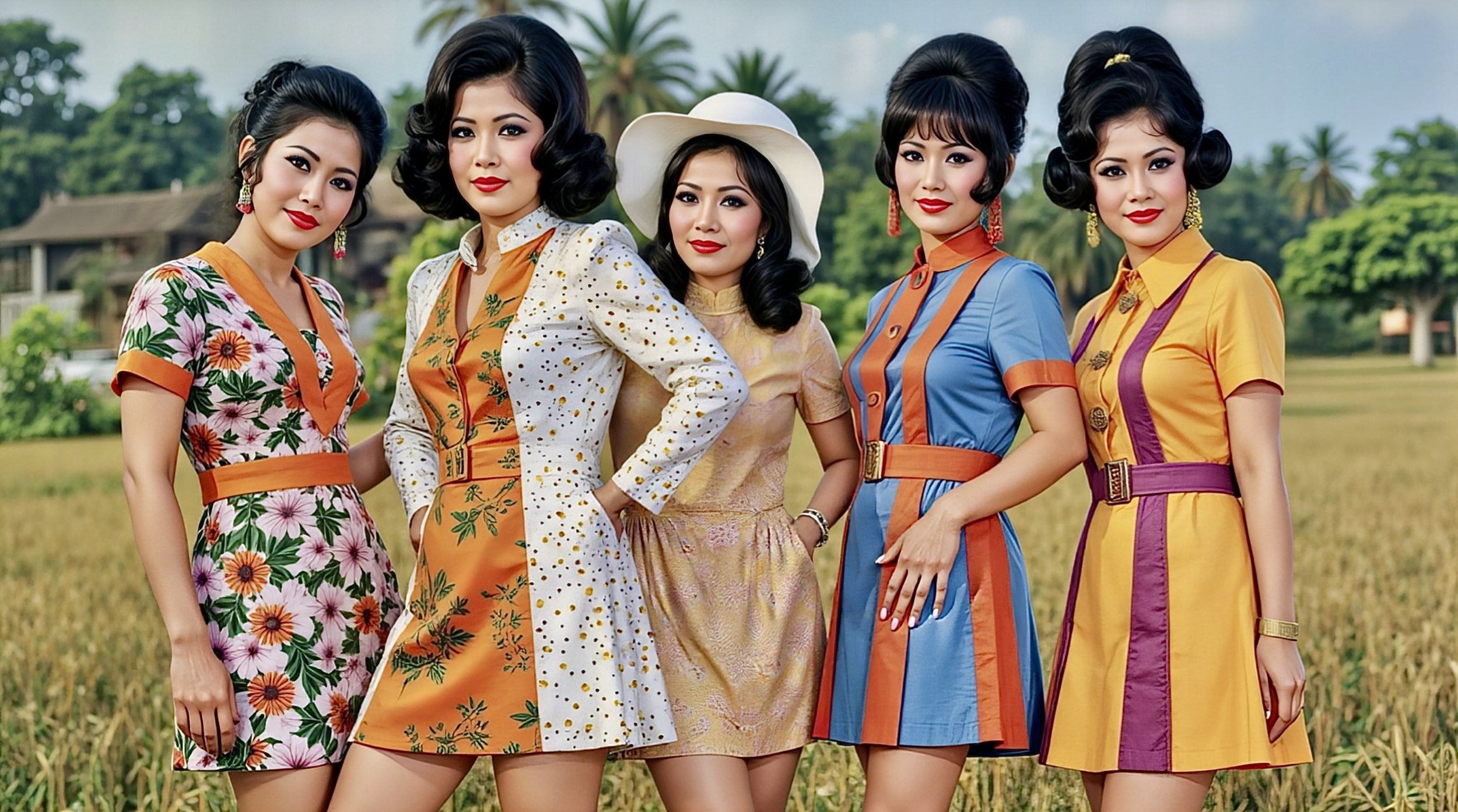
Western 1960s Fashion in Thai musical film, Mon Rak Luk Thung (1970): A Tribute to Thailand’s Fashion Influence
🌼 Western 1960s Fashion & Flower Power in Mon Rak Luk Thung (1970): A Tribute to Thailand’s Fashion Influence 🌼
The 1960s was an era of transformation in both fashion and cinema, and Thailand was no exception to the global style revolution. While Mon Rak Luk Thung (1970) is celebrated as a classic Thai rural romance, it also serves as a fascinating snapshot of how Western fashion trends made their way into Thailand during this vibrant decade.
For this collection, I wanted to pay tribute to Western 1960s fashion, particularly the Flower Power movement, mod style, and the playful spirit of the era, which had a profound influence on Thai fashion at the time. The result is a reinterpretation of 1960s fashion through a bright, colourful, and cinematic lens, reflecting the global trends that shaped Thailand’s fashion identity.
Here are some images from the collection, showcasing how the bold prints, vibrant hues, and iconic silhouettes of Western 1960s fashion could be imagined in a Mon Rak Luk Thung-inspired setting.
🎬 The 1960s: A Decade of Western Fashion Revolution
The 1960s saw a dramatic shift in Western fashion, breaking away from the conservative styles of the previous decade. The rise of mod culture in London, the hippie movement in San Francisco, and high-fashion trends from Paris and Milan brought about a wave of youthful energy, bold prints, and experimental silhouettes.
Key Western Fashion Trends of the 1960s:
✨ Mini & Midi Dresses – Hemlines got shorter, with A-line mini dresses, mod shift dresses, and empire waistlinesdefining the era.
🌼 Floral & Psychedelic Prints – Inspired by the Flower Power movement, these prints exploded onto everything from dresses to accessories.
👢 Go-Go Boots & Heeled Pumps – Knee-high boots and low-heeled pumps became wardrobe staples.
💎 Plastic & Pop-Art Accessories – Jewellery took a fun, playful turn, featuring chunky plastic bangles, oversized floral earrings, and colourful resin pieces.
💇♀️ Voluminous Hair & Winged Eyeliner – Beehives, bouffants, and soft curls were all the rage, paired with dramatic cat-eye makeup.
🌸 How Western Fashion Influenced Thailand in the 1960s
Although Thailand maintained its cultural identity, fashion in the 1960s saw a strong influence from Western trends, especially in urban areas. Thai women began incorporating Western-style dresses, bold floral prints, and modern tailoring into their wardrobes while still honouring traditional elements like pha-sin skirts and Thai textiles.
Mod & Floral Trends – Thai cinema and urban fashion reflected the rise of mod-style silhouettes and floral motifs.
Western Accessories – Plastic jewellery, pop-art brooches, and statement earrings became more common, inspired by European and American trends.
Hairstyle Revolution – Bouffants and soft curls replaced traditional buns and braids, showcasing a shift towards modern Western styling.
By the late 1960s, Thai cinema stars were often seen in hybrid outfits that combined Western cuts with Thai fabrics, showing the unique way Thailand adopted and adapted global trends.

🌸 Mon Rak Luk Thung (มนต์รักลูกทุ่ง) (1970): A Thai Countryside Romance Reimagined Through 1960s Flower Power 🌸
🌸 Mon Rak Luk Thung (มนต์รักลูกทุ่ง) (1970): A Thai Countryside Romance Reimagined Through 1960s Flower Power 🌸
If Thailand’s golden age of cinema had a defining rural love story, Mon Rak Luk Thung (มนต์รักลูกทุ่ง)(1970) would be it. More than just a beloved musical about romance and hardship in the countryside, this film is a visual time capsule of 1960s Thai fashion, blending traditional wear with the everyday styles of the era. However, while the original wardrobe remained realistic and true to its time, my collection takes a bold, imaginative approach, infusing 1960s high fashion, Thai textile heritage, and the vibrant energy of Western Flower Power.
Mon Rak Luk Thung has been remade multiple times, both as feature films and television series, with the most recent TV adaptation airing just a few years ago. If another remake were to be produced in the future, this collection could serve as an exciting source of inspiration for the creative team, offering a fresh perspective on how to bring 1960s Thai countryside fashion to life with a modern, cinematic twist.
🎬 1960s Cinema: Hollywood Glamour vs. Thai Realism
The 1960s was a transformative decade for cinema and fashion worldwide. In Hollywood, the era saw the rise of mod fashion, psychedelic prints, structured tailoring, and pop-art accessories. Films like Breakfast at Tiffany’s (1961) and Cleopatra (1963) showcased glamorous evening wear, while Barbarella (1968) and Easy Rider (1969) reflected the rise of hippie counterculture and Flower Power fashion—characterised by florals, bold colours, and carefree styling.
Meanwhile, in Thai cinema, fashion remained grounded in realism. Mon Rak Luk Thung depicted authentic, everyday countryside attire, rather than the exaggerated glamour of Western films. Female characters wore simple blouses, pha-sin (traditional woven skirts), and modest tailoring, reflecting how Thai women in rural areas truly dressed at the time. While the wardrobe was historically accurate, it lacked the bold, stylised flair that made 1960s Western fashion so visually striking.
This is where my collection takes inspiration—I wanted to reimagine the world of Mon Rak Luk Thung through a fresh lens, blending high fashion elements, bright colours, and traditional Thai textiles with a playful Flower Power twist.
🌺 A New Vision: 1960s Thai Fashion Meets Western Flower Power 🌺
While the original wardrobe was muted and practical, my collection presents a fantastical reinterpretation of what Mon Rak Luk Thung could look like in a heightened, cinematic version of 1960s Thai fashion. My inspiration draws from three key elements:
✨ 1. High Fashion Influence
Western 1960s high fashion embraced sharp tailoring, peplum blouses, fitted silhouettes, and mod-style prints. I kept these elegant cuts but adapted them using Thai textiles, replacing plain fabrics with vibrant pha-sin patterns. Instead of the subdued colours typically seen in rural Thai fashion, I embraced bold, joyful hues that feel celebratory and filmic.
🌸 2. The Flower Power & Hippie Movement
By the late 1960s, floral prints, psychedelic patterns, and free-spirited styling dominated global fashion. The Flower Power movement symbolised peace, optimism, and self-expression, making it a perfect complement to a romantic countryside setting. My collection incorporates:
🌼 Bold floral prints on blouses and skirts
🌸 Oversized floral accessories, such as statement earrings and brooches
🌿 Hair adorned with flowers and decorative headbands
💎 3. Plastic & Pop-Art Jewellery
One of the biggest fashion shifts of the 1960s was the introduction of playful, plastic accessories. While traditional Thai jewellery was typically made of gold, silver, and gemstones, the 1960s brought about a youthful, pop-art-inspired wave of oversized resin earrings, chunky bangles, and statement brooches. I embraced this trend in my designs, adding kitschy, fun accessories to complete the looks.

The Evolution of the Thai Student Bob: From 1920s Modernity to the End of an Outdated Rule
The Evolution of the Thai Student Bob: From 1920s Modernity to the End of an Outdated Rule
Introduction: The End of an Outdated Rule
On 5 March 2025, Thailand’s Supreme Administrative Court finally ruled to revoke the longstanding regulation restricting students' hairstyles, marking a significant victory for personal freedom and self-expression in schools. The Ministry of Education's rule, which dated back to 1975, enforced short bob haircuts for female students as a symbol of discipline, but in reality, it limited personal choice and identity.
The ruling reflects broader global shifts in education, gender equality, and bodily autonomy. But to truly understand the significance of this moment, we must trace the roots of the Thai student bob—how it emerged, why it became institutionalised, and its cultural and political significance in the changing landscape of Thai society.
The Bob as a Symbol of Modernity: From Edwardian Femininity to 1920s Rebellion
The bob haircut was one of the most radical fashion statements of the 20th century, originating in the 1920s as part of the Flapper movement. Western women cut off their long Edwardian hair, rejecting the elaborate upswept styles of the 1900s, which had symbolised traditional femininity, passivity, and domesticity.
Fashion historian Caroline Cox, in Good Hair Days: A History of British Hairstyling, explains that the bob was a direct challenge to Victorian and Edwardian ideals of femininity, where long hair had been a symbol of respectability and modesty. She describes the bob as "a haircut that symbolised modernity, independence, and a rejection of the old-world ideals of womanhood."
Similarly, Valerie Steele, in Paris Fashion: A Cultural History, notes that the bob was "as much a political statement as it was a fashion choice, embodying the spirit of the 'New Woman'—active, independent, and breaking free from past constraints."
The impact of this trend was global—and Siam was no exception.
Under the reign of King Rama VII (1925–1935), Siam was undergoing modernisation, with Western influences shaping urban culture, especially among the educated elite. Wealthy and aristocratic young women in Bangkok’s progressive schools adopted the bob as a statement of modernity and cosmopolitanism, mimicking European trends.
The 1920s Thai Fashion Revolution: Short Pha-sin, Western Blouses, and the Bob
Alongside the bobbed hairstyle, Thai women’s fashion in the 1920s underwent a transformation. My AI-generated collection showcases how young Thai women of the era embraced the flapper aesthetic, adapting it into their own cultural context.
One striking shift was in the traditional pha-sin (ผ้าซิ่น)—instead of the floor-length version, younger women wore shorter pha-sin that fell just below the knee, mimicking the straight, drop-waisted silhouette of 1920s Western dresses. This was paired with Western-style blouses, often lightweight and featuring delicate embellishments, reflecting both practicality and elegance.
By the late 1920s and early 1930s, the bob haircut, shorter pha-sin, and Western blouses became a defining look for progressive Thai women, especially in urban centres like Bangkok.
Institutionalisation: From Trend to School Regulation
By the mid-1930s, the bob haircut was no longer just a fashion statement—it became a school policy.
The Ministry of Education enforced the bob haircut in schools as a symbol of discipline, order, and collective identity. This mirrored similar policies in Japan, China, and other nations where school uniforms and strict grooming standards were used to instil conformity.
However, while the original adoption of the bob in Siam was a marker of modernity and progress, its transformation into a compulsory school rule erased its meaning as an expression of choice.

Kaleng Men and Phu Tai Women from Monton Udon in 1907
Kaleng Men and Phu Tai Women from Monton Udon in 1907
While exploring old photographs of Isan, I came across colourised images from a webpage that has not been updated for a long time (Colorised of Esarn). This website was a valuable archive of rare historical photographs. Although it is no longer updated, the images inspired me to create this AI Photo Collection, using the original historical photographs as a foundation.
The original photographs were taken during the royal inspection tour of Prince Damrong Rajanubhab, then Minister of the Interior, in 1906 (B.E. 2449). The tour covered several provinces in Monthon Udon and surrounding regions, with photographers documenting the way of life and attire of the local people at that time.
Traditional Attire of Phu Tai Women and Kaleng Men
Phu Tai Women
Phu Tai women traditionally wear Phasin Matmee Phu Tai, a distinctive handwoven textile found in Kalasin, Sakon Nakhon, Nakhon Phanom, Mukdahan, and Maha Sarakham provinces. This textile is crafted using weft ikat (Matmee) techniques, featuring ancient patterns that have been preserved through generations, such as:
Khan Mak Beng (ceremonial offering tray motif)
Kha Pia (braided leg motif)
Khorm (lantern motif)
Kho (hook motif)
Krajang (scroll motif)
Eia (ancient wave motif)
Additionally, motifs from Pha Phrae Wa, such as Bai Bun (leaf motif), Kan Kong (vine motif), Maha Phan (floral arrangement motif), are sometimes incorporated into Phu Tai Matmee designs.
Phu Tai women’s attire consists of a long-sleeved or fitted blouse in dark tones, such as navy blue or deep green, paired with a contrasting shoulder cloth (Pha Biang) for added elegance. They accessorise with silver jewellery, including necklaces and earrings, while their hair is often styled in a traditional high bun (Muay Phu Tai).
📷 In the reference photograph, the Phu Tai woman is dressed in a deep green long-sleeved blouse, draped with a red-purple shoulder cloth, reflecting the simplicity and elegance of Phu Tai women's daily wear.
Kaleng Men of Monthon Udon
Commoner men in Monthon Udon, particularly from the Kaleng ethnic group, wore long-sleeved, front-buttoned traditional shirts, made from handwoven cotton or silk in dark hues such as indigo or navy, fastened with silver or wooden buttons.
For the lower garment, they typically wore plain sarongs or traditional loincloths (Chong Kraben), made from plain cotton. They often tied a waist sash for practicality, and some carried woven rattan rice baskets (Krathip Khao) or handwoven shoulder bags (Yam) as everyday accessories.
📷 In the reference photograph, the Kaleng man wears a deep indigo traditional shirt with a plain reddish-brown sarong, secured with a waist sash. He also carries a rice basket, reflecting the traditional lifestyle of Isan commoners over a century ago.
AI Photo Collection: Preserving Cultural Heritage
Using the original photographs and previously colourised versions as a reference, I applied AI technology to create a series of realistic images that highlight the intricate details of traditional attire while staying true to the cultural heritage of the region.
I would like to extend my gratitude to those who initially colourised these photographs, as their work has helped bring historical images back to life. I hope this AI Photo Collection serves as a continuation of their efforts, ensuring the beauty of Isan culture is preserved and appreciated by future generations.

Honouring the Cultural Significance of Phu Thai Renunakhon Dance (ฟ้อนภูไทเรณูนคร)
Honouring the Cultural Significance of Phu Thai Renunakhon Dance (ฟ้อนภูไทเรณูนคร)
Recently, I was thrilled to receive a remarkable photograph from a fan page showcasing a group of ladies performing ฟ้อนภูไทเรณูนคร in the 1960s. This captivating image served as the inspiration for my latest AI collection, allowing me to recreate and honour the rich heritage of this exquisite dance from Nakhon Phanom. It was an absolute joy to use AI to recreate such a cherished cultural tradition and bring these timeless memories to life. This collection not only honours the beauty of ฟ้อนภูไทเรณูนคร but also celebrates the dedication of those who have kept this tradition alive for generations. The vibrant navy blue and red costumes, the graceful movements, and the deep cultural significance make ฟ้อนภูไทเรณูนคร an irreplaceable part of Thailand’s artistic heritage.
I hope this collection inspires more people to appreciate the elegance and history of ฟ้อนภูไทเรณูนคร, just as the original photograph inspired me. Thank you to the fan page for sharing such a treasured piece of history!
The Cultural Heritage of ฟ้อนภูไทเรณูนคร
The traditional dance known as ฟ้อนภูไทเรณูนคร (Phu Thai Renunakhon Dance) represents a significant aspect of the cultural heritage of the Phu Thai ethnic group in Renunakhon District, Nakhon Phanom Province, Thailand. Rooted in ancestral traditions, this dance is a defining element of the province’s artistic identity and continues to be performed as a means of cultural preservation.
One of the most notable historical milestones for ฟ้อนภูไทเรณูนคร occurred in 1955, when Their Majesties the King and Queen of Thailand visited Phra That Phanom. In commemoration of this visit, Governor Sanga Chantarasakha arranged for a performance of the dance. Under the direction of Kamnoeng Intiya, the District Education Officer of Renunakhon, the choreography was refined through consultation with experienced elders. As a result, the dance evolved into a structured form that has been passed down through generations and remains an integral part of the region’s cultural landscape.
The Structure and Performance of ฟ้อนภูไทเรณูนคร
The Phu Thai Renunakhon Dance is characterised by its graceful movements and distinctive choreography. Traditionally performed by male and female pairs, the dance consists of synchronised movements executed in a circular formation. Each pair takes turns performing intricate steps at the centre of the circle, aligning their motions with the rhythm of traditional musical instruments, including the khaen (a bamboo mouth organ), drums, and the phin (a traditional lute).
A unique feature of this dance is its adherence to Phu Thai customs. Dancers perform barefoot, and male dancers are strictly prohibited from making physical contact with their female counterparts. This practice is rooted in spiritual beliefs, as the Phu Thai people uphold a deep reverence for ancestral spirits. Any breach of this custom may necessitate a formal reconciliation ritual, demonstrating the importance of cultural integrity within the performance.าร

Lanna Wooden Houses: The Wisdom and Art of Traditional Living
Lanna Wooden Houses: The Wisdom and Art of Traditional Living
In the 1960s (พ.ศ. 2503–2512), the fashion of Chiang Mai women still reflected the Lanna identity, despite the increasing influence of Western fashion. The "cylinder-sleeve blouse" (เสื้อแขนกระบอก) was a highly popular garment during this period. It was characterised by straight sleeves without pleats or ruffles, emphasising simplicity and elegance. These blouses typically featured a high or round neckline and were made from cotton or locally woven silk. Light or pastel colours, such as white, cream, and soft pink, were commonly worn for their refined appearance and suitability for the northern climate.
The "sin" (ผ้าซิ่น – tubular-style skirt) was another key element of traditional dress, with various types distinguished by patterns and origins, including:
Sin Ta (ซิ่นต๋า) – A horizontally striped sin, usually in dark tones contrasted with bright-coloured lines.
Sin Teen Jok (ซิ่นตีนจก) – A sin with intricate, decorative patterns at the lower border, often worn by noblewomen.
Sin Nam Thuan / Sin Nam Thum (ซิ่นน้ำท่วม / ซิ่นน้ำถ้วม) – A sin with tiered horizontal stripes resembling water levels.
Sin Wiset Mueang Nan (ซิ่นวิเศษเมืองน่าน) – A traditional Nan province sin known for its finely detailed patterns.
Sin Nam Pat-Fak Tha (ซิ่นน้ำปาด-ฟากท่า) – A sin with unique designs from Nam Pat and Fak Tha districts in Uttaradit province.
For daily wear, women preferred simple and comfortable patterns, while more elaborate designs were reserved for special occasions and ceremonies.
"Hair buns" (การมวยผม) were the preferred hairstyle at the time. Women in Chiang Mai typically styled their hair in a "high bun" (เกล้ามวยสูง), adorned with golden or silver hairpins and fresh flowers for added elegance. For formal events or religious ceremonies, older women often favoured "low buns" (เกล้ามวยต่ำ) to maintain a dignified look, while younger women would style their hair in "round buns" (มวยกลม) for a youthful and fashionable appearance.

The Elegance of Chiang Mai Women in the 1960s: Fashion and the Symbolism of Orchids
The Elegance of Chiang Mai Women in the 1960s: Fashion and the Symbolism of Orchids
The 1960s (B.E. 2503-2512) marked an era of graceful yet deeply traditional fashion for women in Chiang Mai, a city that has long been a cultural heartland of Lanna heritage. The distinctive attire of Chiang Mai women during this period consisted of the “เสื้อแขนกระบอก” (seua khaen krabok), a fitted long-sleeved blouse with a buttoned front, paired with the “ผ้าซิ่น” (pha sin), a woven silk or cotton tube skirt. One of the most common variations was the “ผ้าซิ่นต๋า” (pha sin ta), a skirt featuring horizontal stripes throughout the fabric with simple patterns, making it suitable for all occasions. Women often styled their hair in elaborate upswept chignons, a signature look that exuded elegance and refinement.
Beyond fabric and tailoring, what made Lanna women’s fashion particularly striking was their intricate hair adornments, featuring wild orchids or “ดอกเอื้อง” (dok euang). These delicate blossoms, found abundantly in Chiang Mai’s lush forests and misty mountain ranges, were more than just decorations; they were deeply embedded in the region’s cultural and spiritual beliefs.
Orchids in Lanna Culture: A Symbol of Beauty and Prosperity
The forests of Northern Thailand, particularly in areas such as Doi Suthep, Doi Inthanon, and Doi Chiang Dao, are home to a vast variety of orchids. These flowers were not only admired for their beauty but were also revered as sacred symbols of prosperity and good fortune.
Among the many varieties used by Chiang Mai women in the 1960s were:
เอื้องคำ (Dendrobium chrysotoxum), a golden-yellow orchid representing wealth and abundance.
เอื้องภึ้ง (Dendrobium lindleyi), a smaller yet equally striking species often woven into floral garlands.
เอื้องสาย (Dendrobium anosmum), a fragrant variety associated with love and devotion.
เอื้องเงิน (Dendrobium crystallinum), a rare and highly prized orchid believed to bring spiritual protection.
The significance of orchids extended beyond aesthetics. In Lanna tradition, these flowers were often used in ritual offerings to spirits and deities. Women who adorned their hair with orchids were believed to carry an aura of purity, elegance, and good fortune. The choice of orchid was also symbolic—golden-hued varieties were worn during festivals and weddings, while delicate white orchids were preferred for more solemn occasions.

The Rise of the Miniskirt and Its Influence in 1960s Bangkok
The Rise of the Miniskirt and Its Influence in 1960s Bangkok
The Global Miniskirt Revolution
The 1960s marked a transformative period in global fashion, with the miniskirt emerging as one of the most iconic symbols of the era. British designer Mary Quant is often credited with popularising the miniskirt in the early 1960s, pushing the boundaries of hemlines higher than ever before. The trend was widely embraced by young women in London, Paris, and New York, reflecting a broader cultural shift towards youth empowerment, liberation, and modernity. By the mid-1960s, designers such as André Courrèges and Pierre Cardin further cemented the miniskirt’s place in high fashion, incorporating futuristic silhouettes and bold materials that embodied the Space Age aesthetic.
The Adoption of the Miniskirt in Bangkok
As Bangkok modernised rapidly during the 1960s, Western fashion trends found their way into Thai society, particularly among the urban elite and film industry figures. The miniskirt became a statement piece for fashionable young women, influenced by international films, magazines, and Thai celebrities who embraced contemporary styles. Bangkok's fashion scene at the time was deeply intertwined with cinema, as movie stars played a crucial role in shaping public perceptions of modern beauty and elegance.
Among the most notable figures in this movement was Malarin Bunnag (มาลาริน บุนนาค), a famous Thai actress whose stylish wardrobe often incorporated both Western and Thai elements. One of her most memorable outfits, worn at a social gathering, was a stunning fusion of the 1960s miniskirt and traditional Thai dress. Her ensemble consisted of a very short pha-sin-inspired skirt, paired with a long-sleeved lace blouse and a sash similar to แพรสพาย—a nod to the 1920s fashion silhouette during the reign of King Rama VI. This ingenious interpretation blended contemporary trends with Thai heritage, showcasing how Bangkok’s fashionistas creatively adapted Western influences to suit local aesthetics.
The 1960s Miniskirt as a Symbol of Change in Thailand
The adoption of the miniskirt in Thailand reflected the country’s shifting social dynamics during the post-war era. The 1960s was a decade of economic growth, increasing globalisation, and modernisation, particularly in Bangkok. As young Thai women gained greater access to education and career opportunities, fashion became an important medium of self-expression. The miniskirt, with its bold and youthful appeal, was embraced as a statement of confidence and contemporary sophistication.
However, the trend also sparked debates, particularly among conservative segments of Thai society who viewed the rising hemlines as a challenge to traditional values. Despite this, the miniskirt continued to thrive throughout the decade, becoming a mainstay in urban fashion and influencing later adaptations of Thai womenswear.
Conclusion
The story of the miniskirt’s rise in Bangkok during the 1960s highlights the dynamic interplay between global fashion trends and local cultural identity. Figures like Malarin Bunnag (มาลาริน บุนนาค) played a pivotal role in shaping how Thai women embraced and reinterpreted modern styles, creating unique hybrid looks that remain inspiring to this day. Her 1960s party outfit—a fusion of Western miniskirt fashion and Thai traditional elements—stands as a testament to the ingenuity and adaptability of Thai fashion during this vibrant era. Her image has also served as a key inspiration for my AI-generated collection exploring miniskirt fashion in Thailand, showcasing how past trends continue to influence creative interpretations in the digital age.