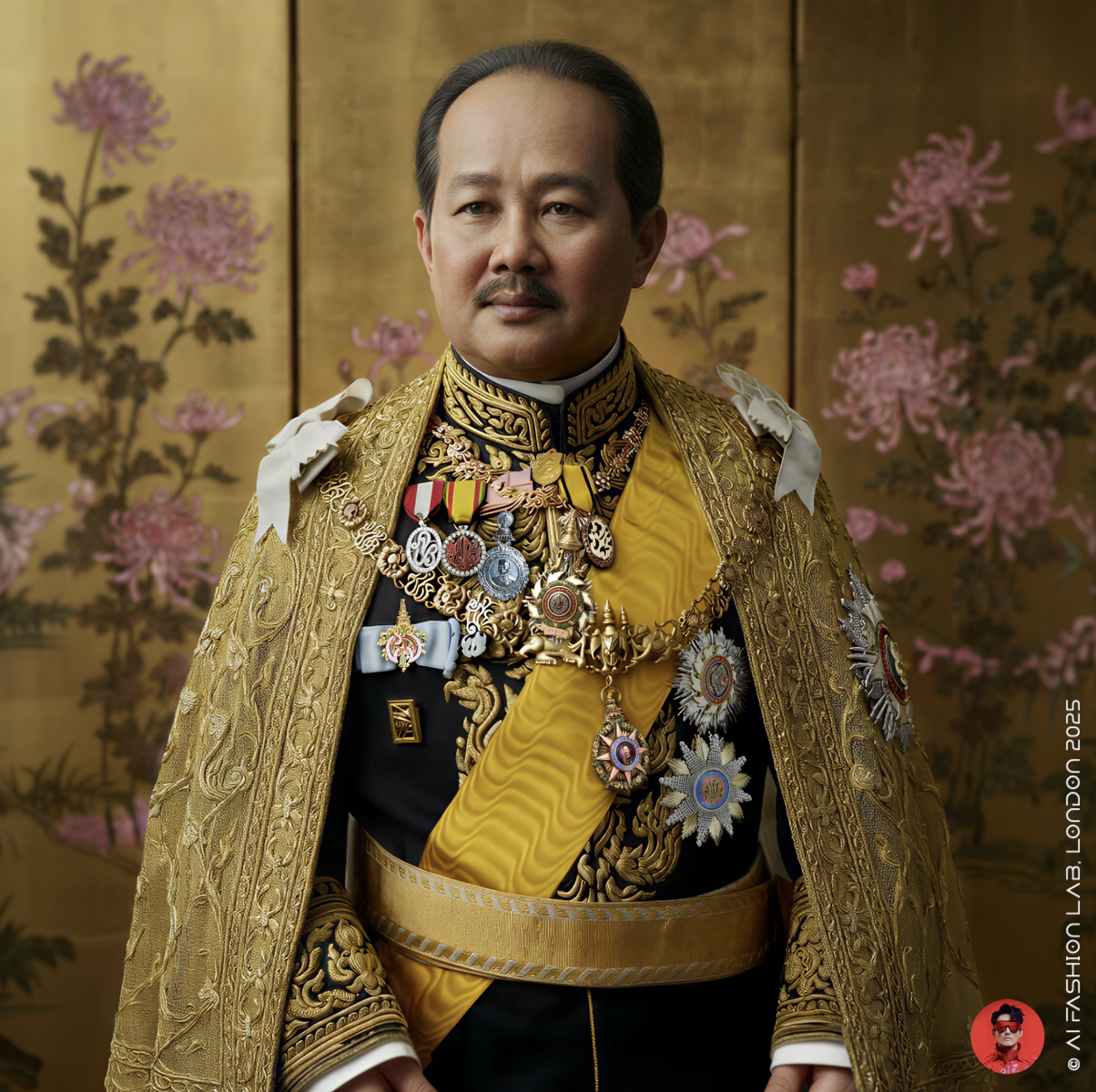
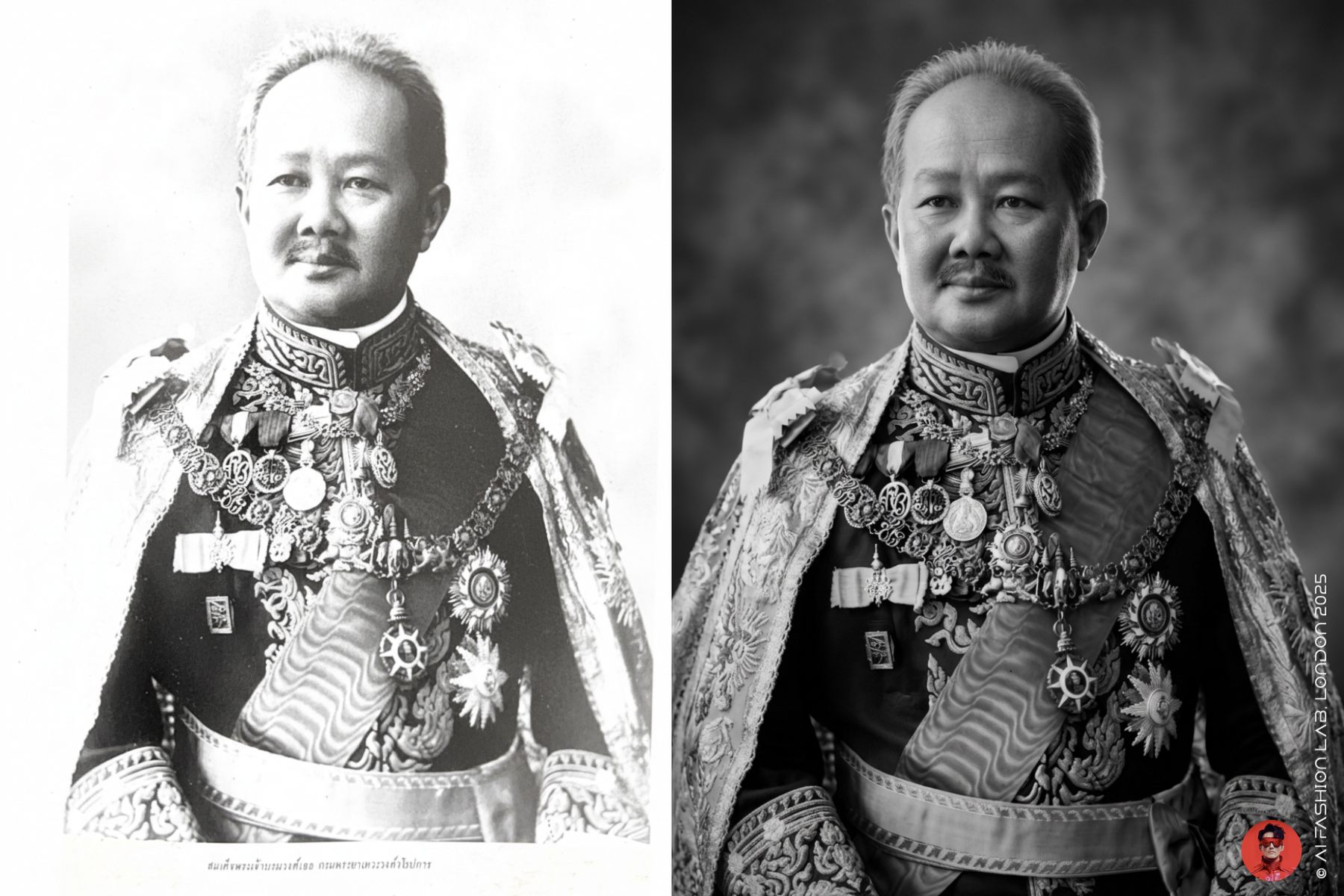
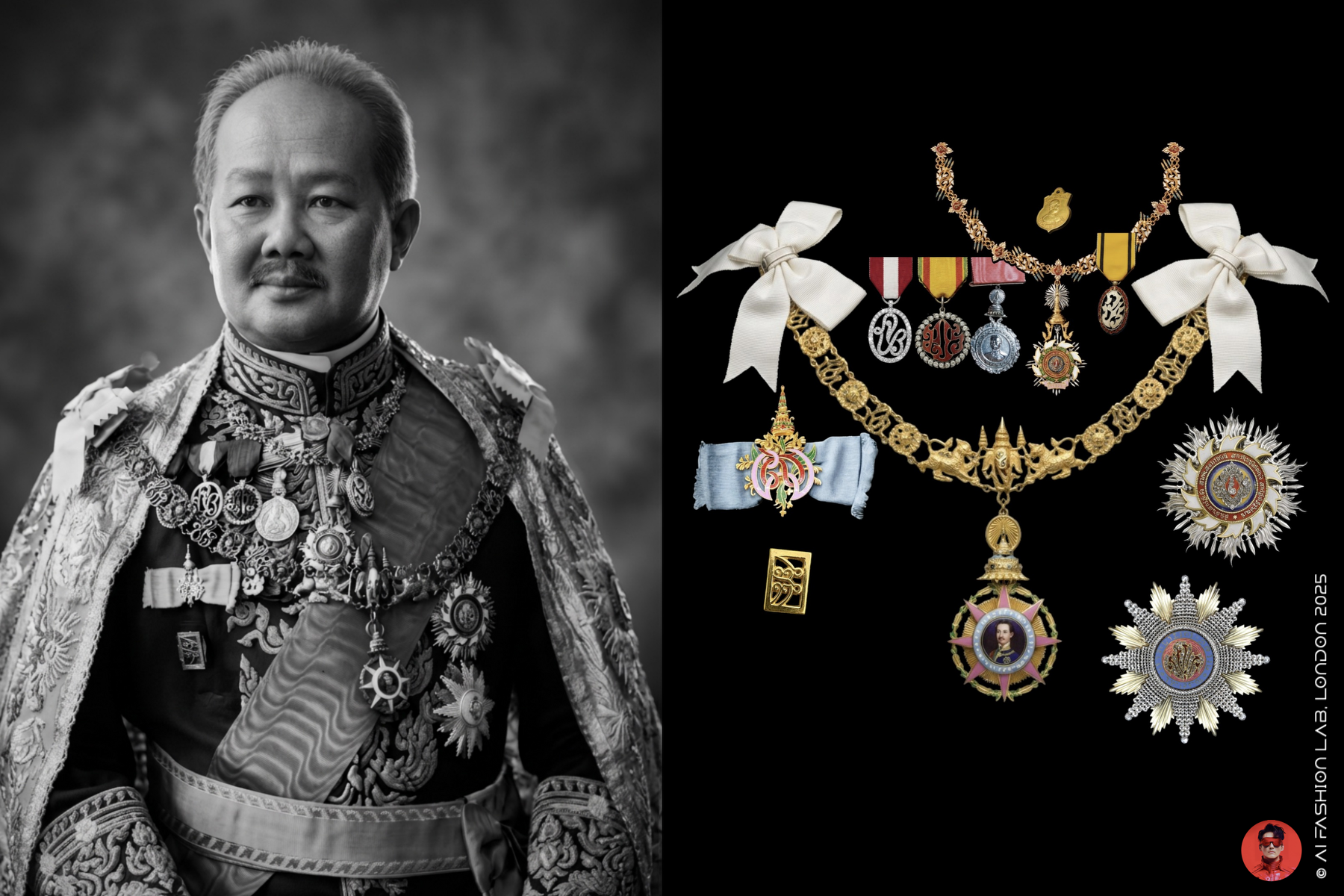
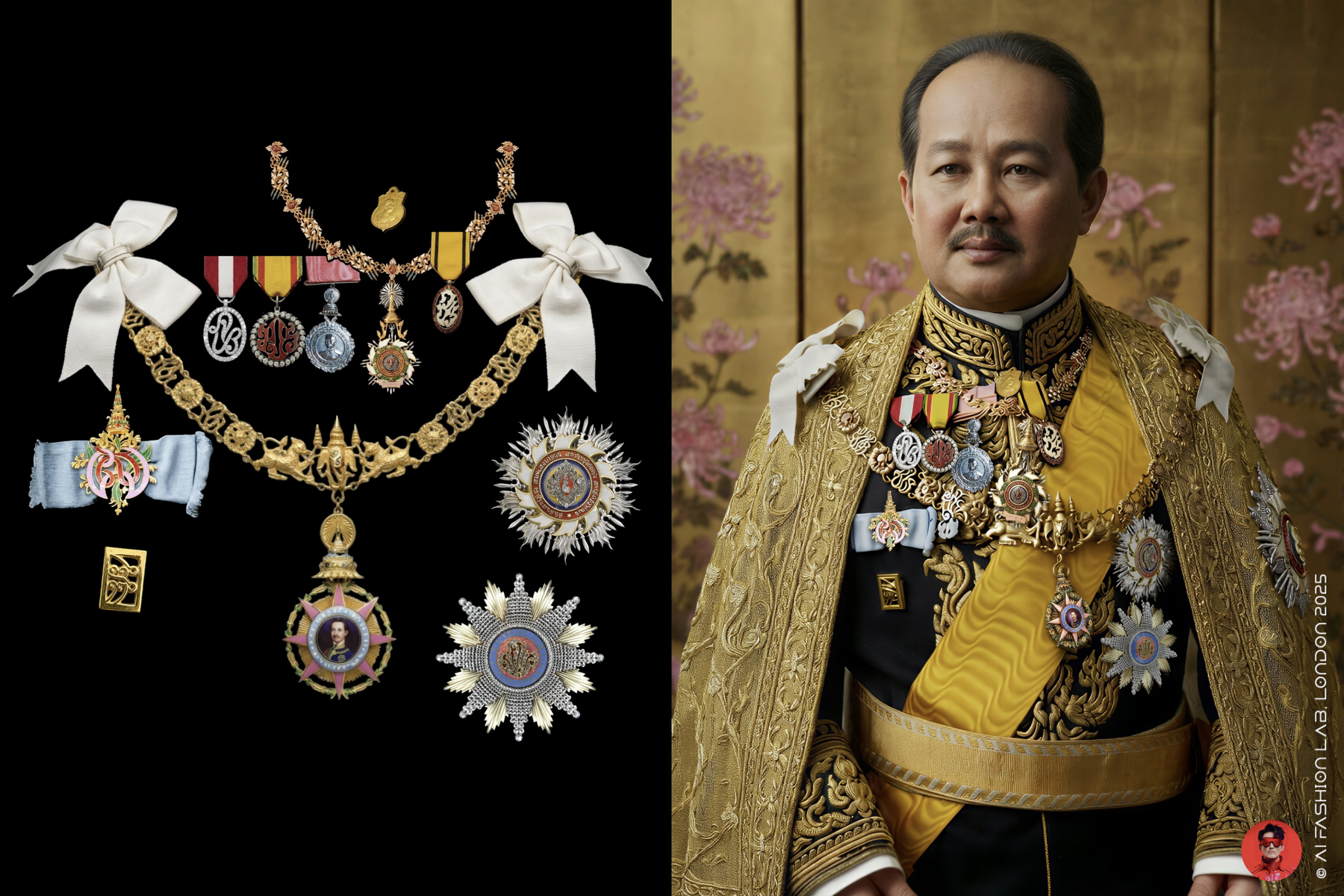
วิธีที่ผมใช้บูรณะภาพถ่ายขาวดำโบราณ โดยเฉพาะภาพที่เต็มไปด้วยเครื่องราชอิสริยาภรณ์ และเหรียญตรา
⭐️ วิธีที่ผมใช้บูรณะภาพถ่ายขาวดำโบราณ โดยเฉพาะภาพที่เต็มไปด้วยเครื่องราชอิสริยาภรณ์ และเหรียญตรา
(ตอบคำถามหลายท่านที่สงสัยว่าผมทำอย่างไรให้สีและรายละเอียดตรงตามประวัติศาสตร์ขนาดนี้)
ช่วงหลังมีหลายท่านถามผมบ่อยมากครับว่า เวลาบูรณะภาพถ่ายเก่า ๆ ด้วยเทคโนโลยี AI—โดยเฉพาะภาพที่เต็มไปด้วยเหรียญตรา เครื่องราชอิสริยาภรณ์ ลวดลายดิ้นทอง และเครื่องแบบราชสำนักที่มีความซับซ้อน—ผมทำอย่างไรให้ สีถูกต้อง ลำดับเหรียญไม่ผิด และผิวสัมผัสของผ้า–โลหะ–เครื่องประดับดูสมจริง ทั้งที่ตัว AI เองก็ไม่ได้ “รู้” อยู่แล้วว่าสีจริงควรเป็นอย่างไร หรือแม้แต่การสะท้อนแสงของดิ้นทองแบบสยามในสมัยรัชกาลที่ ๕–๖ มีลักษณะเฉพาะอย่างไร
ความจริงคือ มันไม่ได้ยากเลยครับ แต่ต้องละเอียดและใจเย็นมาก
และต้องใช้ “ความรู้ทางประวัติศาสตร์แฟชั่น” ร่วมกับ “การคุมทิศทางของ AI” อย่างใกล้ชิด
วันนี้ผมเลยอยากแบ่ง “กระบวนการที่ผมใช้จริง ๆ” ซึ่งหลายคนอาจนำไปประยุกต์ได้ ไม่ว่าจะทำงานบูรณะภาพครอบครัว ภาพโบราณ หรือใช้เพื่อทำงานเชิงวิชาชีพก็ได้เช่นกัน
และต้องบอกไว้ก่อนว่า กระบวนการนี้เป็นวิธีที่ผมนำไปใช้ ในงานอาชีพจริงของผมที่ลอนดอน
ในฐานะ นักออกแบบเครื่องแต่งกายสำหรับภาพยนตร์ ผมใช้เทคนิคเดียวกันนี้ในการสร้างแบบร่างเสื้อผ้าจากภาพขาวดำเก่า ๆ เพื่อศึกษาผิวสัมผัสของผ้า เทคนิคการทอ ลวดลายดิ้นทอง และโครงสร้างเครื่องแบบโบราณในระดับที่ละเอียดแบบงานภาพยนตร์ฮอลลีวูด
ดังนั้นจึงขอเล่า “วิธีที่ผมทำจริง ๆ” ให้ฟัง เผื่อเป็นประโยชน์สำหรับเพื่อน ๆ ที่อยากลองบูรณะภาพคุณภาพสูง โดยกระบวนการเหล่านี้สามารถใช้ได้กับ Google Nano Banana Pro หรือเอ็นจินอื่นที่ออกแบบมาเป็น editing suite แนวเดียวกันครับ
_________
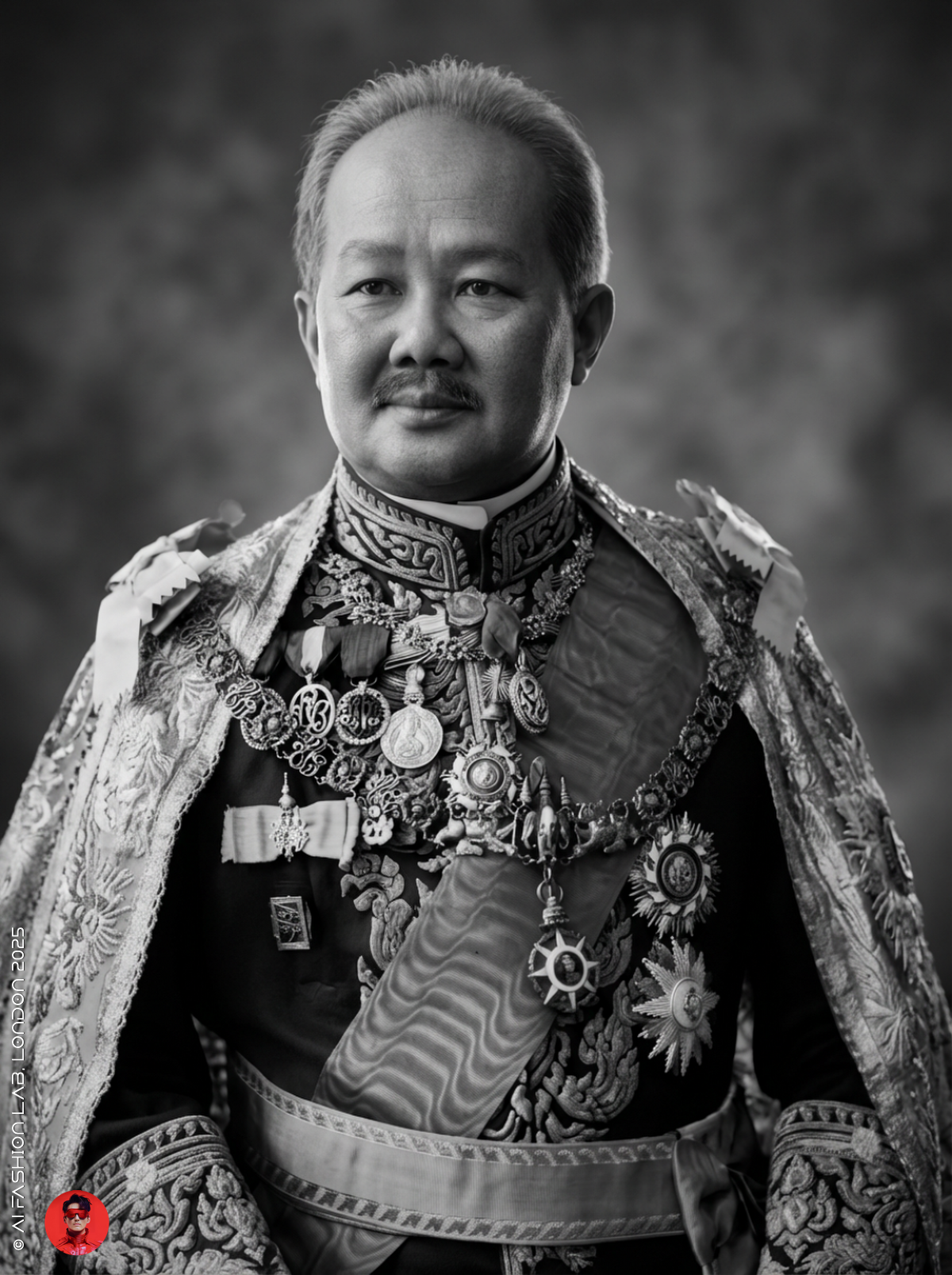
1️⃣ ขั้นแรก—ผมจะบูรณะภาพขาว–ดำก่อนเป็นอันดับแรก
ก่อนจะสร้างสรรค์ภาพสี ผมต้องทำให้ภาพต้นฉบับ “สะอาดที่สุด”
ผมจะลบทุกอย่าง—รอยขีดข่วน, คราบ, ฝุ่น, รอยพับ, คราบเคมีเก่า ๆ
เพราะถ้าฐานภาพไม่ดี การเพิ่มสีสันจะไม่ดีเช่นกัน
แต่ถ้าฐานภาพคมชัด ภาพสีที่ได้จะดูเหมือน “ถ่ายใหม่เมื่อวานนี้”
_________
2️⃣ ขั้นต่อมา—ผมจะระบุเหรียญ เครื่องราชฯ ทุกชิ้นแบบละเอียดที่สุด
อันนี้แหละที่หลายคนมักมองข้าม แต่เป็น หัวใจของงานบูรณะภาพการแต่งกายแบบราชสำนัก
ผมจะตรวจทีละชิ้นว่า:
เหรียญอะไร ชั้นอะไร
ลงยาสีอะไร
ริบบิ้นลายอะไร
ดวงดาราต้องอยู่ตำแหน่งไหน
สายสะพายควรพาดอยู่ฝั่งไหน
ตัวเรือนเป็นทอง เงิน นาก หรือฝังเพชรแบบใด
สายสร้อยแต่ละเส้นเป็นลายอะไร
ตำแหน่งที่ถูกต้องตามแบบแผนการแต่งกาย
ผมจะบูรณะเหรียญแต่ละชิ้นให้คมชัดก่อนเสมอ
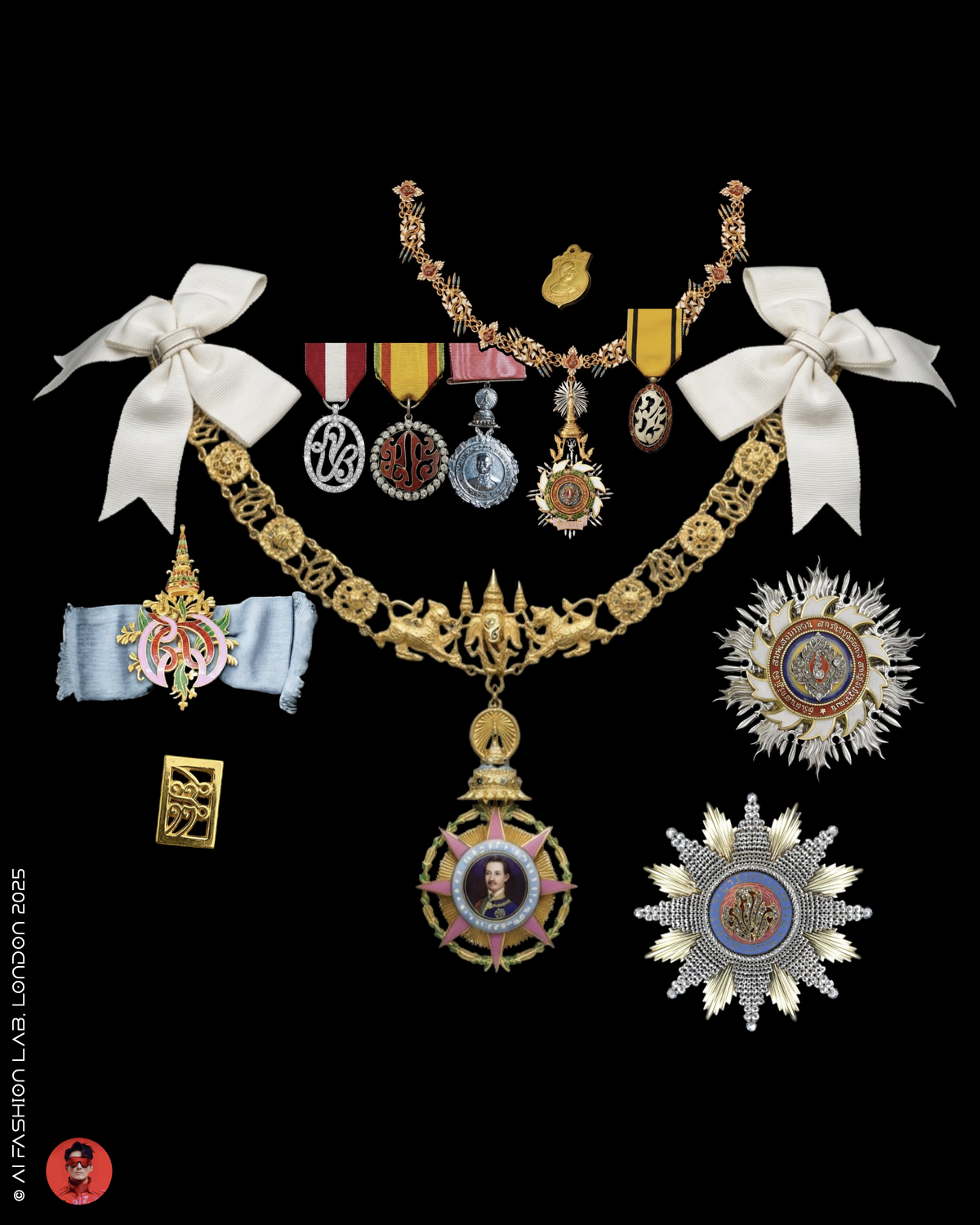
หรือบางครั้งนำเหรียญต้นแบบจากแหล่งข้อมูลที่ถูกต้องที่เรามาสมารถหาได้จากอินเตอร์เน็ต (เหมือนชุด medal board) มาใช้ประกอบ
_________
3️⃣ ต่อด้วยการสร้าง “Transfer Board” — แผงจัดตำแหน่งเหรียญ
ถ้าอธิบายง่าย ๆ มันคือ “แผนที่” ของภาพจริง
ผมจะวางเหรียญทุกชิ้นลงบนบอร์ดนี้ก่อน ไม่ต้องมุมถูก ไม่ต้องแสงถูก แต่ “ต้องตำแหน่งถูก”
มันทำให้ AI ไม่สับสน และวางเหรียญในที่ที่ควรอยู่จริง ๆ
_________
4️⃣ จากนั้น—ผมจะเขียนพรอมต์แบบละเอียดมากในระดับการถ่ายทำภาพยนตร์หรือถ่ายงานแฟชั่นชู๊ต
พรอมต์ที่ดีต้องเล่าทุกอย่าง:
✔ รายละเอียดชุดและสิ่งทอ
ลายดิ้นทอง, moiré, ผ้าแพร, ผ้ากำมะหยี่, การปักแบบปลายรัชกาลที่ 5
ในกระบวนการนี้เราสามารภใช้ภาพตัวอย่างของผ้าหรือเครื่องแต่งการที่ถูกต้องเป็นตัวช่วยการสร้างสรรค์ให้ถูกต้องได้เช่นกัน
✔ รายละเอียดเหรียญทุกชิ้น
สีลงยา, ริบบิ้น, โลหะ, เพชร, ลำดับการติด, ตำแหน่งทางซ้าย–ขวาตามภาพจริง
✔ ฉากหลัง
ผมมักใช้ฉากทองลงรัก, ลายมุก, หรือฉากแบบภาพถ่ายสตูดิโอเก่า
✔ แสง
ผมนึกเหมือนกำลังถ่ายแฟชั่นหรือถ่ายหนัง:
แสงหลักนุ่มหรือแข็ง?
ต้องมี rim light ไหม?
เหรียญต้องสะท้อนอย่างไร?
ต้องการเงาหรือความลึกระดับไหน?
✔ กล้องมืออาชีพ
ผมมักระบุคุณภาพแบบ:
“16K Ultra-Definition Royal Archival Quality”
พร้อมตัวอย่างกล้องโปรระดับโลก เช่น:
Nikon D6
Canon EOS-1D X Mark III
Sony A9 III
เพื่อให้ภาพออกมาคมชัดแบบภาพพิพิธภัณฑ์
_________
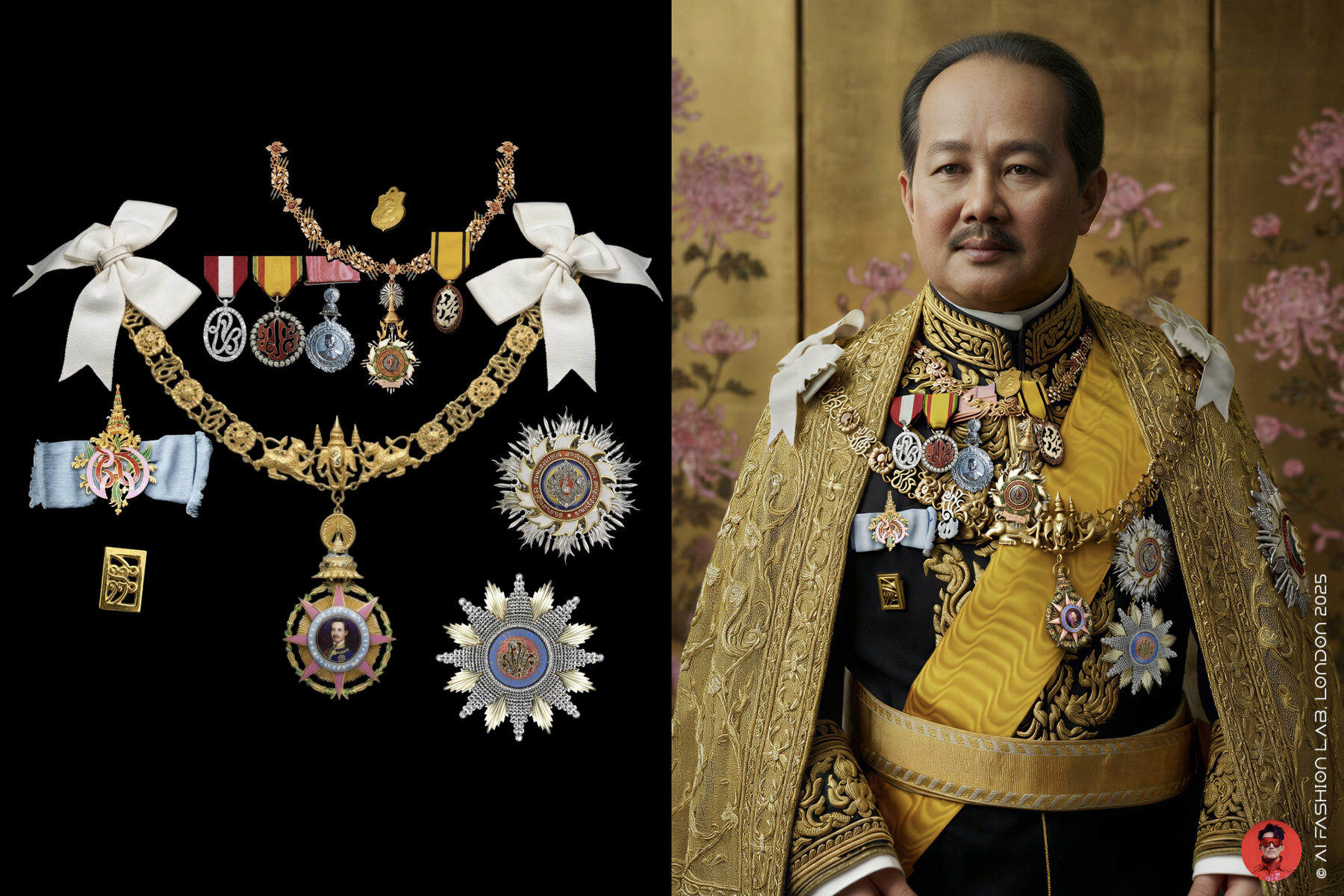
5️⃣ ขั้นสุดท้าย—ประกอบชิ้นงาน และถ้าจำเป็นก็ซ้อนเหรียญจริงทับอีกชั้น
บางครั้ง AI ทำเหรียญให้ดูนุ่มไปหรือไม่คมชัดเท่าที่ต้องการ ผมจะซ้อนเหรียญที่บูรณะเองแบบชัด 100% ลงไปอีกชั้นหนึ่ง
ผลลัพธ์คือภาพที่ “เหมือนยืนอยู่ต่อหน้าเครื่องราชฯ จริง ๆ”
⭐️ และนี่คือ “พรอมต์จริงของผม” ที่หลายคนอยากเห็น
Restore and colourise this photograph @img1, removing all marks, dust, and scratches. Produce a fully colourised, 3D Hyperrealistic photographic portrait with pronounced depth of field, refined textile rendering, and lifelike surface clarity. Output in true 16K quality, as if captured with a modern Canon EOS-1D X Mark III camera (16–50mm lens). The final result should resemble a contemporary glossy fashion-magazine image—crisp, luminous, and rich in dimensional realism. Capture the fine textures of silk, velvet, enamel, gold-work, gemstones, and metalwork with precision.
“Uniform and Accessories”
กรมพระยาเทวะวงศ์วโรปการ wears a black Siamese court uniform with a black standing collar heavily embroidered with gold bullion thread. The chest, collar, and cuffs all feature dense gold bullion embroidery typical of late-Rama V ceremonial court dress.
Across his torso is the yellow moiré sash of the Most Illustrious Order of the House of Chakri (สายสะพาย เครื่องขัตติยราชอิสริยาภรณ์อันมีเกียรติคุณรุ่งเรืองยิ่งมหาจักรีบรมราชวงศ์), showing a shimmering wave pattern.
The gold cloth belt features a deeper shade of gold along the borders, with elaborate bullion embroidery.
He wears the embroidered gold cloak with gold net, and the embroidered breast star of the House of Chakri—silver and white rays with a red enamel ring and blue centre—applied at the upper arm.
🎖 “Orders and Decorations”
(All corrected using @img2 for accurate colours, shapes, and sequence)
“Neck Badges and Neck Chains”
1. Top pendant: A brass sema-shaped medal bearing the portrait of King Chulalongkorn. (เหรียญเสมา รัชกาลที่ 5 เนื้อทอง)
2. Ribbon medal at the collar: Yellow ribbon with black pinstripe borders, suspending an oval medal with a red rim and white lettering. (เหรียญรัตนาภรณ์ รัชกาลที่ ๖)
3. Necklace of the Order of the House of Chakri: Gold and white-enamel chain, with a pendant featuring radiating white enamel rays, green ring, red ring, and blue central medallion. (Thai: เครื่องขัตติยราชอิสริยาภรณ์อันมีเกียรติคุณรุ่งเรืองยิ่งมหาจักรีบรมราชวงศ์)
4. Grand Chain of the Order of Chula Chom Klao: The elaborate gold chain with foliate links, suspending the large portrait badge with pink rays, blue enamel ring, and the miniature portrait of King Chulalongkorn; attached to the shoulders with white bow ribbons. (Thai: เครื่องราชอิสริยาภรณ์จุลจอมเกล้า)
“Ribbon Bars and Medals” (These appear on the photo’s left side (his upper right chest). – Correct Order)
1. Leftmost: Yellow-and-black striped ribbon with a silver portrait medal (commemorative type).
2. Second: White ribbon with red borders, suspending an oval medal set with diamonds around the Royal Cypher. (เหรียญรัตนาภรณ์ รัชกาลที่ ๕)
3. Third: Yellow ribbon with red and green pinstripe borders, suspending a round medal with diamond-set border and red Royal Cypher. (เหรียญรัตนาภรณ์ รัชกาลที่ ๔)
4. Rightmost: Pastel pink ribbon with silver Rama V commemorative medal.
“Brooches and Insignia” (These appear on the photo’s left side (his lower right chest). – Correct Order)
1. Oblong pastel-blue ribbon badge with gold frame and Thai monogram สผ in pink and red enamel. (เข็มกลัดทองคำอักษรพระนามย่อ ส.ผ. สมเด็จพระพันปี)
2. Below it: A gold rectangular brooch with the two-tier Thai numeral ๑๑๖ / ๑๑๖. (เข็มอักษรในการเสด็จพระราชดำเนินประพาศ ประเทศยุโรป รัตนโกสินศก ๑๑๖)
“Breast Stars” (These appear on the photo’s right side (his lower left chest). – Correct Order)
1. Upper star: Breast Star of the Order of the House of Chakri — silver rays with alternating white enamel rays, red enamel ring, blue centre, and diamond-set centrepiece. (Thai: เครื่องขัตติยราชอิสริยาภรณ์อันมีเกียรติคุณรุ่งเรืองยิ่งมหาจักรีบรมราชวงศ์)
2. Lower star: Breast Star of the Order of Chula Chom Klao — alternating silver and gold rays, blue enamel ring, and pink central medallion with diamond-set Thai lettering. (Thai: เครื่องราชอิสริยาภรณ์จุลจอมเกล้า)
🎨 “Background and Lighting”
Depict a gold-lacquered screen with mother-of-pearl inlay of pink chrysanthemum motifs (เบญจมาศ).
Lighting should be soft volumetric fill with subtle three-point illumination to enhance contour and realism.
Add a soft rim light from behind to define silhouette and depth.
Preserve the subject’s original facial features, hairstyle, expression, and posture.
Remove all watermarks, logos, and printed marks to create a clean, timeless presentation.
_________
✨ สุดท้าย—อยากให้เพื่อน ๆ รู้ว่า…
AI ทำให้ “การบูรณะภาพเก่า” กลายเป็นสิ่งที่เป็นไปได้ในระดับที่เราไม่เคยนึกฝันมาก่อน
แต่ความแม่นยำของมันขึ้นอยู่กับ “ความรู้และความใส่ใจของเรา”
ถ้าใครอยากให้ผมทำโพสต์สอนเขียนพรอมต์แบบ Step-by-Step
หรืออยากให้ช่วยดูงานบูรณะภาพของตัวเอง บอกผมได้เลยนะครับ ❤️
_________
⭐️ How I Restore Historical Black-and-White Photographs,
Especially Those Filled with Royal Decorations and Medals
(Answering the many questions about how I achieve such historically accurate colours and details.)
In recent months, many people have asked me how I restore old photographs using AI technology—especially images laden with medals, royal decorations, gold bullion embroidery, and complex court uniforms. People often wonder how I manage to make the colours historically accurate, the order of medals correct, and the textures of fabric, metal, and jewellery convincingly real, even though AI itself does not inherently “know” the correct colours, the sequence of decorations, or how Siamese gold bullion embroidery from the late reigns of King Chulalongkorn (Rama V) and King Vajiravudh (Rama VI) should reflect light.
In truth, it is not difficult, but it requires immense precision and patience—
and, crucially, a combination of fashion-historical knowledge and closely directed AI control.
Today, I would like to share “the actual process I use”, which many people may find useful—whether for restoring family photographs, archival images, or for those working in professional creative fields.
And I must emphasise that this workflow is what I apply in my professional work in London.
As a film costume designer, I use the very same techniques to create costume renderings from historical black-and-white photographs, allowing me to study textile surfaces, weaving techniques, gold-thread embroidery, and historical uniform construction at a level of detail required in Hollywood productions.
So here is “the real method I use”, which may be helpful to anyone wishing to produce truly high-quality restorations.
These principles can be applied to Google Nano Banana Pro or any comparable AI editing suite.
1️⃣ First Step — I Restore the Black-and-White Image Before Anything Else
Before adding colour, I must ensure that the base photograph is as clean as possible.
I remove everything—scratches, stains, dust, chemical marks, creases, and age deterioration.
If the base image is poor, the colouring will also be poor;
but if the foundation is sharp, the colourised result will look as if it were “photographed yesterday.”
2️⃣ Next — I Identify Every Medal and Royal Decoration in Full Detail
This is the step most people overlook, yet it is the heart of restoring royal court attire.
For each medal, I check:
What medal is it? Which class or type?
What are the correct enamel colours?
What does the ribbon pattern look like?
Where should the breast star be placed?
On which shoulder should the sash be worn?
What metal is the insignia—gold, silver, niello, nielloware, or diamond-set?
What design is each chain link or necklace section?
What is the historically correct placement according to court protocol?
I always restore each medal to maximum clarity first.
Sometimes I even source accurate reference medals online (similar to a customised medal board) to ensure absolute correctness.
3️⃣ Then I Create a “Transfer Board” — A Map for Placing the Medals
Put simply, this is the “layout map” of the real photograph.
I place all the medals onto this board first—not worrying about lighting or angle—but ensuring that every piece is positioned correctly.
This prevents AI from making mistakes or rearranging decorations incorrectly.
**4️⃣ After That — I Write an Extremely Detailed Prompt,
Equivalent to Directing a Film Shoot or a High-End Fashion Editorial**
A good prompt must describe everything:
✔ Textile and garment details
Bullion embroidery, moiré silk, satin, velvet, late-Rama-V needlework techniques.
(Reference samples of fabrics or garments can be added to guide accuracy.)
✔ All medal details
Correct enamel colours, ribbons, metals, gemstones, sequence, and left–right positioning.
✔ Background
I often specify gold lacquer screens, mother-of-pearl inlay, or vintage studio backdrops.
✔ Lighting
I imagine it exactly like a fashion or film lighting setup:
Should the key light be soft or hard?
Do I want rim light?
How should the medals catch highlights?
What level of shadow depth is needed?
✔ Professional cameras
I usually specify high-end photographic quality such as:
“16K Ultra-Definition Royal Archival Quality”
Nikon D6
Canon EOS-1D X Mark III
Sony A9 III
This forces the AI to produce museum-grade clarity.
5️⃣ Final Step — Assembly, and When Necessary, I Overlay Real Medals for Maximum Accuracy
Sometimes AI renders medals too softly or without the crisp clarity I want.
In those cases, I overlay fully restored medal layers on top of the AI output.
The final result looks as if you are standing in front of the real decorations.
⭐️ And here is my actual prompt many people have asked to see:
(As seen above)
✨ And lastly, something I want everyone to know…
AI has made it possible to restore old photographs in ways we once thought impossible.
But its accuracy depends entirely on our knowledge, discipline, and care.
If you would like me to make a step-by-step post about prompt writing,
or if you want feedback on your own restoration work, feel free to let me know. ❤️
เรียนเชิญกด Subscribe ได้ที่ลิงก์นี้ครับ เพื่อร่วมติดตามงานสร้างสรรค์ต้นฉบับ งานวิจัยประวัติศาสตร์แฟชั่น และผลงานอนุรักษ์มรดกวัฒนธรรมด้วยเทคโนโลยี AI ของ AI Fashion Lab, London ซึ่งมุ่งตีความอดีตผ่านมิติใหม่ของการบูรณะภาพ การสร้างสรรค์ภาพ และการเล่าเรื่องด้วยศิลปะเชิงดิจิทัล 🔗 https://www.facebook.com/aifashionlab/subscribe/
#aifashionlab #AI #aiartist #aiart #aifashion #aifashiondesign #aifashionstyling #aifashiondesigner #fashion #fashionhistory #historyoffashion #fashionstyling #fashionphotography #digitalfashion #digitalfashiondesign #digitalcostumedesign #digitaldesign #digitalaiart #ThaiFashionHistory #ThaiFashionAI #thailand #UNESCO