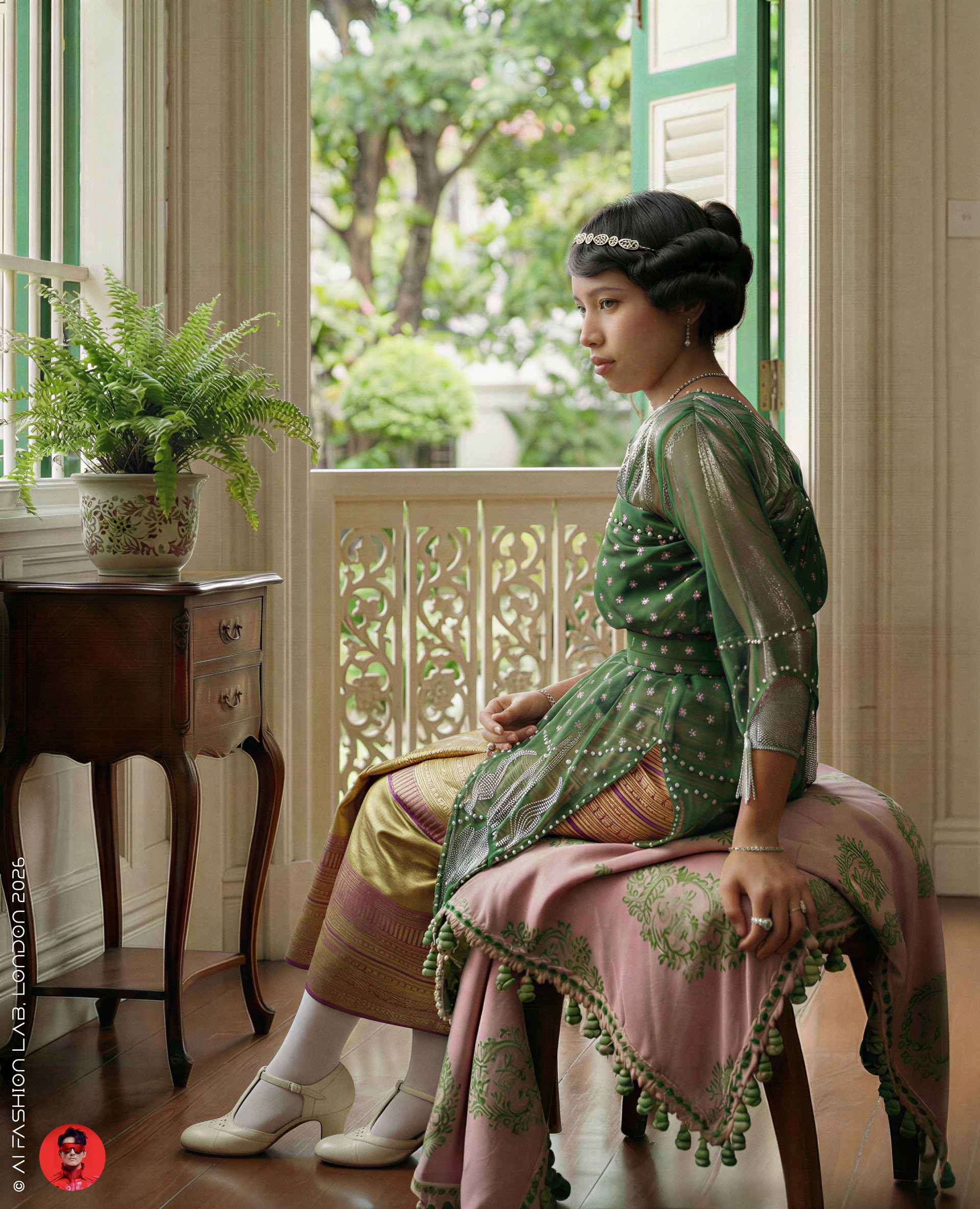
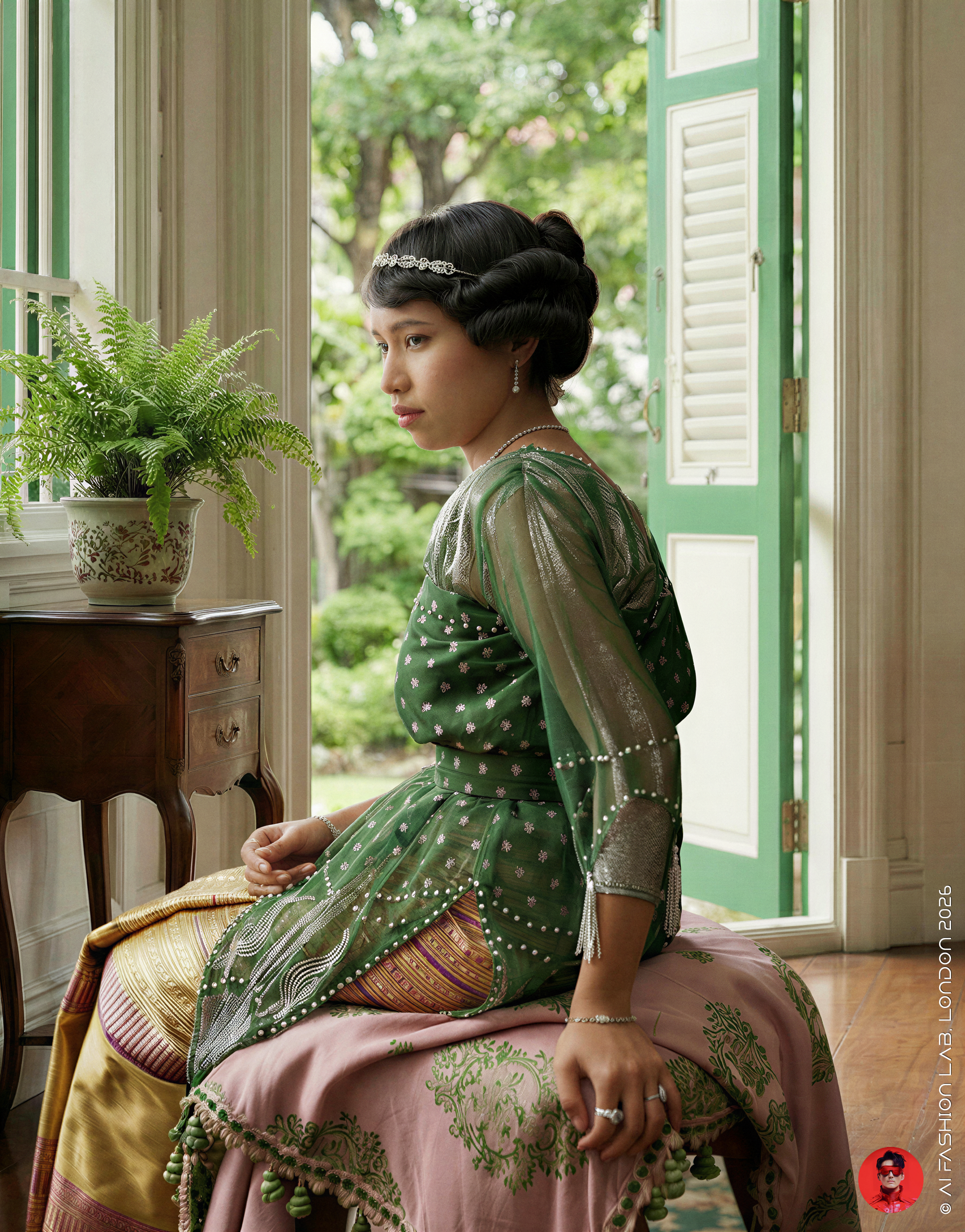
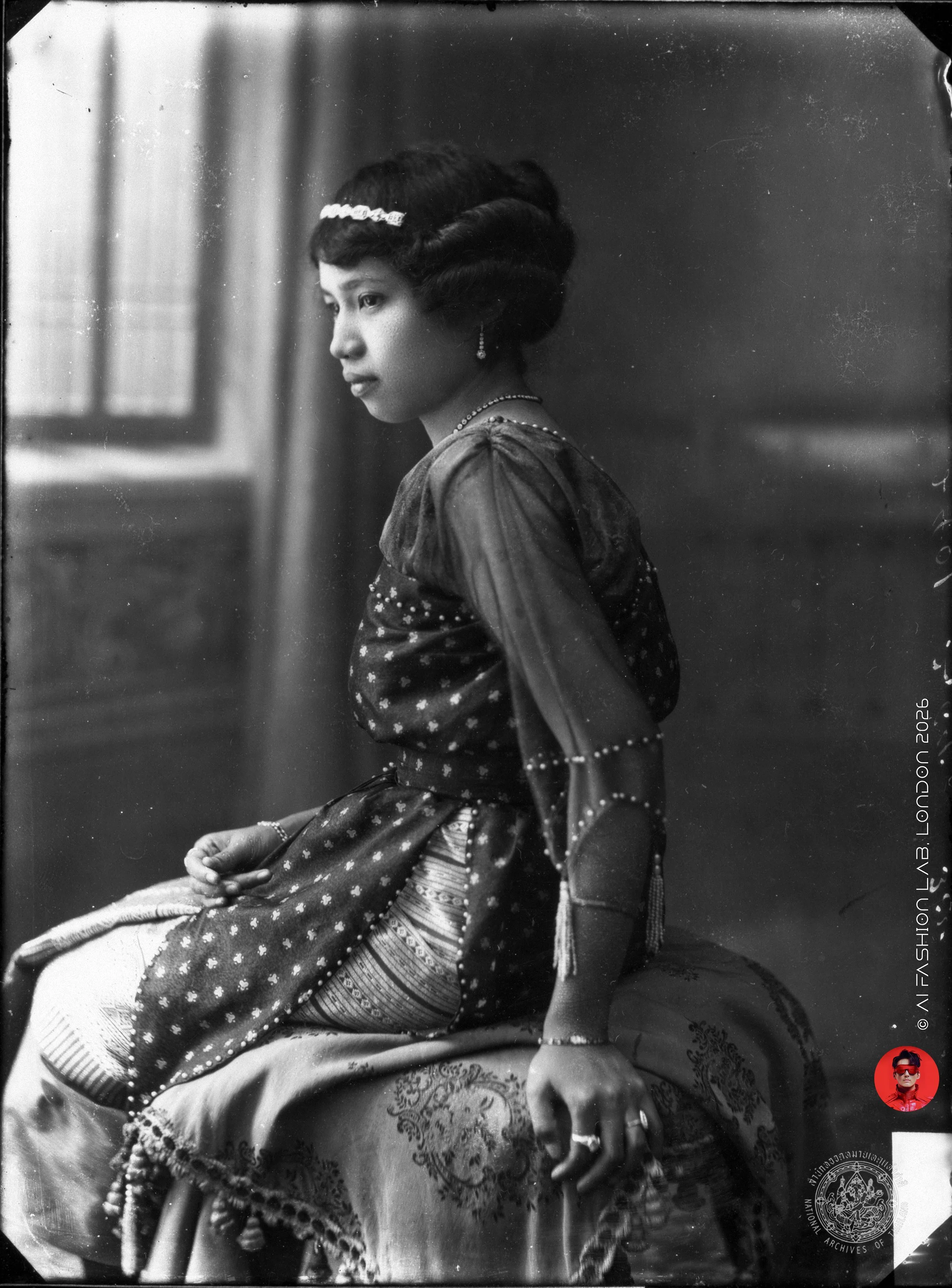
สตรีสยามในช่วงรอยต่อของแฟชั่นโลก Late Teens (พ.ศ. 2458–2462 / ค.ศ. 1915–1919)
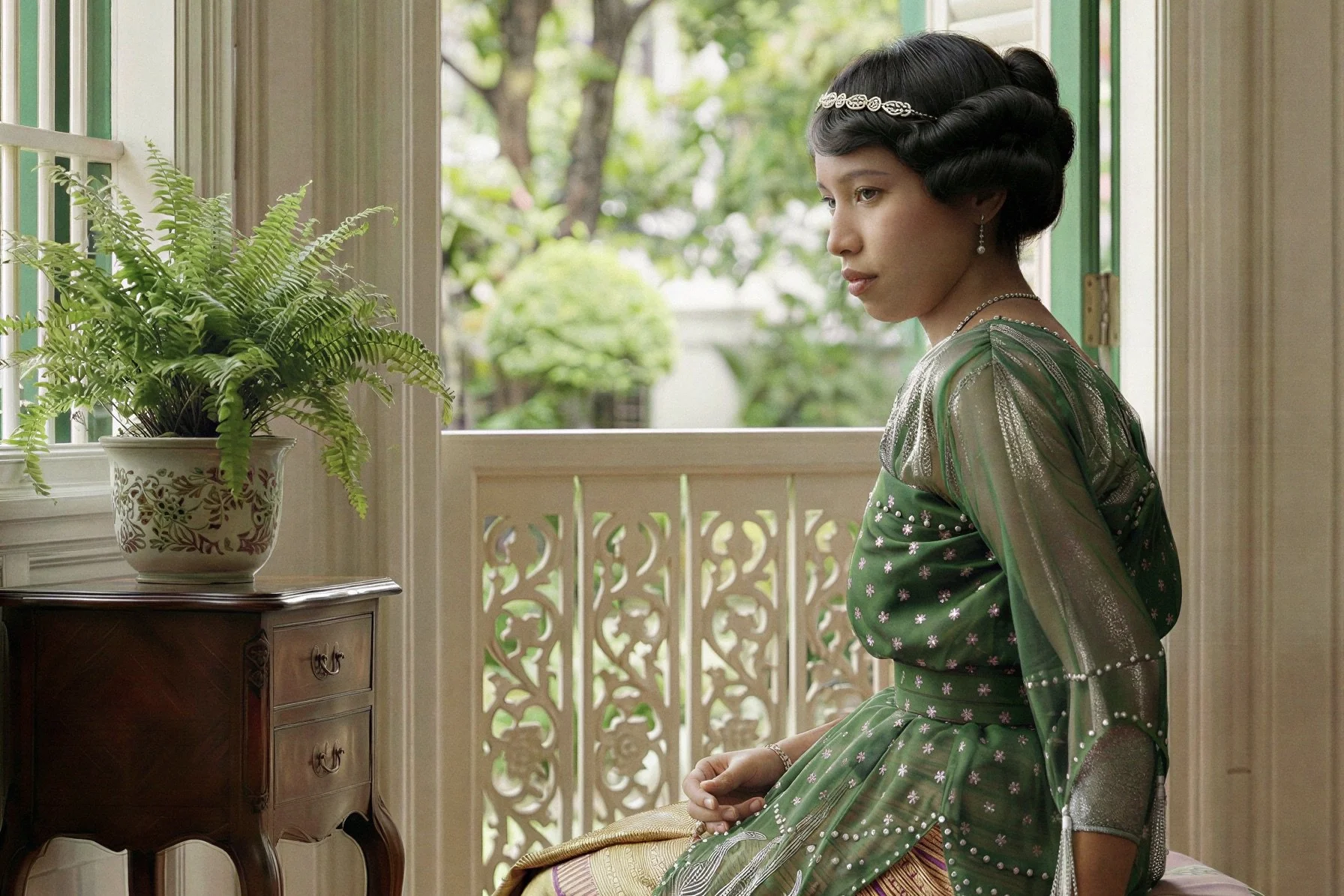
สตรีสยามในช่วงรอยต่อของแฟชั่นโลก Late Teens (พ.ศ. 2458–2462 / ค.ศ. 1915–1919)
ภาพที่ได้รับการบูรณะและสร้างสรรค์ด้วยเทคโนโลยี AI ชุดนี้ เป็นภาพของสตรีสยามในช่วงกลางรัชกาลที่ ๖ นำเสนอในบริบทของนิทรรศการ ฉัฐรัช ภัตราภรณ์ ซึ่งสะท้อนพัฒนาการของแฟชั่นสตรีสยามในช่วงหลังสงครามโลกครั้งที่ ๑ ระหว่างปี พ.ศ. 2458–2462 (ค.ศ. 1915–1919) อันเป็นช่วงเวลาที่หลักฐานภาพถ่ายของแฟชั่นสตรีชั้นสูง มีอยู่เป็นจำนวนมาก
แม้แฟชั่นสมัยเอ็ดเวิร์เดียนในอังกฤษจะสิ้นสุดลงอย่างเป็นทางการภายหลังการสวรรคตของพระเจ้าเอ็ดเวิร์ดที่ 7 ในปี พ.ศ. 2453 (ค.ศ. 1910) หากแต่คติงามแบบเอ็ดเวิร์เดียนยังคงส่งอิทธิพลต่อเนื่องมาจนถึงช่วงต้นทศวรรษ 1910 ก่อนจะค่อย ๆ แปรเปลี่ยนเข้าสู่โครงสร้างแฟชั่นยุคหลังสงคราม ซึ่งเน้นความเรียบง่าย อิสระ และบทบาทใหม่ของสตรีในสังคมสมัยใหม่
________
พัฒนาการแฟชั่นสตรีสยามในรัชกาลที่ ๖ (เรียงตามลำดับเวลา)
ช่วงต้นรัชกาลที่ ๖: Early Teens
พ.ศ. 2453–2457 (ค.ศ. 1910–1914)
ตรงกับแฟชั่นโลกสมัย Late Edwardian ต่อ Early Teens
ในระยะนี้ สตรีสยามยังคงแต่งกายภายใต้อิทธิพลของสมัยรัชกาลที่ ๕ อย่างเด่นชัด นิยมเสื้อผ้าลูกไม้โปร่งบาง เสื้อแพร แขนพอง โครงสร้างยังอิงเรือนร่างแบบเดิม ขณะเดียวกัน การนุ่งโจงกระเบน ยังคงเป็นแบบแผนสำคัญของสตรีชนชั้นสูงสยาม และเป็นสัญลักษณ์ของความสุภาพเรียบร้อยตามขนบราชสำนัก
ช่วงกลางรัชกาลที่ ๖: Late Teens — ช่วงรอยต่อสำคัญ
พ.ศ. 2458–2462 (ค.ศ. 1915–1919)
ช่วงเวลานี้คือหัวใจของการเปลี่ยนผ่านแฟชั่นสตรีในสยาม ตรงกับแฟชั่นโลกสมัย Late Teens และเป็นระยะหลังสงครามโลกครั้งที่ ๑ ซึ่งโครงสร้างเสื้อผ้าเริ่มหลุดพ้นจากอุดมคติแบบเอ็ดเวิร์เดียนอย่างชัดเจน
เจ้านายฝ่ายในและสตรีชั้นสูงเริ่มเปลี่ยนจากการนุ่งโจงกระเบนมาสู่นุ่ง ซิ่นยาว ทั้งซิ่นไหมแบบราชสำนัก และซิ่นทอพื้นเมืองจากล้านนา ขณะเดียวกัน เสื้อที่สวมคู่กันก็เปลี่ยนโครงสร้างอย่างมีนัยสำคัญ จากเสื้อเข้ารูป มาเป็น เสื้อทรงตรงยาว ปล่อยตัว (tubular or tunic blouse) ชายเสื้อยาวระดับสะโพกหรือเข่า
อย่างไรก็ตาม การเปลี่ยนผ่านนี้ มิใช่เรื่องง่าย ทั้งในเชิงรสนิยมและวัฒนธรรมการมองเรือนร่างของสตรีสยาม เสื้อทรงตรงยาวที่ไม่เน้นส่วนอก ไม่เน้นเอว และปล่อยผ้าให้ทิ้งตัวตามธรรมชาติ เป็นสิ่งที่ “แปลกใหม่” อย่างยิ่งในสายตาสตรีที่คุ้นเคยกับเสื้อจับทรงและการห่มนุ่งแบบดั้งเดิม การปรับตัวจึงต้องอาศัย พระราชนิยม เป็นแรงผลักดันสำคัญ
ช่วงปลายรัชกาลที่ ๖: Early Art Deco
พ.ศ. 2463–2468 (ค.ศ. 1920–1925)
ตรงกับแฟชั่นโลกสมัย Flappers หรือ Early Art Deco
ในระยะนี้ สตรีสยามเริ่มนิยมเสื้อผ้าทรงตรง ไม่เน้นรัดรูป แนวเอวเลื่อนต่ำลงมาช่วงสะโพก แขนเสื้อสั้นถึงข้อศอกหรือเปิดไหล่ นุ่งซิ่นสูงขึ้นถึงระดับน่องหรือช่วงต้นขา นิยมสวมถุงน่องและรองเท้าแบบตะวันตก ทรงผมบอบสั้นเริ่มแพร่หลาย สะท้อนภาพลักษณ์ของสตรีสมัยใหม่อย่างเด่นชัด
________
Paul Poiret, Orientalism และต้นแบบเสื้อทรง Tubular
ในระดับสากล แฟชั่นช่วง Late Teens (1915–1919) ได้รับอิทธิพลอย่างสูงจาก Paul Poiret นักออกแบบผู้ปฏิวัติแฟชั่นสตรี ด้วยการปฏิเสธคอร์เซ็ต และเสนออุดมคติใหม่ของเรือนร่างที่เป็นอิสระ
Poiret ได้แรงบันดาลใจจากโลกตะวันออก (Orientalism) ไม่ว่าจะเป็นเสื้อคาฟตาน เสื้อกิโมโน และเสื้อทูนิกยาว โครงสร้างเสื้อผ้าของเขามีลักษณะเด่นคือ
แนวอกอ่อนนุ่ม ไม่ดันทรง
เสื้อทรงตรงยาว ปล่อยตัว (tubular silhouette)
การเดรปผ้าและปล่อยให้ทิ้งตัวตามธรรมชาติ
แนวเอวเลื่อนสูงใต้หน้าอก หรือแทบไม่ปรากฏเอวเลย
แนวคิดนี้ส่งอิทธิพลอย่างชัดเจนต่อแฟชั่นยุโรปหลังสงคราม และเมื่อเดินทางเข้าสู่สยาม ก็เอื้อให้การนุ่งซิ่นและสวมเสื้อทรงยาวหลวม ดูร่วมสมัยและมีความ “สากล” โดยไม่ต้องละทิ้งอัตลักษณ์ท้องถิ่น
________
จุดเปลี่ยนแปลงการสวมผ้าซิ่นแบบพระราชนิยม
การเปลี่ยนแปลงที่แท้จริงของ ผ้าซิ่น ในฐานะเครื่องแต่งกายของสตรีชั้นสูงในกรุงเทพฯ เกิดขึ้นเมื่อ หม่อมเจ้าวรรณวิมล วรวรรณ ซึ่งต่อมาได้รับพระราชทานตำแหน่งเป็น พระวรกัญญาปทาน ได้นำผ้าซิ่นมาใช้เป็น ชุดประจำวัน ขณะประทับอยู่ที่พระตำหนักจิตรลดาในรัชกาลที่ ๖
เมื่อพระองค์ได้รับการหมั้นหมายกับพระบาทสมเด็จพระมงกุฎเกล้าเจ้าอยู่หัว การแต่งกายของพระวรกัญญาปทานจึงกลายเป็นที่จับตามอง แม้การหมั้นจะดำเนินอยู่เพียงระยะเวลาหนึ่ง และภายหลังพระองค์ประทับอยู่ในพระบรมมหาราชวัง แต่ พระบาทสมเด็จพระมงกุฎเกล้าเจ้าอยู่หัวทรงชื่นชมการแต่งกายของพระวรกัญญาปทาน ส่งผลให้ผ้าซิ่นเริ่มได้รับการยอมรับในฐานะแฟชั่นพระราชนิยม และแพร่หลายไปในหมู่สตรีชนชั้นสูงในกรุงเทพฯ อย่างเป็นรูปธรรม
________
แฟชั่น ชาตินิยม และแรงต้านต่อ “ความเป็นฝรั่ง”
แม้ผ้าซิ่นจะได้รับการยอมรับในราชสำนักแล้ว หากแต่แนวคิดเรื่องแฟชั่นตะวันตกยังคงมีอิทธิพลและก่อให้เกิดแรงตึงเครียดทางวัฒนธรรมอย่างชัดเจน ดังปรากฏใน หนังสือพิมพ์ไทย ฉบับวันที่ 5 มกราคม พ.ศ. 2463 (ค.ศ. 1920) ซึ่งเผยแพร่บทความชักชวนให้สตรีไทยนุ่งผ้าซิ่นแทนการสวมกระโปรงแบบตะวันตก โดยระบุว่า:
“หนังสือพิมพ์ไทย ฉบับวันที่ 5 มกราคม พ.ศ. 2463 เขียนชักชวนให้สตรีนุ่งผ้าซิ่น อย่า ‘ดัดจริต’ นุ่งกระโปรงฝรั่ง เพราะพระราชินีในอนาคตคือ พระวรกัญญาปทาน ได้ทรงนำนุ่งผ้าซิ่นขึ้นแล้ว”
ถ้อยคำว่า “อย่าดัดจริต” สะท้อนทัศนคติเชิงลบต่อการแต่งกายแบบตะวันตก และชี้ให้เห็นบรรยากาศ ชาตินิยมในสมัยรัชกาลที่ ๖ ซึ่งมุ่งเน้นการสร้างและตอกย้ำอัตลักษณ์ไทย การที่พระวรกัญญาปทานทรงเลือกนุ่งผ้าซิ่น จึงทำให้ผ้าซิ่นมิใช่เพียงเครื่องนุ่งห่ม หากแต่เป็น สัญลักษณ์ทางวัฒนธรรมและการเมืองของความเป็นไทย ในระดับสูงสุด
________
จากโจงกระเบนสู่ซิ่น: แฟชั่น อัตลักษณ์ และความหมายทางสังคม
แม้เข้าสู่รัชกาลที่ ๖ แล้ว แต่อิทธิพลการแต่งกายแบบสมัยรัชกาลที่ ๕ โดยเฉพาะการนุ่งโจงกระเบน ยังคงได้รับความนิยมในช่วงต้นรัชสมัย เนื่องจากเป็นขนบที่สตรีสยามคุ้นชินมาอย่างยาวนาน
กระทั่งเข้าสู่ช่วง Late Teens (พ.ศ. 2458–2462 / ค.ศ. 1915–1919) การแต่งกายของสตรีสยามจึงค่อย ๆ ปรับเปลี่ยนและก้าวหน้ามากขึ้น โดยรับเอาแฟชั่นตะวันตกซึ่งกำลังเฟื่องฟูในขณะนั้น มาประยุกต์เข้ากับความเป็นไทยสยาม เปลี่ยนจากการนุ่งโจงกระเบนมานุ่งซิ่น รวมถึงการเปลี่ยนทรงผมจาก ทรงดอกกระทุ่ม ไปสู่ผมยาวเกล้ามวย ผมยาวลอนอ่อน และผมบอบสั้น
การเปลี่ยนผ่านนี้สะท้อนอย่างชัดเจนในวรรณกรรมเรื่อง สี่แผ่นดิน ดังข้อความต่อไปนี้:
...วันหนึ่งคุณเปรมพูดขึ้นว่า “แม่พลอย ฉันเห็นว่าต่อไปนี้แม่พลอยเลิกนุ่งผ้าเสียทีก็จะดี”
“แล้วกันคุณเปรม!” พลอยร้องเสียงหลง “ทำไมพูดอย่างนั้นละ อยู่ดีๆ จะให้ฉันเลิกนุ่งผ้าเสียแล้ว!”
คุณเปรมหัวเราะชอบใจพูดว่า “แม่พลอยนี่คงเห็นฉันเป็นบ้าพิลึก! เปล่าหรอก ฉันไม่ได้หมายความว่าจะให้แม่พลอยเลิกนุ่งผ้าเสียเลย แต่ฉันอยากให้นุ่งผ้าซิ่นแทนผ้าโจงกระเบน”
“ตายจริง! นี่คุณเปรมเห็นฉันเป็นลาวมาตั้งแต่เมื่อไร ?”
พลอยถามเพราะไม่เข้าใจความหมายของคุณเปรมเลยแม้แต่น้อย
“ในหลวงท่านโปรด” คุณเปรมตอบสั้นๆ แต่ก็เป็นการอธิบายที่มีความหมายลึกซึ้ง...
ถ้อยคำดังกล่าวสะท้อนทัศนคติร่วมสมัยได้อย่างชัดเจน เนื่องจากวัฒนธรรมการนุ่งซิ่นเดิมเป็นของชาวลาวและยวน ซึ่งคนสยามในอดีตมักเรียกรวมชาวล้านนาว่า “คนลาว” ขณะที่สตรีสยามชั้นสูงดั้งเดิมนิยมผ้าไหมจีบหน้านาง ก่อนจะเปลี่ยนมานุ่งโจงกระเบนเป็นแบบแผนในสมัยรัชกาลที่ ๔
________
Late Teens (1915–1919): แฟชั่นแห่งการต่อรองอัตลักษณ์
จากมุมมองประวัติศาสตร์แฟชั่น Late Teens (พ.ศ. 2458–2462) คือช่วงเวลาที่สตรีสยามต้อง “ต่อรอง” ระหว่างความคุ้นเคยเดิมกับความเป็นสมัยใหม่ เสื้อทรง tubular แบบ Poiret อาจไม่ใช่สิ่งที่สวมใส่ง่ายในทางปฏิบัติ แต่เมื่อผสานเข้ากับซิ่นล้านนา เครื่องประดับ และทรงผมแบบไทย การแต่งกายเช่นนี้กลับสร้างภาพลักษณ์ใหม่ที่สง่า ทันสมัย และมีอัตลักษณ์เฉพาะตัว
กล่าวได้ว่า Late Teens มิใช่เพียงช่วงเปลี่ยนผ่านทางแฟชั่น หากแต่เป็นช่วงเวลาที่สตรีสยามได้ก้าวเข้าสู่ความเป็นสมัยใหม่ ภายใต้เงื่อนไขทางวัฒนธรรม อำนาจ และพระราชรสนิยม อย่างงดงามและมีนัยยะทางประวัติศาสตร์อย่างยิ่ง
____________
Siamese Women at a Global Fashion Crossroads: Late Teens (B.E. 2458–2462 / 1915–1919)
This series of images restored and creatively reimagined using AI technology depicts Siamese women during the early to mid-reign of King Rama VI. Presented within the context of the exhibition Chattrarat Phattharaphon, the collection reflects the development of Siamese women’s fashion in the period following the First World War, between B.E. 2458–2462 (1915–1919)—a time for which photographic evidence of elite women’s fashion survives in relatively substantial numbers.
Although Edwardian fashion in Britain formally came to an end following the death of King Edward VII in B.E. 2453 (1910), Edwardian ideals of beauty continued to exert influence into the early 1910s. These ideals gradually gave way to post-war fashion structures that favoured simplicity, freedom of movement, and new social roles for women in a modernising world.
The Development of Siamese Women’s Fashion during the Reign of King Rama VI
(Presented in chronological order)
Early Reign of King Rama VI
B.E. 2453–2457 (1910–1914): Early Teens
Corresponding to Late Edwardian and Early Teens fashion internationally
During this period, Siamese women’s dress remained strongly influenced by styles of the reign of King Rama V. Lightweight lace blouses, silk garments, puffed sleeves, and body-conscious constructions continued to dominate. At the same time, the chong kraben remained the established form of dress among elite women and served as a marker of propriety within courtly convention.
Middle Reign of King Rama VI: Late Teens — A Crucial Transitional Phase
B.E. 2458–2462 (1915–1919)
This period represents the core moment of transformation in Siamese women’s fashion. Corresponding with Late Teens fashion internationally and occurring in the aftermath of the First World War, clothing structures began to break away decisively from Edwardian ideals.
Women of the inner court and the urban elite gradually shifted from the chong kraben to long sinh skirts, including both court silk sinhs and handwoven northern textiles such as sinh tin jok. At the same time, blouses underwent a significant structural change: fitted garments were replaced by long, straight, loose-fitting tops—tubular or tunic blouses, often extending to the hips or knees.
This transition, however, was far from straightforward. In terms of taste and bodily perception, such garments represented a radical departure from familiar norms. Blouses that neither emphasised the bust nor defined the waist, and that allowed fabric to fall freely, appeared strikingly unfamiliar to women accustomed to shaped bodices and traditional wrapping techniques. Acceptance of this new silhouette therefore relied heavily upon royal patronage as a legitimising force.
Late Reign of King Rama VI
B.E. 2463–2468 (1920–1925): Early Art Deco
Corresponding to Flapper fashion or Early Art Deco
In this later phase, Siamese women increasingly adopted straight-cut garments with lowered waistlines around the hips. Sleeves shortened to the elbow or shoulder, sinhs rose to mid-calf or knee level, and stockings and Western-style shoes became fashionable. Short bobbed hairstyles gained popularity, reflecting the emergence of a distinctly modern female identity.
Paul Poiret, Orientalism, and the Tubular Silhouette
Internationally, Late Teens fashion (1915–1919) was profoundly shaped by the work of Paul Poiret, the designer who revolutionised women’s dress by rejecting the corset and advocating a freer conception of the female body.
Poiret drew inspiration from Orientalism, incorporating elements from Middle Eastern, East Asian, and Russian dress—such as kaftans, kimono forms, and long tunics. Key characteristics of his designs included:
A softened bust line without structural uplift
Straight, elongated garments with a tubular silhouette
Draping that allowed fabric to fall naturally
Elevated or virtually absent waistlines
These ideas exerted strong influence on post-war European fashion and, when they reached Siam, helped render the pairing of long sinh skirts with loose, elongated blouses both modern and internationally legible, without erasing local identity.
A Turning Point: Royal Endorsement of the Sinh
The true transformation of the sinh as elite women’s attire in Bangkok occurred when Mom Chao Wannawimon Worawan, later granted the title Phra Worakanyapatthan, adopted the sinh as her everyday dress while residing at Chitralada Palace during the reign of King Rama VI.
When she became engaged to King Vajiravudh (Rama VI), her manner of dress attracted intense public attention. Although the engagement was brief and she later resided within the Grand Palace, the King expressed admiration for her style, leading the sinh to gain acceptance as a form of royally sanctioned fashion among elite women in Bangkok.
Fashion, Nationalism, and Resistance to “Westernisation”
Despite the sinh’s acceptance at court, Western fashion continued to provoke cultural tension. This is evident in an article published in a Thai newspaper on 5 January B.E. 2463 (1920), which urged women to wear the sinh instead of Western skirts, stating:
“The Thai newspaper of 5 January B.E. 2463 urged women to wear the sinh and not to ‘behave affectedly’ by wearing Western skirts, because the future queen, Phra Worakanyapatthan, had already adopted the sinh.”
The phrase “do not behave affectedly” reveals a negative attitude towards Western dress and reflects the nationalist climate of King Rama VI’s reign, which sought to reinforce Thai cultural identity. Phra Worakanyapatthan’s choice to wear the sinh thus elevated the garment from everyday attire to a symbol of cultural and political meaning at the highest level.
From Chong Kraben to Sinh: Fashion, Identity, and Social Meaning
Although the reign of King Rama VI marked a period of change, dress practices from the era of King Rama V—especially the chong kraben—remained prevalent in the early years due to long-standing custom.
It was during Late Teens (B.E. 2458–2462 / 1915–1919) that Siamese women’s dress gradually transformed more decisively. Western fashions were selectively adapted and reinterpreted within a Siamese framework: chong kraben gave way to the sinh, hairstyles evolved from the dok krathum style to long chignons, soft waves, and eventually short bobs.
This transformation is vividly reflected in the novel Four Reigns, in the following exchange:
…One day Khun Prem said, “Mae Phloi, I think it would be better if from now on you stopped wearing that cloth.”
“Good heavens, Khun Prem!” Phloi exclaimed. “Why would you say such a thing? You want me to stop wearing cloth altogether?”
Khun Prem laughed. “You misunderstand me completely. I don’t mean that at all—I simply want you to wear a sinh instead of the chong kraben.”
“Good grief! Have you always thought of me as Lao?”
Phloi asked, utterly confused.
“His Majesty prefers it,” Khun Prem replied simply—but with profound meaning.
This exchange reflects contemporary attitudes: the sinh was historically associated with Lao and Yuan cultures, whom Siamese society often collectively labelled as “Lao.” Elite Siamese women had traditionally worn pleated silk skirts before the chong kraben became standardised during the reign of King Rama IV.
Late Teens (1915–1919): Fashion as Negotiated Identity
From a fashion-historical perspective, Late Teens (B.E. 2458–2462) represents a moment of negotiation between tradition and modernity. The tubular silhouettes inspired by Poiret were not easy garments to adopt in practice. Yet when combined with northern sinhs, jewellery, and Thai hairstyles, they produced a new visual language—modern, dignified, and culturally distinct.
Late Teens fashion was therefore not merely a stylistic transition, but a critical moment in which Siamese women entered modernity under the intersecting forces of culture, power, and royal taste—an evolution both elegant and historically resonant.
____________
เรียนเชิญกด Subscribe ได้ที่ลิงก์นี้ครับ เพื่อร่วมติดตามงานสร้างสรรค์ต้นฉบับ งานวิจัยประวัติศาสตร์แฟชั่น และผลงานอนุรักษ์มรดกวัฒนธรรมด้วยเทคโนโลยี AI ของ AI Fashion Lab, London ซึ่งมุ่งตีความอดีตผ่านมิติใหม่ของการบูรณะภาพ การสร้างสรรค์ภาพ และการเล่าเรื่องด้วยศิลปะเชิงดิจิทัล 🔗 https://www.facebook.com/aifashionlab/subscribe/
#aifashionlab #AI #aiartist #aiart #aifashion #aifashiondesign #aifashionstyling #aifashiondesigner #fashion #fashionhistory #historyoffashion #fashionstyling #fashionphotography #digitalfashion #digitalfashiondesign #digitalcostumedesign #digitaldesign #digitalaiart #ThaiFashionHistory #ThaiFashionAI #thailand #UNESCO